

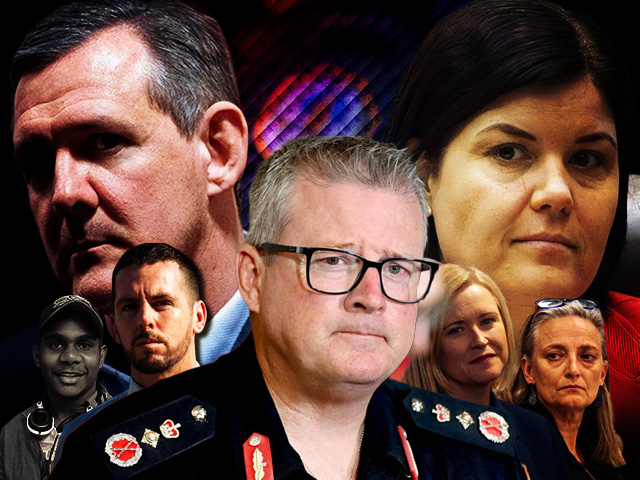
Jamie Chalker’s time as Police Commissioner has been defined by the aftermath of Kumanjayi Walker’s shooting death which raised serious questions about his integrity, including the hiding of key evidence in the Zach Rolfe murder trial and questions of the integrity and morale of the force under his leadership.
In the wake of the unexplained disappearance of the Commissioner, we begin the Tarnished Brass series where we showcase the reporting on his chaotic reign as top cop, bringing together all the failings, the lies, the alleged conspiracies, and mystifying public utterances, of him and those around him.
We start with his failures as the head of the NT Housing Department and then the four days leading up to the charging of Constable Zach Rolfe with murder, told through the notes of the detectives who were investigating Mr Walker’s death.
READ: Tarnished Brass II: ‘An erosion of trust, respect, integrity, and the lack of compassion…’
READ: Tarnished Brass V: ICAC announces investigation into Rolfe murder charge
READ: Tarnished Brass VI: Vote of no confidence in Police Commissioner Jamie Chalker
READ: Tarnished Brass VIII: Police pursued Rolfe murder charge against DPP witness advice
Thursday, October 31, 2019
When John McRoberts was Police Commissioner, Jamie Chalker was rotating through the role of Deputy Commissioner, a job he shared with Reece Kershaw and Mark Payne.
When McRoberts was sacked in 2015 the now top cop, Chalker missed out on replacing McRoberts, and left the police force to become the NT Housing Department chief executive in 2016. Reece Kershaw was made Police Commissioner.
Of course, McRoberts was later charged with, and found guilty of, attempting to pervert the course of justice in a travel agent fraud investigation, where he was having a sexual relationship with the main suspect.
Mr Chalker was plucked from Housing, after Mr Kershaw’s shock departure to head the Australian Federal Police in 2019. He was given the role over then Acting Commissioner Michael Murphy and then Acting Deputy Commissioner Narelle Beer.
Mr Chalker joined the NT Police in 1994 and won a bravery medal in 1999 for his rescue of a man swept down Wattie Creek in flood waters near the remote community of Daguragu in the Victoria River region. He became the first Alice Springs-based assistant commissioner in 2012 and was awarded the Australian Police Medal in 2016.
In a 2020 report, Auditor General Julie Crisp found the remote housing Room to Breathe program Mr Chalker oversaw had been so poorly administered that the government could not properly “assess whether its objectives were being achieved economically, efficiently and effectively” and that serious changes are desperately needed if it wants “to effectively deliver the program”.
The performance audit revealed massive internal problems with the program since its inception in early 2017, including improper procurement practices, lack of oversight, lack of key performance indicators, slow rollout of works, large contract variation costs and unsatisfactory consultations with the remote communities the program was purportedly created to help.
It was also revealed taxpayers were billed more money for the Auditor General to probe the program because Mr Chalker withheld records of the “early works” portion until after the initial audit was completed.
In a related instance, Ms Crisp’s report found that a “consultant” was hired to write a $24,000 report about the “early works” of the program that was never used.
In two-and-a-half years of operating up to that point, only $16.4 million had been spent of the $200 million on actual projects and more than 40 per cent of that cost was attributed to large contract variations after the contracts had been awarded.
In announcing Mr Chalker’s appointment as Police Commissioner in 2019, then-chief minister Michael Gunner said he liked how Mr Chalker had experience as the CEO of Housing, saying it was “an excellent career move…just to get the experience delivering”.
“How do you work early in the piece with intervention, how do you work with other agencies earlier in the picture to make sure crime doesn’t occur?” Mr Gunner said at the time.
“I think Jamie will be exceptional in that sense.”
While Mr Chalker told the ABC he had support from NT Police, Fire and Emergency Services department staff.
“Morale seems to have taken a solid shot in the arm with this appointment and that’s something that I’m very humbled by,” he non-humbly said.
Saturday, November 9, 2019
DPP recommended Rolfe murder charge in 90-minute ‘unfinished brief of evidence’ meeting
Kumanjayi Walker was shot dead by Constable Zach Rolfe on Saturday, November 9 in Yuendumu, after the teenager stabbed the police officer with scissors during a bungled arrest.
This was two days before Jamie Chalker was sworn in as Police Commissioner.
Constable Rolfe was charged with murder four days after the shooting. After he was found not guilty by a Supreme Court jury on March 11, 2022, the NT Independent published a series of articles based on notes made by detectives who investigated the shooting. The notes showed, that on the Monday, Mr Chalker, who was sworn in that day, referred the investigation into the shooting to ICAC for “suspected improper conduct” despite publicly claiming he had nothing to do with it.
The ICAC reporting guidelines for public servants specifically state that there must be a “reasonable” suspicion backed up with “one fact or more upon which your suspicion is based”.
On the Tuesday, Mr Chalker flew to the community with Chief Minister Michael Gunner and then-police minister Nicole Manison on a private plane. This is where Mr Gunner made his now infamous “consequences will flow” remark about the coroner’s inquiry, during a speech at a public meeting in the community.
There were critics of the newly minted Police Commissioner taking a trip to the community with politicians.
Sunday, November 10 to Wednesday November 14, 2019
Chalker met with police executive before detectives told to charge Constable Zach Rolfe with murder
The NT Independent’s series of articles about the four days leading up to NT Police charging Constable Zach Rolfe with murder for the shooting death of Kumanjayi Walker were based on the notes of all the detectives investigating the teenager’s death.
The notes from his own detectives show Mr Chalker was involved at least five times across those four days, despite the top cop’s claims he was not involved at all.
They showed Mr Chalker, and other police executives, gave instructions for Constable Rolfe to be charged in Darwin if any charges were to proceed. Mr Chalker also met with senior police executives 13 minutes before detectives investigating the death of Mr Walker were ordered to arrest and charge Constable Rolfe with murder.
When asked by the media at a press conference in the week after Constable Rolfe was found not guilty why he had been charged so quickly, Mr Chalker said: “I can’t give you an answer to that because I wasn’t involved in that.
“I’ve remained at arms-length from the investigation for the whole period of time and that continues to this day,” he said. “The matter to charge (Constable Rolfe) was a matter for the investigation team and the DPP. I was as shocked as anybody.
“I can’t offer you an opinion on that conversation, there was no meeting that I was involved in …”
Mr Chalker attended the meeting that happened minutes before detectives were told to charge the officer with Acting Deputy Commissioner Michael White and others, after Mr White had returned from handing over the brief of evidence to the DPP.
Diary notes written by then-Detective Senior Sergeant Mark Grieve, stated that the decision for the arrest and murder charge came from the “top level of police” before specifically mentioning the Police Commissioner.
Notes from the shooting’s lead investigator Detective Superintendent Kirk Pennuto, and at least four other detectives investigating the shooting of Mr Walker, raised concerns about what they said was the “highly unusual involvement of the DPP before an investigation was finished”, the speed at which the charges were being considered, and the handing over of an unfinished brief of evidence as the basis for a decision on potential charges.
An arresting officer must reasonably believe the suspect committed the offence. The initial investigators did not seem to ever reach that threshold.
Even as late as 10am on the morning of the meeting with the DPP, Det Supt Pennuto had expressed his opposition to the pending arrest of Constable Rolfe, and a murder charge, in another meeting with Mr White, Mr Anticich, and Cmdr Dole.
“Arresting is premature. Need more time to examine outside of what the BWV (body-worn vision) captured,” he wrote.
After the final meeting with Mr Chalker and the other executives, an extraordinary offer was made by Det Supt Pennuto to the other detectives, that if they had not “formed the belief” the constable should be arrested, he would do it himself. He made no notes about when he himself had “formed the belief” the constable should be arrested, and what made him change his mind.
It was revealed in court, Mr Anticich, who was in charge of the Rolfe investigation, took no notes relating to crucial meetings that lead to the decision to arrest.
Friday, February 21, 2020
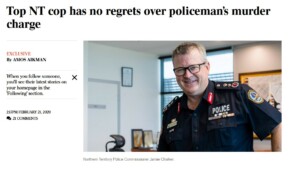
Click on the picture to read the article.
Jamie Chalker told The Australian before the matter was taken to court that claims by front line officers that politics influenced the decision to charge Constable Rolfe with murder were not true and that he had no regrets over the murder charge.
“I can’t have regrets about how it was handled, because my focus was always on making sure that this investigation of that whole incident will withstand all the rigour of every oversight that we will have,” Commissioner Chalker said.
“That’s what I’ve got to do to give Territorians the full confidence of the fact that there will be no fear or favour.”
It was after the not guilty verdict, as reported above, Mr Chalker publicly denied at a press conference, having any involvement with the investigation, and in fact had said he was “as shocked as anybody”.
Police Association president Paul McCue told The Australian Mr Chalker was “out of touch with our troops if he can’t see the irreparable damage the swift charging of Constable Rolfe” had caused to police morale.
“Our members are still completely dumbfounded by the hasty decision to charge Constable Rolfe with murder, just days after the critical incident, and before a thorough investigation had occurred,” Mr McCue said.
“The NTPA still receives numerous calls, daily, from members who are angry, disillusioned, and questioning whether they still want to remain in the NT Police Force …”
That was one of the last times Mr McCue never publicly criticised Mr Chalker, despite what happened in later years.
Tuesday, March 31, 2020
The NT Independent launched with a focus on uncovering corruption, malfeasance in the NT Government, and holding politicians and senior public servants accountable. The then-chief minister Michael Gunner banned the NT Independent from press conferences and getting information from departments. Mr Chalker followed the lead of his master and NT Police did not respond to the NT Independent.
However, scrutiny of Mr Chalker’s and the NT Police executive’s actions increased through the birth of the NT Independent, and some of the most important issues to do with NT Police since then may not have come to public attention had it not been for this paper.
This includes Mr Chalker hiding from the court and the Rolfe defence team, the NT Police coronial report into the shooting of Kumanjayi Walker, the so-called Pollock/Proctor report. And that the Department of Public Prosecutions had advised against the NT Police’s choice of use of force expert in that trial. A fact that was redacted when that same report was released to the defence, under the guise of legal privilege.
However the NT Independent was able to later obtain the unredacted report and publish its secrets.
Tuesday, September 29, 2020
NT Police Commissioner gets political, calls out Prime Minister
Jamie Chalker ramped up an unheard-of political attack on the federal Coalition Government, suggesting Prime Minister Scott Morrison was ignorant of the challenges facing Indigenous people across the Northern Territory.
In the “extraordinary” public criticism of a federal political leader by a Northern Territory public servant, Mr Chalker said Mr Morrison lacked “a deep understanding” of Indigenous issues in the Northern Territory and implied he was responsible for a lack of money hitting the ground in remote communities.
Mr Chalker had said in the week earlier, he could not staff remote police stations properly due to a potential cut to federal funding, through a federal agreement, due to expire in 2022.
That reason was later called into question as other issues were raised by the union as to why the commissioner was having difficulty filling remote police positions.
But Mr Chalker ignored those reasons while interviewed on radio and suggested cuts to remote policing would be necessary if the funding – which was up for renegotiation the next year – was not continued.
But when asked whether he had made any effort to speak to the Prime Minister, Mr Chalker said he had not and had instead attempted to raise concerns through the National Indigenous Australians Agency.
Sunday, March 14, 2021
NT Police still don’t get why reporting sex crimes is in the public interest
The NT Independent reported a three-year-old boy was sexually assaulted while playing in his front yard by a man who drew him close to the fence before the man exposed his penis and forced it into the toddler’s mouth.
The NT Independent published the story three days after the attack, which the NT Police did not inform the public about.
That report sparked a special investigative series exposing the police media unit’s ongoing suppression of serious sex crimes being committed against Territorians, including another disturbing story about a registered sex offender being found outside a child’s bedroom with a ‘rape kit’, a woman being raped in the street and other serious sexual offences from Alice Springs to Darwin.
The NT Independent was recognised for Best Crime Reporting at the NT Media Awards in 2021 for its series, which the national judges called an “extraordinary series of reports” which exposed the police’s failures to properly inform the public.
Following on from this, the Opposition demanded that the Chief Minister and the Police Minister explain to Territorians why details of serious sex crimes were being concealed from the public, accusing the government of political interference.
Then-police minister Nicole Manison rejected claims that the Gunner Government had directed NT Police media to downplay sexual assaults, calling the accusation “absolute nonsense, rubbish”.
Meanwhile, NT Police said they acted appropriately at all times in how they dealt with the incident, claiming it was not “common practice” to inform the public, and that police felt releasing the information about the incident was not in the public interest.
“I think there’s a distinct difference between what’s in the public interest and what’s just interesting to the public,” Commander Martin Dole said on Mix 104.9.
He added the offender was arrested shortly after the incident and that protecting the privacy of the victim was their chief concern.
Cmdr Dole then claimed releasing information about the incident would only have served as “instant gratification” for the public.
“It’s not common practice to put this stuff out in the media instantly for everyone else’s gratification,” he said.
Mr Chalker said the leaking of information about sex crimes that the police were suppressing – that was very much in the public interest – was akin to “throwing victims under the bus”.
In response, the police executive stopped shared access to daily lists of major crimes created by detectives, known as running sheets, which include the dates, case ID, case officer, the arrest with notes of what happened and the charges or probability of charges – shared between divisions that ensure investigations are not doubling up.
Sunday, May 16, 2021
Alleged rape of boy in remote community not initially made public by police
A boy was allegedly raped by a man in a remote community early the morning before, which the police media unit initially did not report publicly until being sent questions by the NT Independent.
A source said the boy was between eight and 12-years-old and that the offence was committed by a man in his 40s.
NT Police media manager Rob Cross did not respond to a series of questions by the NT Independent about the alleged attack but after being sent the questions, the media unit released a statement to inform the public that the man was arrested and would face court in Darwin.
It was just another example exposed by the NT Independent of police not making serious sex crimes public.
Friday, June 4, 2021
Jamie Chalker tried to ban the publication of allegations he, and senior executive members, intentionally withheld the Pollock coronial report from the defence team and the Director of Public Prosecutions in the Constable Zach Rolfe murder case.
His attempt was rejected by Supreme Court judge Dean Mildren.
Mr Rolfe’s lawyer David Edwardson told the court coronial reports compiled by officer Superintendent Scott Pollock would refute evidence that would be given by the prosecution’s star witnesses.
Mr Edwardson said the reports were not provided to the defence team until they became aware of them and subpoenaed the reports, which were only recently handed over in part, with large sections redacted.
Mr Edwardson said Mr Chalker had refused “not only the existence, but also the production of these materials on the basis that we could not demonstrate a legitimate forensic purpose”.
He said that Mr Pollock had considered reports made by the prosecution’s two expert witnesses and had set out in his own report for the coroner “why those expert opinions were misconceived, ill-informed and wrong”.
Crown prosecutor Sophie Callan then made an application to the court for any references to the Pollock reports – and claims that they were intentionally withheld – be suppressed from being reported by the media due to concerns it could taint a potential jury in the upcoming trial.
Mr Edwardson further said that the Pollock reports for the coroner that were in draft form were “seized” and edited by the officer in charge of the criminal matter, Kirk Pennuto.
“The Coronial inquiry was the province of Mr Pollock, who created the report or the draft reports, they were then seized by Mr Pennuto, and it’s Mr Pennuto who then sought to try and, as it were, edit the Pollock reports,” Mr Edwardson said.
Ms Callan rejected Mr Edwardson’s submissions to the court that the matter should not be suppressed.
“There is a proper basis for non-publication orders where there is a real risk that media reporting may extend widely a notion that there has been an unfair prosecution, at least to date, in relation to Mr Rolfe,” she said.
Monday, June 21, 2021
Chalker claims police college’s failings are being addressed, offers no evidence: Estimates
Jamie Chalker told Estimates hearings the police college had failed to meet national standards and was working towards addressing its non-compliance issues that saw unqualified instructors employed and recruits graduated before being properly assessed for competency.
It’s the first time Mr Chalker had discussed the college after the NT Independent revealed it had failed a 2017 external audit to gauge its compliance with national standards and was still hiring unqualified instructors as late as October 2019.
Mr Chalker said the college was undergoing “some treatments” after failing the audit, which had found the college employed unqualified instructors, failed to keep proper records of recruit training and could not determine who its managers were or if they were “fit and proper” people.
The audit also found recruits were graduated despite failing basic literacy and numeracy tests and that the college could not explain why it had passed some recruits.
An internal document from October 2019 showed the college had not improved two years after failing the audit and did not have a process for verifying if its instructors were qualified.
The officers being put on patrol before being assessed was identified in the internal memo as posing a “significant risk” to the NT Police.
The scandal had Civil Liberties Australia suggesting that criminal convictions could be called into question and millions in damages paid out because the college was graduating recruits without proper training.
Mr Chalker claimed the 2017 audit was “to understand their compliance with the RTO (Registered Training Organisation) status”, which it failed. He did not provide any evidence of the college’s improvements.
NOTE: Part 2 of this series exploring the tumultuous tenure of Jamie Chalker as Police Commissioner will continue tomorrow

The sooner ICAC come out with their report into the actions of Gunner, Chalker and others the better. They are taking far too long.
ICAC are not going to bite the hand that feeds them!
ICAC is a complete and utter scam.
You know what another name is for Whistleblower is in the NT? Interstater!!
Keep up the good work. Lies have a way of trapping those spreading them.