

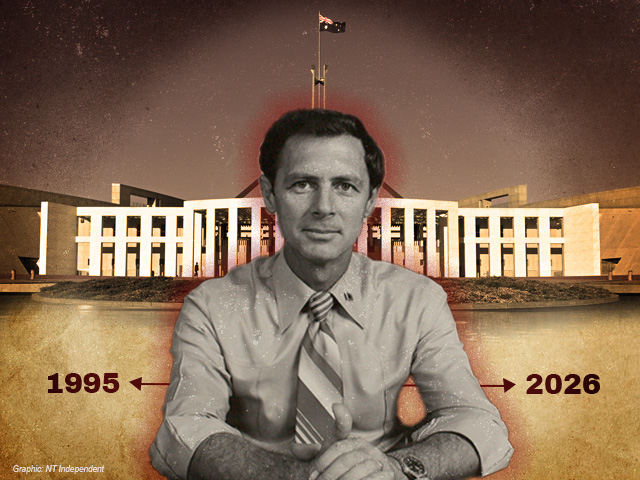
This is second instalment of a three part series looking at the history of the Northern Territory’s Rights of the Terminally Ill Bill.
Following passage of Marshall Perron’s Rights of the Terminally Ill Act in 1995, Territory Health Services commissioned Chips Mackinolty of Green Ant Research, Art and Publishing to take news of the legislation to the bush.
Because it happened after the event, it could hardly be described as consultation, so an extensive program of bush visits, badged as education, was undertaken in the dry season of 1996.
Funding for the project was provided by the federal government, which had transitioned from the Keating ALP government to the Howard LNP government in a landslide election on March 2 that year.
Between June and October, Mackinolty and his team convened 21 meetings with 900 people — in the order of six per cent of the adult Aboriginal population in the Northern Territory — who represented about 100 communities.
For young and very young readers, there was no social media. The internet was new in Australia and only available in the cities. News spread by snail mail, print media or the legendary bush telegraph.
In towns, repositories of knowledge were libraries. In the bush, repositories of knowledge were the elders whose world views were shaped by traditional knowledge on country and the lived experience of white men imposing rules and regulations, routinely enforced by guns in the early days.

READ: The dismissal: An NT parliamentary link
READ: Sex, lies and colonisation: Errol Flynn buys a girl for the price of two pigs and some seashells
What was this ‘kill business’ law?
The NT’s chief health officer Dr Shirley Hendy described the brief as provision of “unbiased and factual information on euthanasia to Aboriginal communities.”
It is almost impossible to determine motivation for the funding: whether it was ideologically motivated by members and senators; or whether the impetus was generated within the bureaucracy of the federal department.
Speculation aside, Mackinolty’s team, which included interpreters, divided each meeting by gender and delivered the ROTI education program to some of the most remote parts of the NT.
As the program unfolded, the team honoured the two-way principle by undertaking “to relay any concerns people had back to Northern Territory Health Services,” Mackinolty said. In turn, many face-to-face participants agreed to pass the information on in their communities.
Following Kevin Andrews’ introduction of the Euthanasia Laws Bill (the Andrews Bill), in November 1996 it was referred to the Senate Legal and Constitutional Affairs Committee with a reporting date of March 6, 1997.
The committee was tasked to examine four aspects of the bill: the desirability of its provisions; the constitutional implications for each of the territories; the impact of the bill on the NT’s Criminal Code; and the impact on and attitudes of the Aboriginal community.
It placed advertisements in major daily newspapers throughout the country calling for submissions.
To use contemporary parlance, the committee was smashed.

Here was a parliamentary committee representing the entire Australian population sitting in judgement of matters potentially affecting the 2.7 per cent who were resident in the territories.
Everyone had a view and many responded with submissions, including a smattering of people with no franchise at all in Australia — from Canada, Finland, Hong Kong, New Zealand, the United States of America, Netherlands and the United Kingdom — who felt entitled to have their two bob’s worth.
The committee received 12,577 submissions.
In their own words, “the response to this parliamentary inquiry has been unprecedented.
“The committee understands that previous topical inquiries such as aircraft noise in Sydney and child support received 5,000 and 6,000 submissions respectively.”
The committee took evidence at hearings in Darwin and Canberra.
Dawn Lawrie, by now the Territory’s Anti-Discrimination Commissioner, and Mackinolty appeared as witnesses.
It was the committee’s fourth area of inquiry that drew their attention to Mackinolty’s work and why there had been not just rejection of the legislation, but anxiety and suspicion.
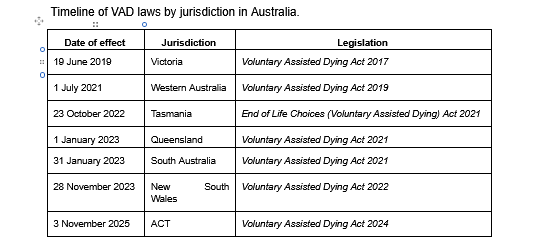
Timeline of voluntary assisted dying laws by jurisdiction in Australia.

READ: Unfinished Business: The Territory’s ugly truth
READ: Opinion: A tale of two Houses
READ: Opinion: Colonial genetics driving tough-on-crime mindset
The power of the euthanasia needle
“It is not the needle as such that people fear,” Mackinolty said.
“It is the capacity of the ‘euthanasia needle’ to be used as an agent of death — particularly by sorcerers — that has engendered such universal distrust, and widespread demands that the euthanasia drugs not be kept on communities; that community clinics and staff be prohibited from practising euthanasia; and for the legislation to be repealed.
“So imagine, if you can, the fearful power a sorcerer might wield through the ‘agency’ of euthanasia: being able to ‘make’ a white doctor in Darwin, say, kill someone through the ‘euthanasia needle’.”
It is not difficult to imagine the committee’s collectively furrowed brow upon hearing evidence of this nature.
Allegations of church manipulation giving rise to opposition on communities that had been mission settlements came to the fore.
“I strongly suspect that the Christian churches present on many Aboriginal communities were not as influential and successful on this issue as they might have liked,” Mackinolty told the committee.
“…rejection of the ROTI legislation was just as strong on communities not heavily influenced by Christian churches.
“It is my firm view that it is traditional religion and law that has been the overwhelmingly dominant factor influencing Aboriginal peoples’ rejection and fear of the…legislation.”
Considering the proposition that Aboriginal opposition to ROTI was simply a clash of traditional and Western cosmologies, Mackinolty said there was no clash because the “two cosmologies just weren’t meeting at all.”

Reducing the matter to basics, he acknowledged that he was simplifying difficult concepts for the benefit of the committee.
“…in Aboriginal cosmology the notion of ‘natural’ death applies only, perhaps, to the extremely old person,” Mackinolty said.
“In all other cases, cause of death lies in a complex interplay of sorcery, payback and/or transgression of the law.”
He went on to explain that the likely outcome for Aboriginal people is that they would assiduously avoid attending clinics and hospitals because of this whitefella ‘kill business’ law.
The implications for already dire Aboriginal health profiles and outcomes were obvious. Perhaps this was the impetus for federal funding of the bush ‘education’ project.
There was a further dichotomy.
“One of the great ironies of the ROTI legislation is that while its original drafting and subsequent amendments were designed to maximise and protect the role of the individual in the equation, it is this aspect of the legislation which most clearly transgresses and offends against Aboriginal ideas about civil society, which is collectivist,” Mackinolty explained.
It is highly likely that the committee, which was chaired by Senator Eric Abetz from Tasmania, had never been schooled in the fundamental tenets of traditional knowledges and practices in remote NT.
Evidence of this nature would have been enlightening.
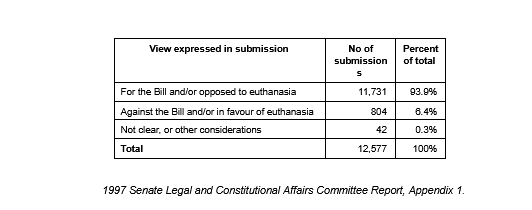
But it was incidental to the big picture of the Andrews Bill, which was about nothing more than his moral position on euthanasia — and it was moral positions that overwhelmingly dominated submissions to the committee.
The resulting report could be described as underwhelming.
“The committee makes no recommendation to the Senate on the Euthanasia Laws Bill because it is a private member’s Bill and is subject to a ‘conscience vote’,” the report said.
The Andrews Bill became law on March 27, 1997 after which the Rights of the Terminally Act was neutered.
Some 25 years later, the Restoring Territory Rights Act resurrected the NT’s capacity for legislative sovereignty, if not Perron’s legislation. By this time, every state jurisdiction in Australia had its own voluntary assisted dying (VAD) law.
Whether it was the effluxion of time or the lessons of history having been learnt, on this occasion successive NT governments approached bush attitudes in a somewhat different manner.
READ: Part I: The long road to the Rights of the Terminally Ill Bill

Dr Robyn Smith is a lecturer in colonial history and Indigenous futures at Charles Darwin University. She is a PhD (Political History), Master of Cultural Heritage and Bachelor of Arts (Journalism & Anthropology) and is well written on the history, heritage and politics of the Northern Territory. Her latest book,Licence to Kill: Massacre Men of Australia’s North, was published in 2024.
It was the Aboriginal fear that got rid of the early inheritance bill, not southern influence. In those days the media had contacts in the Aboriginal communities, today they have none and kid themselves that the Indigenous and Aboriginal communities are the same. Amazing isn’t it contact with those in Aboriginal communities has never been easier, all have phones and yet our media made up mostly of southern rejects have only one contact, old Ned.