

By Dr Robyn Smith
Tenuous connections to famous people and events are not uncommon in family histories or, for that matter, the media.
Almost every family has the equivalent of ‘my great-great grandfather was shot in the arm by Ned Kelly’. Of course, we are at liberty to accept it as fact or reject it as folklore.
It is, however, true that there is a Northern Territory link to the Whitlam dismissal of 11 November 1975, although it was not apparent at the time.
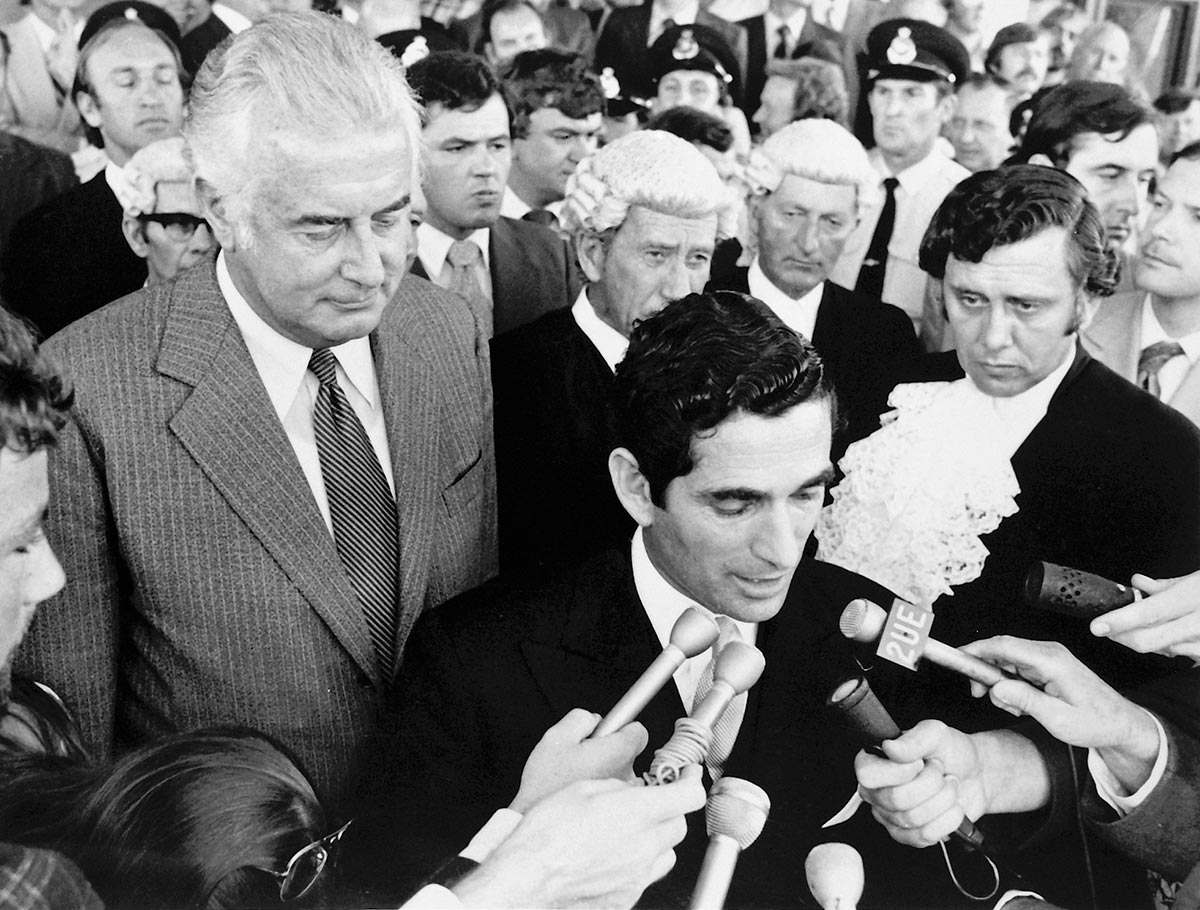
In the above historic image held by the National Archives of Australia, Sir David Smith, Official Secretary to the Governor-General, stands on the steps of Parliament House in Canberra and reads Sir John Kerr’s proclamation dismissing the government and dissolving both Houses of parliament.
Gough Whitlam towers over him. The wigged men are the Clerks of the parliament bearing witness to the making of history by the vice-regal execution of sovereign powers vested in an individual on the other side of the world.
The man in the lace jabot to the right of the Official Secretary is Usher of the Black Rod Guy Smith.
‘Black Rod’, as the usher is known, is responsible for the security of the upper House, just as the Serjeant-at-Arms is in the lower House.
Guy Smith was a future Clerk of the Legislative Assembly of the Northern Territory, taking up the position in 1983.
During a Condolence Motion following his death in 2002, Chief Minister Clare Martin noted that by the time he retired in 1994, Smith had clocked up 36 years of parliamentary service.
Deputy Chief Minister Syd Stirling was elected Member for Nhulunbuy in 1990 while Smith was at the parliamentary helm.
“His knowledge of parliamentary procedure and standing orders was not just beyond reproach. It was not the technical mastery of the profession, and it was even more than a deep respect for the Westminster system of parliamentary democracy,” he said.
“In the mid-1980s we know he rewrote entirely the Standing Orders pertaining to this Assembly, and he built the committee system, in its infancy in those days, into what we have today.”
Smith’s service spanned three Speakers: Nick Dondas, Roger Steele and Terry McCarthy.
He oversaw the Assembly’s transition from the leaky cyclone-ravaged Chan Building to the new Parliament House in what is now known as the State Square precinct in 1994.
In a departure from usual parliamentary procedure, Smith’s successor Ian McNeill was invited to contribute to the Condolence Motion.
“This building is a testament to his capacity in his role in the planning, design, construction and now, the functioning, of a Parliament House for the Northern Territory,” he said.
McNeill had been Smith’s junior in the Senate so his recruitment as Deputy Clerk in 1985 should not have been surprising, although it took considerable persuasion.
Sadly, both are now deceased. The Legislative Assembly of the Northern Territory is in their debt for their knowledge and implementation of parliamentary practice and procedure.
Note: The author is not related to any of the aforementioned Smiths.
Dr Robyn Smith is a Lecturer in colonial history at Charles Darwin University and is well written on the politics and history of the Northern Territory. With the late Dean Jaensch, she co-authored Turning 40: The Legislative Assembly of the Northern Territory 1974-2014 and wrote Licence to Kill: Massacre Men of Australia’s North, which was published last year.

An even more relevant event was that Gough was a Flt Lt navigator flying bombers from Gove during World War II.