

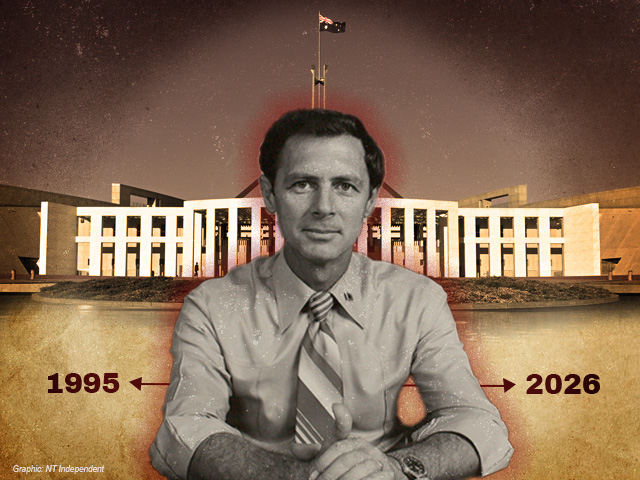
This is part one of a three part series looking at the history of the Northern Territory’s Rights of the Terminally Ill Bill.
Criticism of distant government from Canberra is nothing new in the Northern Territory.
Precisely when it began is difficult to pinpoint, but it is reasonable to assume it was contemporaneous with the Commonwealth assuming control of the Territory in 1911.
A case in point was the 1919 Darwin Rebellion during which an effigy of the Administrator was burnt, protest marches culminated at Government House, workers breached the fence line and Administrator Gilruth compelled to flee his northern outpost.
Colourful assessments, replete with creative fusions of expletives, were certainly common during World War II.
Commonwealth imposition of emergency disaster management after Cyclone Tracy in 1974 drew a more refined, though not dissimilar, assessment from Dawn Lawrie.
“The very worst…Northern Territory government is better than a central government from Canberra,” Lawrie said.
The Legislative Assembly was barely a month old when Tracy struck Darwin. Lawrie was the independent member for Nightcliff, one of two non-CLP members.
It was a somewhat different Assembly to which Marshall Perron would introduce the Rights of the Terminally Ill Bill (ROTI) on February 22, 1995.
He did so in his capacity of private member rather than an executive member exercising a function under a portfolio.
Because Perron had announced his intention at the beginning of that month, six petitions seeking to refer the bill to a select committee were presented on the day of its introduction.
At the time, the Northern Territory population was in the order of 97,255. The 815 petitioners represented about 0.83 per cent of the population.
Referring a bill to a committee for scrutiny is a standard parliamentary device. Perron’s bill, however, was different; it ventured, some said, into forbidden spiritual territory.

His second reading speech was prescient.
“I wish to turn now to the question of opposition to the concept based on religious belief,” he said.
“I appreciate that those who object on these grounds hold those beliefs sincerely, but the question which must be asked is whether those beliefs should be forced on others,” Perron said.
“It is interesting to consider the probability that, on the passage of this bill, opponents of this calibre might seek to have the Commonwealth veto the law under the reserve powers that Canberra still holds through the Northern Territory (Self-Government) Act.
“The in-principle support for this bill by the federal Minister for Human Services and Health makes that unlikely, but it has been interesting to consider to what lengths opponents driven by an emotional commitment might go to deny a right which so many desire.”
The Minister for Human Services and Health was none other than former WA Premier Dr Carmen Lawrence who was by then serving as the member for Fremantle in the Keating Government.
Perron’s confidence in her was justified.
After the bill’s introduction, activists around the country galvanised, ramping up community and media lobbying.
No fewer than 11 petitions were presented when the Assembly reconvened to debate the bill in May. All of them urged members to vote against it, nine urging greater spending on or best practice in palliative care services.
On this occasion, the petitions, presented by five members, represented 2.92 per cent of the Territory population.
That day — Wednesday May 24,1995 — was the longest sitting day in the history of the Legislative Assembly.
At the designated time of 10am, members gathered in the chamber where the drama began to unfold.

Perron made two announcements as his wife Cherry looked on from the Speaker’s Gallery: first, that he would resign as chief minister at the end of the week; and second, that he would resign as the member for Fannie Bay the following Monday.
After the presentation of petitions and an hour for questions, business was reordered to call on Perron’s bill. It was shortly after 11am. With the exception of a two-hour suspension for lunch, the Assembly debated the bill, including consideration clause by clause, until 3.45 the following morning.
At the crucial stage of the second reading debate, passage was achieved by a single vote: 13-12.
Had that vote been lost, the bill would not have progressed to consideration clause-by-clause.
Ultimately, the legislation was passed by a vote of 15-10.
Debate was certainly robust and — without question — exhaustive.
The Rights of the Terminally Ill Act received assent from Administrator Austin Asche on June 16, 1995 and became a law of the Northern Territory on July 1, 1996.
It was a world first.
READ: The dismissal: An NT parliamentary link
READ: Sex, lies and colonisation: Errol Flynn buys a girl for the price of two pigs and some seashells
A ‘faith-filled’ man
Notwithstanding Perron’s confidence in Lawrence, he hadn’t countenanced Kevin Andrews.
Elected to the Australian Parliament in 1991 as the member for Menzies in Victoria, Andrews was an opponent with an ironed-on “emotional commitment” to denial, as Perron foreshadowed.
A barrister, former race caller and sports reporter from Sale in the Gippsland region, Andrews was a “faith-filled” man who, with his wife Margaret, served on the Australian Catholic Marriage and Family Council and co-convened the marriage education program for Catholics in Melbourne.
According to biographer Fiona Basile, Andrews’ “legislative achievements and policy initiatives reflected his commitment to protecting the dignity of human life, supporting families and fostering social cohesion.
“Notably, he introduced a private member’s bill in 1996 to overturn the Northern Territory’s euthanasia laws, a decision grounded in his deep belief in the sanctity of life,” Basile wrote.

How ironic that this deep belief in the sanctity of life could not have been imposed on his fellow Victorian citizens because the sanctity of state sovereignty over its citizens is guaranteed by the Australian Constitution.
Less than two months after Australia’s first voluntary euthanasia law took effect, Andrews introduced the Euthanasia Laws Bill, the purpose of which was: “to provide that the Northern Territory Legislative Assembly, the Australian Capital Territory Legislative Assembly, and the Norfolk Island Legislative Assembly do not have the power to make laws which would permit that form of intentional killing of another called euthanasia (which includes mercy-killing) or the assisting of another person to terminate his or her own life.”
His legislation passed both houses of the Australian Parliament, received royal assent and became law as and from March 27, 1997, effectively sending the NT Legislative Assembly to the competent governance naughty corner.
Lawrie must have been having an apoplectic meltdown.
READ: Unfinished Business: The Territory’s ugly truth
READ: Opinion: A tale of two Houses
READ: Opinion: Colonial genetics driving tough-on-crime mindset
ROTI never repealed
While the Andrews Bill violated the Territory’s right and capacity to legislate, it had no effect on what had gone before: the Rights of the Terminally Ill Act has never been repealed and remains a statute — albeit impotent — on the Territory’s law books.
Nine attempts to reverse the effect of the Andrews legislation were made in the Australian Parliament between 2004 and 2021. Although none succeeded, they served to keep the matter on the agenda during which time all Australian state jurisdictions introduced their own voluntary assisted dying laws.
The territories didn’t enjoy the same legislative liberty until August 1, 2022 when Luke Gosling and Alicia Payne, representing the NT and the ACT respectively, co-sponsored the Restoring the Territory Rights Bill in the House of Representatives. It was introduced in the Senate two days later. Passage was swift and assent given on December 13, the same year.
Andrews died of cancer in December 2024. Had he wished, he could have availed himself of voluntary euthanasia because Victoria legalised it in 2017.

On January 2 this year, Attorney-General Marie-Clare Boothby announced the government’s intention to reintroduce voluntary euthanasia legislation by the middle of the year on advice from the Assembly’s Legal and Constitutional Affairs Committee.
Boothby said the move was about “dignity, compassion and choice at the end of life” within a set of parameters recommended by the Committee, which also recommended that the legislation be called the Rights of the Terminally Ill Act — doubtless in deference to Marshall Perron and a thumbing of the nose to the Australian Parliament — and that a waiting period apply between passage and commencement.
Perron himself has pre-empted and criticised any ‘qualification period’ for those diagnosed with a terminal disease, noting both the inherent assumptions embedded in such a notion and the notorious inaccuracy of predicting life expectancy.
Notwithstanding those concerns, if the Assembly adopts the Committee’s report and recommendations, it will be at least March 2028 before voluntary euthanasia is again available in the Northern Territory, 33 years after Perron set the global precedent.
By any measure, it’s been a very long road.
Dr Robyn Smith is a lecturer in colonial history and Indigenous futures at Charles Darwin University. She is a PhD (Political History), Master of Cultural Heritage and Bachelor of Arts (Journalism & Anthropology) and is well written on the history, heritage and politics of the Northern Territory. Her latest book,Licence to Kill: Massacre Men of Australia’s North, was published in 2024.


Thank you. Can’t wait for the remaining two of your three-part series. Not only due to valued historical information. But because . . . truth always under attack.
Many thanks for your comprehensive review of this historical legislation, Robyn.
Your writing is easy to digest and simple in explanation.
I look forward to reading your subsequent contributions to this extensive journey.