

By Dr Robyn Smith
The timing was coincidental; the juxtaposition was vintage socio-political Australia.
On the same day the federal government amended the Social Security Act to give police power to recommend cancellation of welfare payments for those subject to outstanding arrest warrants for the alleged commission of serious offences, the Northern Territory Police Force released its much-anticipated Anti-Racism Strategy and Action Plan.
As is the case elsewhere in the country, this is a police force in which an officer who shoots a person dead is suspended on full pay on the presumption of innocence while an investigation, painstaking and for as long as necessary, is undertaken.
The same presumption of innocence won’t apply to welfare recipients.
Welcome to settler colonialism, which, according to former prime minister Tony Abbott’s interpretation of history, isn’t as bad as some people make it out to be.
In July, NT Coroner Elisabeth Armitage released her report into the death of 19-year-old Kumanjayi Walker at Yuendumu in November 2019.
Her findings included “entrenched systemic and structural racism” in the NT Police.
She called for training in relation to “officer-induced jeopardy” and was joined by the UN Human Rights Commissioner in calling for reform of policing practices.
The NT Police Anti-Racism Strategy was jointly announced in Alice Springs by newly sworn Police Commissioner Martin Dole and the strategy’s author, former SA police officer, lawyer, policy expert and Arrernte woman Leanne Liddle.
Liddle has one of the toughest jobs in Australia. She is Executive Director of Cultural Reform Command within the NT Police and before that was Director of the Aboriginal Justice Unit in the Department of Attorney-General.
By any measure, hers is a big gig. Not only does she have to convince police that their workplace is mired in systemic racism, she has to teach them exactly what that means and convince them to reject it—no easy task when you consider the colonial history of Australia, never mind the tinderbox that is the Northern Territory where the newish CLP government trades heavily on its tough-on-crime mantra.
This is the tough-on-crime Territory where 10-year-olds are considered criminally responsible. It is the Territory with the highest incarceration rate in Australia, second only to El Salvador in the world. Almost half of those in the system are on remand, meaning they have yet to be tried for their alleged offences. Here, if you’re a black person the system stacks the odds against you before you are born.
Liddle identified these issues in the NT’s Aboriginal Justice Agreement. She compared imprisonment rates with the population: 84 per cent of the adult prison population yet 25 per cent of the adult population is Aboriginal; 96 per cent of the youth prison population yet 45 per cent of the 10-17 years population is Aboriginal. Aboriginal men are imprisoned at 15 times the rate of non-Aboriginal men. For women, the figure is 14 times and for young people, it’s 24 times.
In a statement tendered to the Kumanjayi Walker inquest in March 2023, Liddle provided some background.
“The history of policing and police powers is in many ways inseparable from the history of frontier wars, past and present. State policing institutions were founded in frontier wars, genocide and racist violence,” she said.
“The earliest forms of police included the Mounted Police and Border Police whose purpose was to extend the colonial frontier and garrisons.
“Massacres of Aboriginal people involving Australian police officers were commonplace throughout the 18th and 19th century, and continued well into the 20th century…”
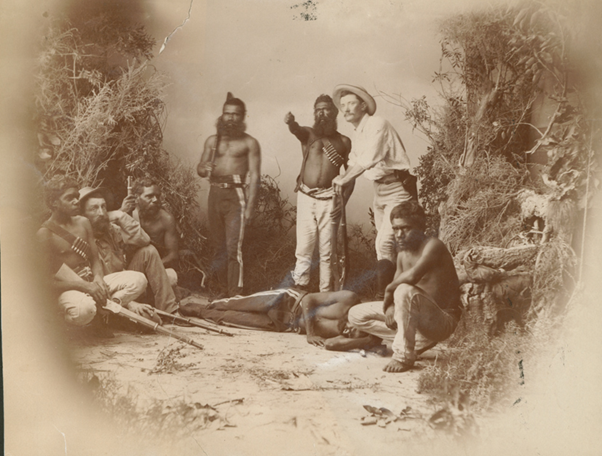
1888 – Northern Territory Native Police Unit. Left to right: Undiah, Mounted Constable Erwein Wurmbrand, Undudna, Ardahkee, Corporal Chickylia, Mounted Constable William Willshire and Jack. Billy lies prostrate. Image: State Library of South Australia.
“In addition to the violence of the colonial frontier, police officers played an integral role in the removal of Aboriginal children under a policy known as ‘protectionism’,” she said.
In succinct fashion, she moved on to Aboriginal deaths in custody.
Little wonder, then, as the Anti-Racism Action Plan points out, Aboriginal people have an inherent distrust of police.
Much of the media attention focussed on the plan’s immediate task of delivering anti-racism training across the NT Police workforce. There was little attention focussed on police commitments to improve understanding of the impacts of intergenerational trauma, to implement trauma-informed practices into policing or to eliminate racial profiling.
The plan’s elephant in the room was apparently invisible: empower Aboriginal communities to address and reduce crime.
Aboriginal leaders have been calling for exactly that since the tough-on-crime policies were announced and implemented.
The independent Member for Mulka in the NT Legislative Assembly, Yingiya Guyula, repeatedly implores the government in the same terms. A senior traditional man from Arnhem Land, he is politely and routinely ignored.
Ned Hargraves, Kumanjayi Walker’s grandfather, has been calling for community self-determination since his grandson was fatally shot by Constable Zachary Rolfe at Yuendumu. He is grieving for another grandson from Yuendumu who died in police custody in Alice Springs earlier this year.
To date, the government has been steadfast in its opposition to all these calls, intransigent in its obsequious adherence to its tough-on-crime dogma. Perhaps the notion of Aboriginal empowerment will have a credibility flourish because it comes from police, a portfolio Chief Minister Lia Finocchiaro covets.
Liddle’s statement to the Kumanjayi Walker inquest was not confined to historical matters.
“Almost eight in 10 Australians believe that institutional racism exists in America and is responsible for incidents like the death of George Floyd, yet only three in 10 feel this is also true of Australia,” she said.
Those sentiments are not difficult to understand in the context of deficit ideology, which is well illustrated by another recent NT case. It involved a young man driving into two Aboriginal pedestrians resulting in the death of one. For this hit-and-run he received a non-custodial sentence because the Sentencing Act requires a judge to take into account an accused person’s housing arrangements, employment history and contact with the justice system.
That sentence, under appeal by the Director of Public Prosecutions, was given notwithstanding circumstances including speeding, driving unlicensed, driving unregistered, failing to stop, failing to report an accident and a series of overtly racist text messages in which he bragged that he would not go to prison because his [non-Aboriginal] family does not go to prison.
Coincidentally, he was later revealed to be related to the Northern Territory Attorney-General although we are assured that this was and remains irrelevant.
Neither the case nor the sentence auger well for young Aboriginal men from almost anywhere in the Northern Territory, particularly remote regions where housing is poor and in extremely short supply, employment prospects range from few to none and contact with the justice system is inevitable given the size of communities and the policing model.
The divide between Aboriginal and non-Aboriginal people is immediately evident. It is the product of settler colonialism engineered on successive principles of dispossession. Legislation is created by the colonisers in institutions established by the colonisers for a society built by and for the colonisers.
Discriminatory legislation is systemic and effortlessly perpetuated.
The Legislative Assembly of the Northern Territory is a creature of the Australian Parliament. That it relies on the national parliament for its practices and precedents is unsurprising, which returns us to the unfinished business of the big House.
Given the howls of objection from elected Members and Senators as well as a variety of Indigenous, civil liberties, legal and community advocates, did the Social Security and Other Legislation Amendment Bill, which passed into law on the second-last sitting day of the year, replicate systemic stacking of the odds against Australia’s first peoples?
Dr Robyn Smith is a lecturer in colonial history at Charles Darwin University and is PhD (Political History), Master of Cultural Heritage and Bachelor of Arts (Journalism & Anthropology). She is well written on the history, heritage and politics of the Northern Territory. Her latest book, Licence to Kill: Massacre Men of Australia’s North, was published last year.

Thank you Dr Robyn Smith, Ms Leanne Liddle, and the NT Independent for pulling the corner of the carpet back to reveal our horrid, hidden, history.
The truth is now being regularly revealed right around Australia. It is as if people are embarrassed by the outcome of The Voice Referendum.
I bet, there’s phone calls from the fifth floor to Vice Chancellor Scott Bowman with a delicate conversation including the words “Funding”,”Cuts”,”Pull Your Head In”! Very similar to the direct conversation that occurred between the VC and the Natasha Fyles Administration when the VC said/alluded, in a genius marketing coo for the University, “Darwin Is Not Safe”!
Its fantastic that no staff in Darwin can keep there mouths shut!
Australians are not embarrassed by The Voice outcome as we voted against an ill planned, illogical, discriminatory Canberra third tier bureaucracy. The NT corruption, collusion & cronyism doesn’t just make the local community unsafe for Aboriginals, it is unsafe & unjust for whites. The two-party political system in such a small, networked town, with Freemasons who are anti-Christian in power, only serves a minority. Time for identity politics & victimhood mentality to stop & fix the real problem that affects all of humanity, mafia style corruption for self-interest. These predators want blak verse white division.
The Usual one side rant by her, if the English had not arrived and by some chance nobody else did Aboriginals would still be living in the stone age.
Hopefully, once the incumbent government is replaced by an Independent, Greens and Labor team, these issues can be adequately addressed.
It’s a shame that the former Labor Attorney-General didn’t instigate this while in power for an 8-year period. Opportunity delayed; not lost.