

by Dr Robyn Smith
Historically, the Northern Territory had a peculiar governance system dominated by unelected bureaucratic marionettes whose strings were manipulated by a succession of political masters located well below the 23rd parallel.
This entrenched system of abject neglect was the product of colonisation and shunted along by imperial regimes in New South Wales and South Australia before being shifted to an equally ineffective federal model under South Australia in 1901.
In 1910, after South Australia lamented the spectacular lack of riches at the end of the over-promised rainbow of its fearless ‘explorers’ whose principal legacy, after personal ambition, was littering the landscape with the names of their political enablers and private benefactors.
For that reason alone, South Australia relinquished the Northern Territory to the Commonwealth in 1911 and triggered a series of governance models, each of which was rancorous to the citizenry upon which it was imposed.
As I pointed out in an earlier article in September, from 1947 the model was:
… the Legislative Council, a patronising pretence of democracy disguised as an ‘advisory body’ that ensured the Commonwealth retained absolute control with more appointed than elected members reinforced by the [appointed] presiding officer having both a deliberative and a casting vote.
To be clear, Commonwealth public servants were running the show.
On 19 October 1974, residents of the Northern Territory dabbled in the world of parliamentary democracy when they elected the first Legislative Assembly, which was comprised of 19 Members.
| Division | Member | Party |
| Alice Springs | Bernard (Bernie) Francis Kilgariff | CLP |
| Arnhem | Rupert James Kentish | CLP |
| Barkly | Ian Lindsay Tuxworth | CLP |
| Casuarina | Nicholas Manuel Dondas | CLP |
| Elsey | John Leslie Stuart Macfarlane | CLP |
| Fannie Bay | Grant Ernest Tambling | CLP |
| Gillen | James Murray Robertson | CLP |
| Jingili | Paul Anthony Edward Everingham | CLP |
| Ludmilla | Roger Michael Steele | CLP |
| Macdonnell | David Lloyd Pollock | CLP |
| Millner | Roger Ryan | CLP |
| Nightcliff | Alline (Dawn) Dawn Lawrie | Ind |
| Nhulunbuy | Milton James Ballantyne | CLP |
| Port Darwin | Ronald John Withnall | Ind |
| Sanderson | Elizabeth (Liz) Jean Andrew | CLP |
| Stuart | Roger Willian Stanley Vale | CLP |
| Stuart Park | Marshall Bruce Perron | CLP |
| Tiwi | Hyacinth Tungutalum | CLP |
| Victoria River | Godfrey (Goff) Alan Letts | CLP |
On the strength of that thumping victory, it is little wonder that the late Alistair Heatley chose to name his 1998 history of the CLP ‘The Territory Party’.
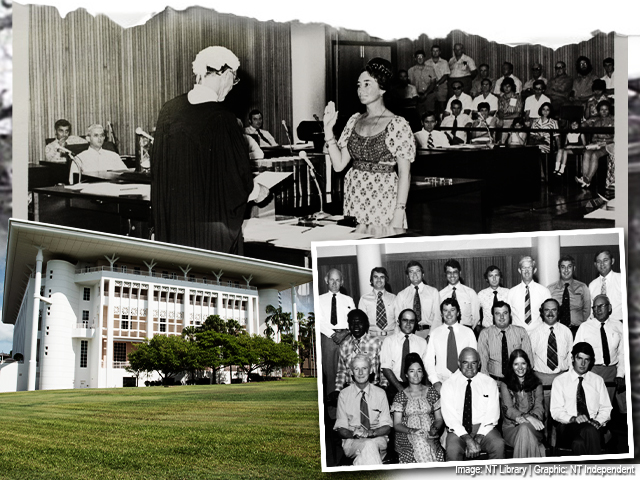
On 20 November 1974, Members of the First Legislative Assembly found their seats in the Chamber, which was at the end of Mitchell Street in the same precinct as Parliament House.
On the command of His Honour the Administrator, John (Jock) Nelson, His Honour (later Justice Sir) William Forster of the Supreme Court administered the Oaths of Office before Clerk Fred Walker and official guests in the public gallery.
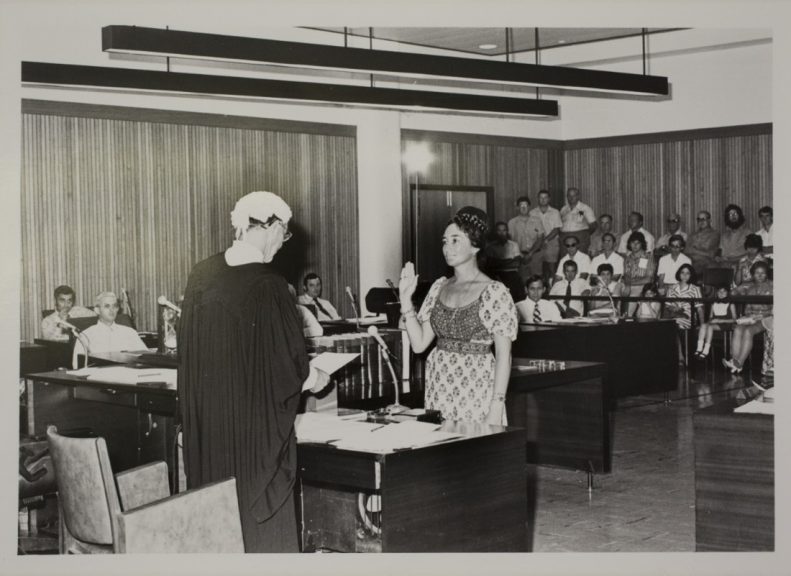
Dawn Lawrie taking the oath of office as the Member for Nightcliff, 20 November 1974. Image: NT Library.
Goff Letts was the leader of the new government. The election result meant that there was no Opposition as is normally the case in a Westminster parliament. That role fell to Independents Dawn Lawrie and Ron Withnall, each representing an urban Darwin electorate.
Of course, the first day of a new parliament is replete with pomp and ceremony. On this occasion, though, it was a freshly elected parliament under a new governance model so attention to matters of a mechanical nature was required—Standing Orders by which the Assembly would run, for example.
Bernie Kilgariff was elected Speaker, a position known as President under the Legislative Council model.
The first items of business included a bill to authorise the Speaker and a bill to create the NT’s own public service, which was singularly intended to wrest bureaucratic control from Canberra.
What we now know as Ministers were then known as Executive Members. They were:
| Member | Portfolios |
| Goff Letts | Majority Leader, Primary Industry, NT Public Service |
| Paul Everingham | Deputy Majority Leader, Finance and Law |
| Grant Tambling | Community Development |
| Liz Andrew | Education, Community Services |
| Dave Pollock | Social Affairs |
| Ian Tuxworth | Resource Development |
| Roger Ryan | Transport and Secondary Industries |
It wasn’t until after self-government that normal Westminster nomenclature attached to government and opposition office holders.
The standard range of parliamentary committees was appointed in addition to which a motion to appoint Goff Letts and Ron Withnall as NT representatives to the Australian Constitutional Convention was put and passed.
After those proceedings, at the giddying hour of 3:40pm, the Assembly was adjourned until 10am the following day when the two bills were passed on urgency and at 12 noon the Assembly adjourned until a date to be fixed.
As it happened, the Assembly did not reconvene until after Cyclone Tracy had wreaked havoc on Darwin, leaving thousands homeless and our northern city in shreds.
At a hastily convened sitting on 2 January 1975, messages of condolence were received from parliaments around the country and the business of the day was dominated by cyclone recovery: representation on the Darwin Reconstruction Commission, Cyclone Disaster Emergency Bill, Cyclone Disaster Relief Fund Bill, Cyclone Disaster (Moratorium) Bill, a motion of thanks to everyone who had rendered assistance, and leave of absence for Members who could not get to Darwin for sittings for logistical reasons.
How the sittings occurred is in no small measure down to the efforts of Assembly officer Ray Chin. As then chief minister Adam Giles said during a condolence motion for Mr Chin in 2013:
Bernie Kilgariff, then Speaker of the Legislative Assembly, remembered the first sittings following the cyclone when Ray was a mainstay in getting the Chamber up and running all over again.
At the time, the roof continued to leak, but Ray paddled through pools of water on the Chamber floor, carrying a tape recorder to record all proceedings of the day so we could have formal records.
Ray was appointed Deputy Clerk in 1978 and then served as Clerk of the Legislative Assembly from 1982 until his retirement on 7 September 1983, the first Australian of Chinese descent to hold such an office.
The Legislative Assembly Chamber on 19 March 1975. Image: NT Library.
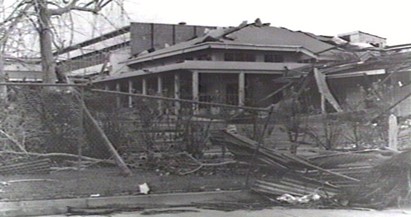
Assembly buildings on 1 January 1975. Image: NT Library.
What had been—not unreasonably—an ambitious parliamentary agenda was, of necessity, put on hold while the worst natural disaster in Australia’s history was dealt with as a matter of priority for the ensuing years.
How the Northern Territory’s parliamentary democracy developed is a story for another day.
Dr Robyn Smith is a Lecturer in colonial history at Charles Darwin University and is well written on the politics and history of the Northern Territory. With the late Dean Jaensch, she co-authored Turning 40: The Legislative Assembly of the Northern Territory 1974-2014 and wrote Licence to Kill: Massacre Men of Australia’s North, which was published earlier this year.

Corrupt now as it was back then!
I can draw a line from the initial parliament members to their useless uneducated children who hold fantastic government positions that only DNA and Political membership can bestow!
An interesting survey would target old Territorians, asking whether we ordinary folk were better off pre or post 1974 and 1978. Most opine that life was better under the ‘colonial’ Northern Territory Administration (NTA).
My recollection is that only three politicians up to 1974 demonstrated loyalty to Territorians and they were Goff Letts. Grant Tambling, and Ron Withnall. All others feathered their own nests.
Following 1978, our lives have steadily deteriorated as politicians adopted the belief that democracy, as defined by Paine and Lincoln, was obsolete; and so we were reduced to electing a preselected range of dictators and oligarchs. Corruption rapidly became par for the course and is now considered to be normal.
Unfortunately the cowboys in charge today have little knowledge and have pick up a few traits from the known cowboys of the past. In the beginning we all had high hopes, that over the years have turned into despair. With that said the Territory is still a pretty good place to live, even if behind barb wire, lights, cameras and alarms.
This morning’s 50th-anniversary event streamed from Parliament House put much of the ‘cowboy culture’ on display.
Congratulations, Madam Speaker, for some fascinating insights with some excellent presentations.