

This is part three of a three part series looking at the history of the Northern Territory’s Rights of the Terminally Ill Bill.
On July 22, 2023 – well after the federal parliament’s passage of the Restoring Territory Rights Act – Chief Minister Natasha Fyles announced the appointment an ‘expert advisory panel’ under the Inquiries Act to lead “a community consultation process for the development of a framework for Voluntary Assisted Dying (VAD) that will be suited to our needs for accessible and safe care”.
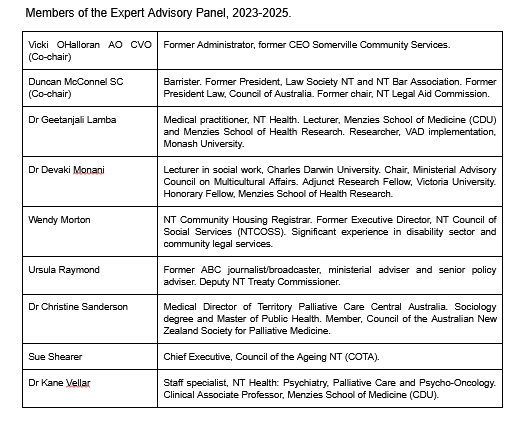
The panel would be co-chaired by Vicki O’Halloran and Duncan McConnel SC and was to report to government by the end of July 2024.
The Assembly was prorogued on July 31, prior to the August general election, which means the report was received but not discussed before the ALP government was removed in the CLP’s thumping victory.
The expert panel’s terms of reference required it to provide advice about consultation and legislation, and specifically: what the Northern Territory could learn from VAD experiences in other jurisdictions; who should be able to access it; the process; models of care for effective delivery of VAD in the NT context; legal and ethical obligations of health practitioners who provide VAD services; safeguards; compliance monitoring; and anything else the panel considered appropriate.
The panel of nine engaged in consultations between August 2023 and April 2024 in Darwin, Katherine, Tennant Creek, Alice Springs, Wadeye and Nhulunbuy.
Reporting by its deadline, it made 22 recommendations including that the NT implement VAD legislation.

Importantly for the bush, the panel recommended that cultural safety design and resourcing be central to implementation and that accredited interpreters be not only used in decision making about VAD but be required to certify their work.
Also important in the context of Chips Mackinolty’s evidence to the Senate committee 27 years earlier, the panel recommended that the legislation provide for the safe supply, storage and disposal of VAD drugs.
Critically for everyone outside metropolitan Darwin and Alice Springs, the panel recommended that telehealth be permitted for at least one of the two assessments recommended for patients wishing to access VAD.
The panel’s final recommendation was that VAD implementation be operational within 18 months of the legislation’s passage.
In May 2025, Attorney-General Marie Clare Boothby referred the expert panel’s report to the Legislative Assembly’s Legal and Constitutional Affairs Committee (LCAC) for inquiry and report by September.
Chaired by the member for Fong Lim Tanzil Rahman, LCAC members were Matthew Kerle (Blain), Oly Carlson (Wanguri), Dheran Young (Daly) and Kat McNamara (Nightcliff) who were supported by an impressive panel of legal and medical experts.

Since that time, Rahman lost the chairmanship of the committee and McNamara resigned as a member of the Legislative Assembly.
However, the LCAC’s terms of reference were to:
* prepare a consolidated consultation paper, drawing upon previous reports, inquiries, proposals, and the Rights of the Terminally Ill Act 1995 (NT);
* consult extensively with communities across the Northern Territory, particularly in remote areas, to gather views on the possible introduction of voluntary assisted dying (VAD) in the NT;
* evaluate different VAD models and safeguards, with a focus on those that would be appropriate for the NT context;
* identify any specific challenges associated with delivering VAD in the NT; and
* if the committee recommends adoption, provide drafting instructions for model legislation to give effect to VAD in the NT.
Consultation fatigue is not new to Aboriginal communities, but they could have been forgiven for suffering from “kill business” fatigue arising from or concomitant with our emergence from the competent governance naughty corner.
READ: The dismissal: An NT parliamentary link
READ: Sex, lies and colonisation: Errol Flynn buys a girl for the price of two pigs and some seashells
From sorcery to finishing up well
The LCAC then embarked on its work, releasing a consultation paper in July 2025 in response to which 411 submissions were received.
It undertook extensive community consultations, hearing from a range of witnesses in Darwin, Ngukurr, Borroloola, Barunga, Wurrumiyanga, Gunbalanya, Papunya, Alice Springs, Maningrida, Numbulwar and Tennant Creek.
What had changed since Mackinolty’s consultations in the mid-1990s and the LCAC’s consultations last year – no doubt assisted by vastly improved communications coverage in remote regions and the passage of time – was a shift in thinking from the sorcerer’s euthanasia needle delivering “kill business” to the notion of finishing up well on country, with family and at the time of one’s choosing.
For Aboriginal people, the phrase ‘finish up’ is a euphemism within a palliative care context that creates a culturally safe way of discussing the inevitability of death.
It is here that telehealth can play a vital role, not just in assessment but in guidance from various providers following the requisite approvals and arrangements.
Use of telehealth was supported by the LCAC, but an amendment to the Criminal Code, which forbids the use of telehealth for VAD purposes, will be required before that can happen.

Further, there are logistical difficulties associated with the use of telehealth including lack of teleconferencing facilities, poor or no reception, seasonal factors and the distance of outstations from serviced communities.
Speaking in the Assembly when he tabled the report, former chair Rahman said: “…we considered finishing up on country, which was of profound importance to huge numbers of Indigenous people wanting to connect to place and have the opportunity, provision and support to not die in a hospital bed in an urban centre, miles from the place you are connected to culturally, spiritually and practically.
“Finishing up on country…had to be mentioned with care and detail in our report.”
It was. In fact, the LCAC devoted an entire chapter of its report to finishing up well.
Fellow LCAC member Matthew Kerle told the Assembly that “there were a lot of findings about the importance of finishing up on country and returning to country.
“Pretty much everywhere we went people said that when they were getting towards their end of life and they knew they were going to be finishing up, they really wanted to go back to their country, their community or their homelands and finish up there,” Kerle said.
“…We heard a lot of evidence around withdrawing from treatment. That was a new thing for a lot of us on the committee – the idea that people would voluntarily withdraw from treatment to return home to the place they know and love and where their loved ones were, knowing that it would likely result in their end.”
That is not unlike assiduously avoiding hospitals and clinics for treatment because of the kill business associated with sorcerers and their deployment of the euthanasia needle on the unsuspecting.
READ: Unfinished Business: The Territory’s ugly truth
READ: Opinion: A tale of two Houses
READ: Opinion: Colonial genetics driving tough-on-crime mindset
Hitting the road to ROTI
The Legal and Constitutional Affairs Committee made 86 recommendations, including that VAD legislation be adopted, that the legislation be called the Rights of the Terminally Ill Act, and that an implementation period of 18 months apply between passage and commencement, as the expert panel recommended.
The jurisdiction that had been metaphorically knocked down to size for its trail-blazing legislation in relation to euthanasia may well re-emerge as a world leader for not only the reintroduction of legislation, but for provisions facilitating one of the oldest cultures on earth to finish up on country, with family and at the time of one’s choosing.
Member for Nightcliff Kat McNamara said as much in the Assembly.
“The committee has recommended that NT legislate for VAD with strong safeguards, robust oversight and, critically, with cultural safety embedded as a guiding principle in the legislation,” McNamara said.
“This would make the NT the first Australian jurisdiction to enshrine cultural safety in VAD law.”
There were, however, caveats.
“The report recommends that cultural safety be embedded as a guiding principle in the legislation,” McNamara said.
“It recommends enhanced Aboriginal representation on the review board and co-design of the VAD service with Aboriginal communities before implementation begins.

“It allows for video recordings of formal requests as a culturally appropriate alternative to written documents, and it provides flexibility around interpreter requirements, recognising the severe shortage of Aboriginal interpreters and the cultural challenges many interpreters face in discussing death.
“These are important steps, but I remain concerned about the cultural safety implications of voluntary assisted dying and the potential for it to further damage Aboriginal people’s perceptions of, and trust in, the white-dominated healthcare system.
“This is not a theoretical concern; we heard it clearly from Aboriginal people and Aboriginal health organisations during our consultations.
“The fear of ‘the needle’ administered by non-Aboriginal healthcare workers carries a profound historical weight.”
That historical weight was made abundantly clear to the Senate Committee decades earlier by Mackinolty.
And that brings us to 2026 when the matter will return to the Legislative Assembly, as the Attorney-General indicated at the beginning of the year.
If legislation is introduced this year, it will be at least March 2028 before VAD once again becomes available in the Northern Territory.
Marshall Perron should be proud of – if not exhausted by – his 33 years on the very long road to ROTI.
READ: Part I: The long road to the Rights of the Terminally Ill Bill
READ: Part II: The long road to the Rights of the Terminally Ill Bill
Dr Robyn Smith is a lecturer in colonial history and Indigenous futures at Charles Darwin University. She is a PhD (Political History), Master of Cultural Heritage and Bachelor of Arts (Journalism & Anthropology) and is well written on the history, heritage and politics of the Northern Territory. Her latest book, Licence to Kill: Massacre Men of Australia’s North, was published in 2024.
0 Comments