


The NT Government’s gas supply deal with Beetaloo Basin gas players is estimated to be worth $4 billion, which a new report says will provide roughly three times more gas than the NT needs to generate electricity by 2030, while better value for money could have been achieved for the Territory.
The Better than Beetaloo – How the NT can deliver energy security this decade without fracking report was produced by Springmount Advisory managing director Tom Quinn, for Frack Free NT, which is part of the Lock the Gate Alliance.
The Lawler Government struck a nine-year agreement with Tamboran Resources in April to supply Beetaloo Basin gas from the second half of 2026 to keep the electricity grid moving, and which the government said it needed following a decline in gas produced by ENI’s Blacktip field in the Joseph Bonaparte Gulf.
The report said the deal would play a foundational role in enabling the exploitation of fracked gas from the Beetaloo, providing 40 terajoules of gas per day, equivalent to 14.6 PJ per annum.
“The deal is a terrible outcome for NT taxpayers that will cost billions over the next decade, effectively abandons the NT’s 50 per cent renewable energy target by 2030, and undermines the commercial position of other energy providers in the Northern Territory,” the report said.

“Rather than providing billions in support to foreign-owned gas companies, the NT should be supporting households and businesses to install solar and storage, developing new large-scale renewable energy and grid connected storage projects in the Territory, and securing gas supply from existing producers like Central Petroleum and gas exporters like INPEX.”
Springmount Advisory pitches itself as providing policy, research, and strategy support for think tanks, peak groups, unions, business and government organisations designing and implementing projects to decrease emissions and address climate change. Mr Quinn was previously research and policy head at Beyond Zero Emissions, was the founding CEO of the Future Business Council, and has worked at senior levels across government and the private sector.
Chief Minister Eva Lawler previously denied the government had timed the announcement of the deal to assist Tamboran with its initial public offering on the New York Stock Exchange in June to continue its gas exploration interests in the Beetaloo Basin. The prospectus figures showed the company has $29.5 million in cash and cash equivalents but needed $85.5 million to operate for the rest of the year. The government signed the deal before final environmental approvals were given to the company to extract gas.
The company hoped to raise $262.5 million, but after reducing its IPO by less than half, it raised $113,060,475.
On July 26, a day after the Federal Government committed a quarter of a billion dollars for renewable energy in the Territory, the Lawler Government signed a second gas supply agreement with Empire Energy, another key Beetaloo Basin player, for the Territory’s electricity system, again before the company has been provided final environmental approvals for expansion or finalising an agreement with traditional owners.
On July 29, the Lawler Government also announced it had signed a six year deal starting next year, to provide up to 29 Terajoules of gas per day from Central Petroleum, New Zealand Oil & Gas, Horizon Australia Energy and Cue Energy from the Mereenie and Palm Valley Fields, in central Australia.
The supply agreement with Empire Energy will see a “target” of 25 terajoules of gas per day from the company’s Carpentaria Pilot Project from mid-next year until 2035, with an opportunity to extend to 2040.
The costs of those deals have not been made public and the Springmount Advisory report was written before the deals were announced.
In its latest annual Electricity Outlook Report, the independent electricity regulator, NT Utilities Commission, said investments were needed to reach the government’s aim of having 50 per cent of electricity generated from renewables by 2030, or face blackouts and higher costs for consumers. Last year, only 6.6 per cent of the NT’s electricity was sourced from renewables.
The cost to taxpayers for the gas deals
The Lawler Government would not say how much any of the deals will cost the Territory, but the report said the Federal Government’s recently released Future Gas Strategy suggests the current cost of gas the NT Government buys from Eni is likely $14/GJ, which would likely be the minimum for gas sourced from the Beetaloo Basin. However, as the basin is undeveloped, requires new pipelines, and is twice as far from Darwin as Blacktip, it was possible that the gas could be potentially be as high was $16/GJ.
It said that as a minimum, Tamboran told shareholders in 2023 that a minimum price of $10.50/GJ was required.
The report considered a low, likely and high scenario, based on those three prices. Based on the $14/GJ figure, Mr Quinn said the nine-year deal with Tamboran was likely to cost about $1.8 billion, and with a possible 6.5 year extension, the total cost could be as high as $3.6 billion.
Mr Quinn provided additional calculations to the NT Independent for the other deals, concluding at the $14/GJ price, the Empire Energy contract was worth $1.3 billion over 10 years, while the Central Petroleum contract would be worth $889.1 million over six years, with a total for the three deal coming to about $3.98 billion.
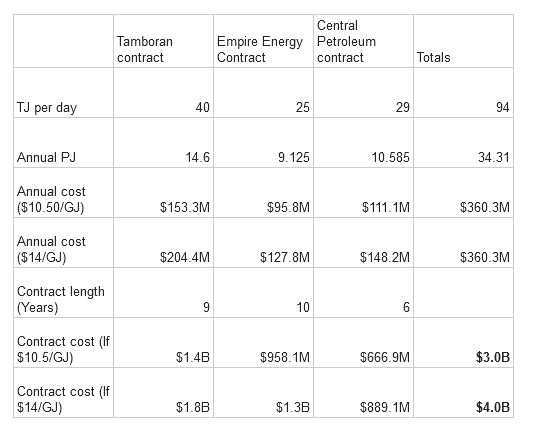
Contract calculations by Tom Quinn.
“Burning gas to produce electricity is very inefficient. Producing 1 PJ of electricity requires burning 3 PJ of gas, resulting in two thirds of the energy being wasted in the process,” the report said.
“Gas generation is particularly inefficient in the NT due to high temperatures and low daytime loads which results in gas turbines being operated at low capacity.”
The report also said gas-fired generation was also the most expensive form of electricity available in Australia, with the 2024 CSIRO GenCost report showing gas generation costs between $124/MWh and $183/MWh, compared to the total cost of solar, including battery storage and new transmission infrastructure at between $99/MWh and $139/MWh.
“The GenCost report underscores that gas generation is almost twice as expensive as firmed renewable energy and storage. Embracing solar will both improve reliability and reduce the cost of electricity in the NT,” the report said.
“The NT is currently the national renewable energy laggard. Despite having the most abundant solar in the country, in 2022-23, only 5.5 per cent of the NT’s electricity was generated from renewable sources compared to the national average of 32.3 per cent.
“When only considering electricity produced in the three NT grids operated by Power and Water Corporation, 16.6 per cent of electricity was produced from renewable sources in 2023-24, far behind South Australia which achieved 75 per cent in 2023.
“The Tamboran deal will effectively lock in higher prices for electricity as well as renewable energy underperformance in the NT for at least the next decade.
“The deal, by default, will see the NT effectively abandon its 50 per cent renewables by 2030 target – already a low ambition target given the rest of the nation is targeting 82 per cent renewables by 2030, and states like South Australia are targeting 100 per cent renewable energy by 2027.
“Alternatively, the deal will see the NT have to on-sell gas, likely at a loss, as significantly less gas generation will be required in the system if the 50 per cent renewables target is to be met.”
Mr Quinn said achieving 50 per cent renewable energy by 2030 would require the NT to reduce the quantity of gas used for electricity generation from 18 PJ per annum currently, to an estimated 11.8 PJ per annum by 2030. The total volume of the three contracts the government signed is 34.3 PJ per year.
“Assuming a steady ramp-up of renewable energy and reduction in gas use of 6 per cent per annum, by the year 2026-27, when the Tamboran gas supply deal commences providing 14.6PJ per year, gas demand for electricity should have already been reduced to 15 PJ per annum – including gas supplied to Alice Springs from the Amadeus basin,” the report said.
“Beetaloo gas is not competitive on the east coast. If the NTG was to try and achieve 50 per cent renewables by 2030 by on-selling gas to the east coast, this will likely be undertaken at a significant loss to the NTG.
“Wholesale gas prices on the east coast are lower than the likely offtake price the NT Government has struck for Beetaloo gas.
“Even using the optimised price scenario forecast in the Future Gas Strategy, which estimated a price of $14.97/GJ for Beetaloo gas delivered to Melbourne, the cost is still substantially higher than current market prices.”
Achieving 50 per cent renewables by 2030 and securing gas supplies without Beetaloo
Mr Quinn argued Power and Water Corporation’s forecast that electricity demand across the Darwin-Katherine, Tennant Creek, and Alice Springs grids will increase slightly to 1,758 GWh in 2030, and that achieving 50 per cent renewables by 2030 means that 879 GWh of that volume will be produced from renewable energy sources, was the equivalent to the output from 388 MW of solar installed in the NT.
The report said that Australia installed 4,600 MW of solar in 2023, and achieving 50 per cent renewables for the NT was less solar power than the 400MW Western Downs solar farm in Queensland, which was constructed in less than three years, and which was underpinned by the state-owned electricity company CleanCo, which signed a 10-year agreement to take 80 per cent of the power generated.

“A faster rate of renewable energy build out is possible in the NT, if there is political will, however in the event there is not, the gas required to run existing gas turbines can easily be procured from existing gas producers in the Territory,” the report said.
Mr Quinn used figures from the Australian Energy Market Operator’s Gas Statement of Opportunity report that calculates the NT requires 18 PJ for electricity and 6 PJ for industry while INPEX exported an estimated 453 PJ in 2022-23.
“Establishing a domestic gas reservation policy equivalent to 5 per cent of LNG export gas (in contrast, Western Australia has a 15 per cent reservation policy) would cover the NT’s total gas demand for electricity generation and industry,” the report said.
“Onshore, Central Petroleum is a proven and established gas producer that is capable of producing the quantity of gas contracted from Beetaloo today. In 2023, the firm produced 14PJ of gas from its three primary production fields. The two largest fields Mereenie (9.5PJ, 2023) and Palm Valley (3.3PJ, 2023) are already directly connected to Darwin via the Amadeus gas pipeline.”
Securing the NT’s energy future
The report said that the Tamboran deal was a poor use of taxpayer money, meaning Territorians would pay billions of dollars to an overseas company via their electricity bills.
“To deliver the best value for money, the NT should establish a competitive reverse auction process, where all energy producers, including renewable energy developers and existing gas producers, can bid to meet the NT’s electricity requirements at lowest cost,” the report said.
“In parallel, the NT should establish an annual renewable energy installation target to ensure 50 per cent renewables by 2030 can be achieved – complemented by a 5 per cent domestic reservation policy to ensure gas exporters in the NT are also providing for local gas demand.”
Mr Quinn said the NT Government should sign large-scale offtakes and storage contracts so the NT aligns with the national target of 82 per cent renewables by 2030, with renewable energy and storage build rates showing it was feasible.
The report said the government should still hit its 50 per cent target with large scale renewable contracts, with remaining electricity generated from Central Petroleum and Inpex gas, and even if it failed, households would continue to install solar, which was likely to ensure renewable energy hits 30 per cent in 2030, with the remaining electricity demand met with gas procured from Central Petroleum and Inpex.
“Fracked gas from the Beetaloo Basin is not required in any scenario,” the report said.
Charging royalties on LNG exports will generate needed revenue
Mr Quinn wrote that Inpex pays no royalties on the gas it exports from Darwin each year, which is equivalent to 10 per cent of Japan’s LNG demand, while in contrast, Queensland applies a royalty rate of 27 cents/GJ plus 0.09 cents/GJ for each 1 cent/GJ more than $9/GJ to LNG supply projects.
“To ensure there is a return to Territorians, an export levy should be applied that is commensurate with royalty rates,” the report said.
“As Inpex gas is sourced from the offshore Ichthys basin, the NTG should request that the Federal Government apply an equivalent export levy to INPEX exports.
“This would raise an estimated $122 million royalties per annum that could be directed to the NT.”

You would have to take any report supplied by the lock the gate mob with a grain of salt.
The ad they are running ATM shows a greens dill setting alight to a river in QLD, they are trying to make out it is caused by fracking when infact it is a natural event.
Wouldn’t believe a word they say
the fact that these deals were done ahead of approvals illustrates this labor government’s disregard for managing environmental harm
No environmental harm, Justin; this report is a fairy tale for true believers who think renewables are cheap even though they are poor quality.