

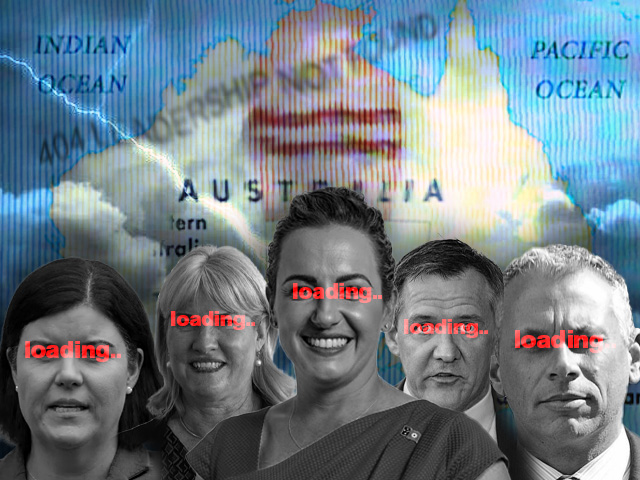
This is the first instalment in a series by Dr Don Fuller examining the major governance failures in the Northern Territory; the moral and integrity shortcomings of politicians and government, the politicisation of and the resultant instability in the public service and the police, and the unfair and unjust treatment of lower level employees in the public service and police in contrast to the more powerful members.
The Finocchiaro Government is in a rolling series of crises, a situation which has afflicted NT governments that preceded it, with the central public concern around the failure of Chief Minister Lia Finocchiaro and her ministers to clean up the perception of ongoing graft, corruption and nepotism in the public service, which is part of the wider dysfunction in the Territory.
One of the most serious recent illustrations involve Ms Finocchiaro ignoring documented evidence of serious improper conduct at the taxpayer-funded Darwin Waterfront Corporation, which is where her husband Sam Burke works, evidence that showed he benefitted from $400,000 of taxpayer money through higher duties allowances over six years for made-up jobs in other agencies that was all paid through the Waterfront Corporation, approved by colleagues with no oversight and contrary to recruitment rules.
The revelations about the Waterfront Corporation stemming from the NT Independent’s reporting include other examples of the deep seated problems of cronyism where friends and relatives are appointed to senior positions with little value placed on ability to do the job efficiently and ethically.
The idea that Ms Finocchiaro lacks the appetite to act on these endemic failures is supported and reinforced by her appearing unable or unwilling to admit the seriousness of major breaches in ethical governance, until forced to act by pressure from the media and public concern, in the matter of the Office of the Independent Commissioner Against Corruption’s investigation into the now ex-police commissioner Michael Murphy hiring his friend Peter Kennon to be an Assistant Commissioner.
This example also encapsulates much that is wrong with governance at many levels in the NT, and while Mr Murphy is now gone – his contract somehow entitles him to six months remuneration despite the circumstances – and an independent inquiry announced by the Chief Minister into senior promotions since he began in the job in August 2023, it still falls far short of a wide-ranging investigation, or royal commission, into the NT Police that many outside of the government and police executive believe is required.
It encourages behaviours such as those exhibited by Mr Murphy, who refused to accept responsibility for his completely unacceptable conduct and resign with at least some degree of acceptance of responsibility.
It highlights a cultural disintegration of ethical governance practices where mistruths are preferred by senior politicians, senior bureaucrats, and senior police, and where spin doctors come into their own, over ethical accountability to the public.

This is further reinforced by a collapse in institutions such as the ICAC, which is supposed to exist to ensure that ethical governance practices are followed by politicians and those in positions of authority within the government structures.
I make note that the ICAC’s investigation into Mr Murphy is one of the few times the corruption watchdog has made a finding of improper conduct, let alone corruption, since the disgraced and very recently departed Michael Riches became Commissioner in July 2021, and even this report seems to come to a far too credulous conclusion when it comes to the appointment of the current Acting Police Commissioner Martin Dole as Deputy Police Commissioner.
The obvious inability of government to do anything about this collapse provides further serious examples of how democracy in the NT has degenerated to where government is all about retaining the positions of power and associated financial benefits for those within the government systems, at the expense of governing for the people.
Many of the main problems associated with bad political and administrative leadership have been observed over successive governments in the Territory.
Key problems have included actions not matching words, a desire for politicians and other senior public servants to surround themselves with ‘yes’ people, an inability to listen to alternative views and ideas, a desire to over-control, attitudes driven by ego, and an inability to learn from previous mistakes.
Such characteristics act to create a culture of self-interest above the needs of the general population, and lead to corrupt behaviors from those politicians and senior public servants.
An example of that self-interest, which has large ramifications for the NT as a whole, concerns how approximately $800 million annually that is given to the NT from the federal government in GST payments that is intended for Aboriginal disadvantage to be spent on services in remote areas, is actually spent.
It instead gets spent in the population centres, primarily Darwin, in the mostly white electorates that are most important in helping governments win power and hold onto it.

This clearly shows politicians to be focused on power, not the people, and the Territory as a whole, and it is magnified by a lack of concern in the NT for the main principles of a Westminster-style democratic government which has involved governments dismantling some of the key requirements.
These include ignoring ministerial codes of conduct generally, including for post-employment, and politicising senior levels of the NT public service and the NT Police.
The foundation of a merit-based public service with security of tenure has been demolished, with many executives on time-limited contracts and needing to please the Minister to get a new contract. Inequitable, unfair and unjust treatment, favouring senior levels of the public service and police, have become the norm.
I will give disturbing examples of this later in the series.
This has led to the politicisation of public servants and the cowering of the public servants to the politicians. It has enabled politicians to use the complicity of the public service to act against the interest of the citizens, and in the interest of furthering their own power and entitlements.
A main objective of this series is to examine important examples of these transgressions, and to highlight implications for the future governance and development of the Territory.
A number of these examples rest on investigative reporting undertaken by the NT Independent.
A short background on the Northern Territory
The NT government is responsible for almost one-fifth of the landmass of Australia and it aspires to statehood. Its ministers sit at the table with those of the states, and the Commonwealth, at intergovernmental meetings.
Yet it behaves like the most irresponsible, non-representative and fractious of town councils.
In particular, politicians from both sides of the main parties in the Territory have been plagued by a lack of concern about the ethical standards and principles required for a functioning democracy.
The Australian National University Centre Aboriginal Economic Policy Research visiting fellow Michael Dillon put it succinctly in The Saturday Paper in 2016.
“Not only do they have the least capability of any jurisdiction in the country, but they’ve got the most difficult problems,” Mr Dillon was quoted as saying.
However, the rest of Australia recognises the difficult problems with their lopsided financial support. Less than 30 per cent of the money the NT spends comes from own-source revenue. The other, over 70 per cent, comes from the federal government and Australian taxpayers.
Of that money, by far the largest amount, which is about 50 per cent of the Territory’s budget, comes in the form of GST revenue.
Every year the Commonwealth Grants Commission hands the NT government between five and six times the amount it would get if the GST money were divided evenly throughout Australia on a per-capita basis.
The Commission apportions funds on the basis of a formula of assessed need. The aim is to provide for equal service delivery to everyone in Australia.

The NT gets far more than other states on a per-capita basis because of its small revenue base, remoteness, sparseness of its population, and particularly because of its large, scattered, and generally impoverished Indigenous population.
There is however, unfortunately, no legal obligation on the state and territory governments to spend the GST funds distributed to them in accordance with the CGC’s assessments.
And the NT government doesn’t.
It overspends on luxury facilities such as sports stadiums, and Parliament House itself is a classic example, and infrastructure in Darwin, where most of the white population lives, and under spends in the more remote parts of the Territory, where 80 per cent of the Indigenous population lives.
An analysis published in The Guardian in 2018 by former NT Council of Social Services president Barry Hansen showed that 68 per cent of the $3.4 billion in CGC assessments were intended to benefit Indigenous people. However, the NT government only spent 53 per cent of it on Indigenous people, its own Indigenous expenditure review showed.
Back then it was $500 million that had been taken from Aboriginal people to Darwin; the difference in today’s money amounts to around $800 million.
It has been observed that Darwin is a nice modern city but the rest of the Territory is more like a hovel in comparison.
This practice has continued since the NT received self-government in 1978.
The results of syphoning money
We are now seeing the social results of this inequitable distribution of government monies with escalating levels of crime and violence in the NT, particularly from highly disadvantaged, younger Aboriginal people.
Last year, former Liberal Prime Minister John Howard labelled the NT a “failed state” based on the NT government’s inability to provide basic social services, meaning that disadvantaged Territorians were not being helped in the way they needed.
At the same time another former Liberal Prime Minister, Tony Abbott, also said the NT was a failed state.
Their comments followed the revelation of the NT government’s lingering failures highlighted in national reports about the jurisdiction’s poor education system, with one in five students being underfunded, and 85 per cent of Indigenous students falling below minimum literacy and numeracy standards.
Since self-government, and regardless of the political party in power, the NT has been bedevilled by serious problems of governance, which bring into question whether Territory politicians are capable of governing for all of their citizens with the standards required for a functioning democratic government.
The causes of bad government
Bad government manifests in various forms both within the executive branch and the administrative branch, from corruption, to abuse of power, to inefficiency, to a disregard for the welfare of the people, and just a general lack of knowledge and ability to do the job.
Understanding the causes of bad government is crucial for addressing the problem and working towards better governance.
One of the primary causes of bad government is corruption. When officials prioritise personal gain over the public interest, it erodes trust in government institutions and undermines the rule of law.
Corruption can take many forms, from embezzlement, bribery and kick-backs to nepotism and cronyism. It thrives in environments where transparency and accountability are lacking, and where there is a culture of impunity.
Such characteristics have unfortunately characterised successive NT governments since self-government.
Another significant factor contributing to bad government is the absence of effective checks and balances, by the different branches of government.
There is the executive branch, consisting of the Chief Minister and Cabinet, the legislative branch, consisting of the Legislative Assembly made up of the 25 politicians elected in the NT, the administrative branch, consisting of the public service and police, and the judiciary, consisting of the courts.
They are designed to provide oversight and checks and balances against each other, and by this means prevent the abuse of power.

However, when one branch becomes too dominant, such as the position of Chief Minister, compared with the rest of the Cabinet, and the Legislative Assembly for example, or when these institutions fail to perform their roles adequately, it can lead to bad governance.
Think, for example, of what Ms Finocchiaro is proposing with the Territory Coordinator position, and giving herself the same powers, which include the power to declare exemptions to the law, and to override other decision makers.
With this she takes power from her fellow ministers, as well as public servants, including the supposedly independent statutory bodies such as the Development Consent Authority.
It has echoes of former Liberal Prime Minister Scott Morrison secretly having himself appointed to administer the health, finance, treasury, home affairs and industry, science, and energy and resources ministries.
In the NT, there have also been serious questions raised regarding the public service and the police, undertaking their responsibilities in a legally acceptable, fair, just, and transparent manner.
There is a belief that the public service and NT Police have been badly eroded by politicisation, public policy fiascos, adverse findings, and a growing sense that ‘frank and fearless’ advice has been replaced by leaders jumping to their political masters’ commands.
Such problems often occur when leaders manipulate or weaken these institutions to consolidate their power, and I reiterate here the role of insecure tenure in this.
Lack of transparency is a related cause of bad government. When governments operate behind closed doors, without public scrutiny, it becomes easier for corruption and abuses of power to go unnoticed.
Transparency is essential for holding politicians and officials accountable, and ensuring they act in the best interests of the people they serve.
Freedom of the press, and access to information laws are crucial tools in promoting transparency. Again, there have been serious breaches of these requirements in the case of the Territory, particularly in relation to the banning by government of the NT Independent, and the NT Police’s secret attempt to create the conditions so it could raid the paper, which I will discuss later.
Having an open Freedom of Information system that adheres to the intent of its creation is important, with a reported rate of residual FOI requests in the NT five years ago being seven times higher than Victoria, and eight times higher than Western Australia.
There is also the problem of government using the excuse of Cabinet-in-confidence as a reason not to release documents – even to the ICAC – and using commercial confidence claims to hide the cost of contracts in a way that goes against the legislation, making it a common occurrence rather than being used in extreme cases.
The growth of the number of un-named spin doctors for ministers and in departments has dramatically reduced the information that is made public, with the majority of what is provided being increasingly opaque and without real meaning or accountability.
At the same time, important parliamentary bodies such as legislative scrutiny committees have been severely limited in their time and ability to examine important pieces of legislation. The Gunner Government first merged two of those committees into one, then later scrapped that committee, and while the Finocchiaro Government revived it, the government prevented its important and complex new crime legislation from being reviewed by the committee.

In many cases, bad government is also a result of inadequate leadership and a failure to prioritise the common good. Leaders who are more interested in maintaining their grip on power than in addressing the needs of their citizens can lead to very poor governance.
Effective leaders should be responsive to the concerns of their constituents, engage in inclusive policy making, and work towards the well-being of all citizens.
There is evidence that such engagement is badly lacking in the Finocchiaro Government. And there is evidence the government is not listening to the people.
Furthermore, economic factors play a major role in the quality of governance.
High levels of poverty and inequality – as touched on with the missing $800 million in GST money – can lead to social unrest and instability, which in turn can result in bad governance. Governments that do not address the economic needs of their citizens are more likely to face public discontent and political turmoil.
In the case of the Territory, the major impacts of social and economic inequality, particularly for Aboriginal people, is now manifesting in significant crimes and social unrest.
Trust in government is falling, and nowhere more so than the NT.
Increasingly, citizens are questioning the moral conduct and integrity of government, viewing it as not fit for purpose, and often corrupt.
They see politicians as focused mainly on their personal careers, fighting their way to the top through patronage and factional infighting, and then leaving politics to use information acquired in government to work for their own benefit, on very large salaries in private business.
At the core of these perceptions is a sense that those in power are not governing in the common interest, but rather in the interests of politicians themselves and the groups that fund and support them.
Such views are growing in the Territory, and leaders seem unable to address these crucial questions which are therefore likely to worsen.

Further reading by Don Fuller:
READ: The vice-chancellor needs re-focus to make CDU a high quality university
READ: Rising social conflicts and escalating debt mean a bleak outlook for the Northern Territory
READ: Northern Territory – Failed governance, cultural clash and an uncertain future
READ: How not to manage government finances – The case of the Northern Territory
READ: The Gunner Government: A collision between Budget misuse and democratic responsibilities
Dr Don Fuller holds a first class Honours degree and PhD in economics from the University of Adelaide and has worked as a senior public servant in the Territory and as Professor of Governance and Head of the Schools of Law and Business at Charles Darwin University. He grew up in Darwin and attended Darwin High School.
He was also involved with the establishment of the first NT medical school under the leadership of Flinders University vice-chancellor Professor Ian Chubb.
Dr Fuller was also an adviser to the former CLP MLA Maralampuwi Francis Xavier, was briefly the senior private secretary to Chief Minister Paul Everingham, and is a former member of the CLP and the ALP.

~Heaps and heaps to agree with in your well written piece Dr Fuller. Read back at our comments and we’ve been saying the same things over and over again for close to 18 months now.
~However, we differ on some important positions with you and others Don.
~You offered a choice:
‘unable or unwilling to admit to serious breaches of unethical governance.’
~We would say: unwilling. They know what they’re doing. They know right from wrong, most of them. They just don’t care to be seen to be unwilling.
~Your word choice here is more generous let’s say than ours:
‘It highlights a cultural disintegration of ethical governance practices where mistruths are preferred by senior politicians
This is further reinforced by a collapse in institutions such as the ICAC’
~The implication to us here is that the politicians in your Hellscape feel like bystanders to the degradation around them.
Like excited heroes in a movie of journeyman trials, ending in valiant failure but not from want of trying.
~And you choose the euphemistic ‘mistruths’. You ask us to believe that the collapse of ICAC, is probably an unfortunate example of buckling under too much hard work.
~In our opinion, that degradation and collapse, are deliberate.
~Your ‘mistruths’ are what we call LIES.
~You appear to sound like all of this is an accident of circumstance, and while we agree that this sometimes happens when you put imbecilic puppets such as the Attorney General in charge of serious ministries, most of this disintegration is purposeful in our opinion.
~Dysfunction is what the Territory expects and disintegration is what the Territory is getting.
~My husband used to be a teacher. He told me that if you expect your students to fail and you keep telling them that they will fail then guess what: they fail and no one is surprised.
‘The obvious inability of government to do anything about this collapse
Many of the main problems associated with bad political and administrative leadership have been observed over successive governments in the Territory.
Key problems have included actions not matching words,
and an inability to learn from previous mistakes’
~Again, it’s not an ‘inability’, the slow moving collapse we are witnessing over many Parliaments, is wilful.
~Gold star: they’ve all been doing it over recent years. Broken record alert: the ALP and the CLP are the same when it comes to such disastrous execution of public duties.
~It is what the Criminal Code Act calls:
Corruption,
Abuse of Office,
False Accounting,
‘helping an offender escape prosecution’ is labelled Accessory After the Fact.
‘Key problems have included actions not matching words’
~aka LIES
‘and an inability to learn from previous mistakes’
~Again we see the innocent bystander label. We disagree.
~We could go on and on but we don’t want to nit pick your piece too much.
~We all know the problems and the types of problematic people.
~Solutions? we’ve explained them in the last few months of comments but here again is the pointy end of that stick.
~Our friends are the only ones who appear to have the stomach for criminal prosecution of these LiaRs and cheats and snake oil salesmen/women (aka LIARS).
~Lying is intentional, that kind of intent to do ill to others for your own personal gain grounds criminal acts the world over. The ALP and CLP are fraudsters on the public interest.
Some other words to describe their calculated behaviour:
It’s a scam.
It’s a sham.
It’s graft.
It’s fake.
It’s duplicitous.
It’s a swindle.
It’s deceit.
It’s misrepresentation.
~These words all have nefarious and sometimes criminal intent behind them, as our house and our friends say, in solid agreement with you Don:
~Yes, both of the 2 main parties have been guilty of this kind of sickening fraud for many years and yet where are the criminal convictions?
~There are no internal or other parts of the NT Government willing to push through with consequences.
~So, let’s change The Game, on them.
~Start the processes of criminal legal consequences for their Game.
Use the Legislation which they helped write, which they use on others but refuse to use on themselves.
~We almost vomited reading how a criminal prosecution was binned for his mate by a senior NT supposed to be Public Servant.
~We know of a low level public servant who was charged criminally years ago for something that everyone in the public service does yet he was singled out and ruined. Then we have to read this:
‘It specifically detailed that Mr Trier ended the investigation into Mr Knowles because Mr Knowles and his wife, Claire Manalo, were concerned that prosecution for the two animal abuse charges would result in their public service jobs being terminated.
“Mr Knowles…made full admissions to the offences that would have resulted in a conviction,” the whistleblower said in the email.’
~The time has truly come, the gloves are off now.
~Contact your local Police station and show them the evidence on this website.
~Direct them to the places in the Government ecosystem, both in written folders and in the electronic/email system, where all the other incriminating evidence is stored. Just sitting there waiting to be found and set free.
~And don’t forget to tell them: you can delete emails from your inbox but all Governments, NT included, have back up copies of all communication as required by law in case the system goes down and they have to keep doing their business.
~If evidence suddenly disappears from email accounts then head to the back up system, constable/sergeant/investigator.
It’s not hard to find.
~Let’s all be Game Changers, literally.
I agree senior public servants like this author should have done much better when they were inside the glass house they are now throwing stones etc.