

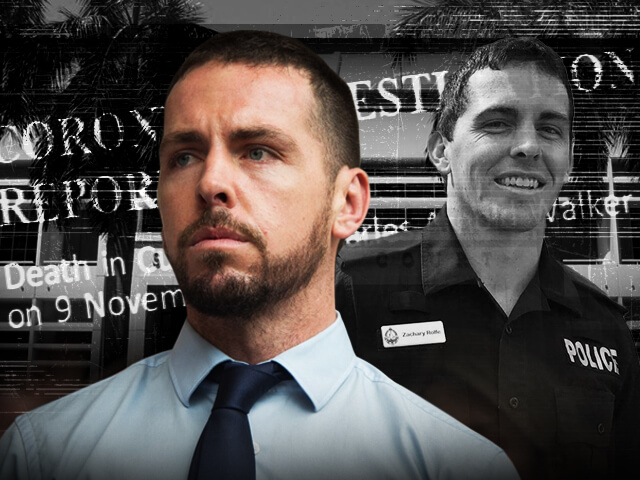
EXCLUSIVE: Constable Zach Rolfe would not have been recruited into the police force if he had been honest about his military disciplinary history, and the impact of undisclosed medication he was taking for a “psychiatric condition” in the months before shooting and killing Kumanjayi Walker in Yuendumu will never be known, a draft coronial report prepared by the NT Police states.
The report covers issues identified about Constable Rolfe following the shooting, including not admitting to a theft charge while he was a member of the Australian Defence Force, what it said was an “inclination” to use force when dealing with the public that had been overlooked by supervisors, and the use of medication that raised questions about its effect on him the night he shot and killed Mr Walker.
The use of benzodiazepines would have ruled him out of being a member of the Immediate Response Team, the report found, and an internal police disciplinary matter should also have rendered him unsuitable for the unit.
The document is what the NT Independent understands to be a later draft of a report by Superintendent Scott Pollock investigating the death of Mr Walker for the coroner, a death which will be the subject of a three month coronial inquiry beginning on Monday.
Supt Pollock was designated the Commissioned Officer in Charge of the Coronial Investigation three days after Mr Walker was shot and killed by Constable Zach Rolfe – who was part of an IRT mission – during a failed arrest, in a house in Yuendumu on Saturday, November 9, 2019.
Supt Pollock was later controversially removed from the role before he could finish. Some of the sections of the report are redacted with claims of legal privilege, and it comes with an annotation that Commander David Proctor was officially delegated the role on August 10, 2020. The document quotes from the Constable Rolfe committal hearing which finished in the first week of September 2020.
Constable Rolfe volunteered to be part of the mission after Yuendumu officer-in-charge Sergeant Julie Frost requested ‘specialist’ extra officers from Divisional Superintendent Jodie Nobbs in Alice Springs to assist with general police work because of officer fatigue, but also to arrest Mr Walker who had broken out of an alcohol rehabilitation facility at the end of October, and had run at two local police officers in a house with an axe when they attempted to arrest him three days earlier.
The NT Independent previously reported the coronial document also found Assistant Commissioner Travis Wurst and Supt Jody Nobbs, should never have deployed the IRT “without strict protocols in place for the apprehension of a ‘high-risk’ offender”, while the report at another point stated that IRT should not have been deployed at all.
And the coronial report also said Mr Walker would “most likely” still be alive had IRT members followed proper training and policies in Yuendumu that night.
Constable Rolfe was charged with murder four days after the shooting, which police investigating the matter expressed grave concerns because the brief of evidence was not finished, also questioning the early and pressing involvement of the office of the Director of Public Prosecutions.
He was acquitted of murder, manslaughter and engaging in a violent act causing death by a Supreme Court jury in March this year.
Weeks later, the Independent Commissioner Against Corruption Michael Riches announced he would investigate allegations of political interference in the charging of Constable Rolfe, a claim which has been denied by Mr Chalker and then-chief minister Michael Gunner.
The Rolfe defence team alleged Supt Pollock was stopped from completing the report by then-Assistant Commissioner Nick Anticich, the document was then “seized” and edited by the officer in charge of the criminal matter, Detective Acting Superintendent Kirk Pennuto, and purposely suppressed by Police Commissioner Jamie Chalker. They subpoenaed it after they learned of its existence sometime before May 2020.
Unlikely to have remained in IRT because of medication
The report said the NT Police was the only police force in Australia where there is no mandatory testing of officers for drugs and alcohol and Constable Rolfe had an undisclosed “psychiatric condition”. Constable Rolfe was also not asked by the initial investigation team to volunteer either a sample of breath or submit to a blood test following the shooting.
“At the point in time when Rolfe shot and killed Walker there was no reason to suspect that he was under the influence of drugs or alcohol but, without specific legislative powers, there was no capability to do so,” the report said.
“It was not until he was arrested on 13 November 2019, that he admitted to taking prescribed medication for a psychiatric condition…
“Rolfe did not [previously] disclose that during the preceding 12 months he had been prescribed a range of benzodiazepines. How his medication affected his psychological state and altered decision making ability will never be known.”
Benzodiazepines cover a range of different drugs and include those sold under the well known brand names Valium and Xanax. The Australian Drug and Alcohol Foundation describes them as depressants and minor tranquillisers, and usually prescribed for stress and anxiety and to help people sleep.
The report went on to say Constable Rolfe breached the Northern Territory Police General Order – Return to Work and Restricted Duty, and the Work, Health, and Safety (National Uniform Legislation Act 2011), but it was unlikely he was aware of his obligations to report his condition or his medication to his superior.
“The Divisional Officer will assess the potential risk factors and take any necessary action to both assist the member, and ensure that the member is removed from performing any duties that may pose a risk to the member, their colleagues and/or members of the Northern Territory community,” the police general order states.
“Had Rolfe disclosed his use of prescribed medication to his Divisional Superintendent it is unlikely that he would have remained eligible for IRT selection and duties,” the report said.
The IRT is a part-time unit, which draws from a pool of up to 16 more specially trained Alice Springs general duties officers selected with a preference for having military backgrounds, who volunteer when needed for special deployments, especially when Territory Response Group officers from Darwin cannot be deployed in time. After Mr Walker’s death the unit was suspended and later disbanded.
Rolfe should not have been in IRT at the time of the shooting
The report goes on to say that Constable Rolfe should not have been a member of the IRT at the time of the shooting.
“Further stipulations apply to the eligibility of the IRT members as follows,” the report said.
“Members who are the subject of disciplinary action will be stood down during the investigation or subsequent penalty period at the discretion of the Commander Southern Command, and in consultation with the OIC IRT and Alice Springs Divisional Superintendent.”
It said that Constable Rolfe had two “complaints against police” matters being internally investigated, as well as one other matter under internal investigation, but the report did not go into detail about what they were.
The report states that investigators seized Constable Rolfe’s police notebook when he returned from Yuendumu to Alice Springs.
“He obtained a new notebook from Alice Springs Police Station on 10 November 2019 and he then recorded notes of the incident,” the report said.
“Rolfe had made notes of the incident in his official police note book but Investigators were not aware that it existed. The whereabouts of this notebook remains unknown.”
‘It is likely he would never have been recruited into the NTPOL’
The report said the coronal investigation exposed flaws in police recruitment and integrity checks and “in particular” the recruitment of Constable Rolfe highlighted a lack of probity checks.
“Zachary Rolfe initially provided false information in his written application to join the Northern Territory Police,” the report said.
The coronial report goes on to say Constable Rolfe had said on his NT Police recruitment application that he had not applied to join other police forces but in actuality had completed his application that day for Queensland, Western Australia, and Victoria.
Queensland Police had banned him from applying there again for 10 years for lying about his involvement in a violent incident that was dealt with by police in that state.
“He initially did not disclose an incident in which he was involved in Townsville where he was fined by Queensland Police,” the report said.
The report did not provide details of the incident.
Whilst in the ADF, Constable Rolfe faced disciplinary action for a stealing offence where he subsequently was issued with a show cause notice, but he was not dismissed from the ADF and was subsequently deployed to Afghanistan for the period from July 9, 2014, to January 17, 2015, the report said.
“Furthermore he did not self-disclose his adverse military history – a mandatory requirement in the application form for ex-ADF members.
“In doing so Rolfe was selected for a face-to-face interview with the recruiting panel. Had he completed his application form in all honesty, it would have been unlikely he would have been selected for an interview.”
However, the report said, when he did concede that he had applied for other policing jurisdictions and mentioned the incident in Townsville in the interview, he was well received.
“…Well presented and confident during the interview. Was forthcoming and honest throughout,” the recruiter, NT Police psychologist Bruce Van Haeften, wrote.
However the report said Constable Rolfe was “not entirely forthcoming” in the interview, and did not tell recruiters he had been charged with stealing in the ADF.
“Had he disclosed this matter this application would have been referred to the NTPOL integrity committee, who would have in all likelihood rejected his application,” the report said.
It went on to say it was an offence of false representation under the Police Administration Act 1978 and despite Constable Rolfe appearing to give a false representation, Police Commissioner Jamie Chalker had decided not to prosecute based on advice of the Director for Public Prosecutions that there was not enough evidence and it would not be in the public interest to do so.
“Since it was discovered that Rolfe did not disclose his adverse military disciplinary history the Northern Territory Police have tightened recruitment process and probity checks for ex-ADF members,” the report said.
“If they had done so prior to Rolfe applying for the NTPOL, it is likely he would never have been recruited into the NTPOL.”
Rolfe an example of problem police culture in Alice Springs: Report
The report says that by November 9, 2019, the policing culture in Alice Springs had degenerated to a state where “unacceptable police behaviour was allegedly being condoned by supervisors and senior police management”.
It said during his almost three years on the job, Constable Rolfe already had 46 ‘use of force’ entries in the NT Police computer program PROMIS.
Under police general orders officers should only use force that is “reasonable, necessary, proportionate and appropriate to the circumstances”, the report said.
And police should use the minimum force required for the safe and effective performance of their duties, and when force is used, supervisors have to “audit” the actions of the officers to see if they are appropriate and necessary.
“A review of Constable Zachary Rolfe’s use of force involvements led Senior Sergeant Barram [the NT Police use of force expert in Constable Rofle’s murder trial] to identify five occasions…where Rolfe has used force that Barram assessed as ‘not reasonable, necessary, proportionate, and appropriate’,” he said.
These were recorded in the PROMIS system and roughly described in the following way: Rolfe chasing and tackling a person involved in a disturbance in a public place potentially causing a shoulder injury; repeatedly punching a man in the face requiring hospital treatment for cuts; pushing a drunk old man to the ground with unnecessary force; chasing a man and pushing him into a fence after he appeared to surrender, leading to hospital treatment for ‘breathing difficulties’; and pushing a man’s head into a building with such force it caused a cut to the head that was treated in hospital.
In the second instance identified, a domestic violence case, an entry into the PROMIS systems states Constable Rolfe did not turn on his body-worn camera and the alleged offender’s stepfather was assaulted by Constable Rolfe, and was later repeatedly punched by him and taken to hospital with cuts to the face, with the officer saying the man eye-gouged him in the first instance.
“The subject has now been charged with offences of assaulting police and the matter is now before the courts – Nil issues arising,” the senior sergeant use of force review comments said.
The report said when it proceeded through court Judge Greg Borchers found Constable Rolfe lied.
“I find that Constable Rolfe’s evidence lacks credibility,” he wrote.
“He lied. He has lied in a statutory declaration about what happened in the bedroom…it is highly likely that he was unconscious when Rolfe punched him in the face…Rolfe deliberately banged his head into the floor as he was being turned over to be handcuffed.”
There was no action taken against Constable Rolfe in any of those instances, and the report said the lack of detailed review by the supervisors of the force used was concerning.
“I think he just, um, felt like he could do whatever he wanted because the senior sergeants were always going to cover it up for him. So use of force, um, well yeah, I think he just felt like he could just use unjustified force all the time because it was always going to be covered up,” said ex-police officer Claudia Campagnaro, who dated Constable Rolfe for a period of time while he as based in Alice Springs
The report said, of further concern, was that only one of these use-of-force episodes was accompanied by a mandatory injury report, which is required when a person receives an injury or medical treatment while in custody.
Those reports are then reviewed by a divisional superintendent, and the document argued it was likely Constable Rolfe’s actions would have been addressed if those reports had been done.
It said there were more concerns identified in a statutory declaration by Professional Standards Command ethics and integrity division’s Detective Superintendent Virginia Read, who managed complaints against police reports.
“…Rolfe was repeatedly engaging in concerning behaviour, including not operating his BWV [body-worn vision],” the report quoted her as saying.
“She had cause to meet or otherwise discuss issues pertaining to Rolfe’s alleged inappropriate behaviours with the Alice Springs Command Management Team on at least three occasions.”
She noted Constable Rolfe’s non-adherence to the existing BWV policy and his failure to activate his BWV during ‘use of force’ episodes.
“No report of any action taken by the Alice Springs supervisor is recorded in the minutes of the Alice Springs Command Management Team meetings, in June, July, or October 2019 when these issues were directly raised by Detective Superintendent Read,” the report said.
Following the death of Kumamjayi Walker on November 9, the IRT members immediately turned off their cameras once it was mentioned investigators from Alice Springs were making their way to Yuendumu, the report continued.
While it said Constable Rolfe’s “hyper-vigilance” should have triggered an NT Police managerial response, the Northern Territory Police do not have an “early intervention system” in place for officers identified as engaging in “discerning behaviours.”
“Had such a program been in place it would clearly identified Rolfe‘s ‘use of force’ involvements as ‘high’ and appropriate intervention tools could and should have been put in place.”
Constable Rolfe was later cleared of all use-of-force issues and disciplinary matters before being reinstated to the NT Police in July.

0 Comments