

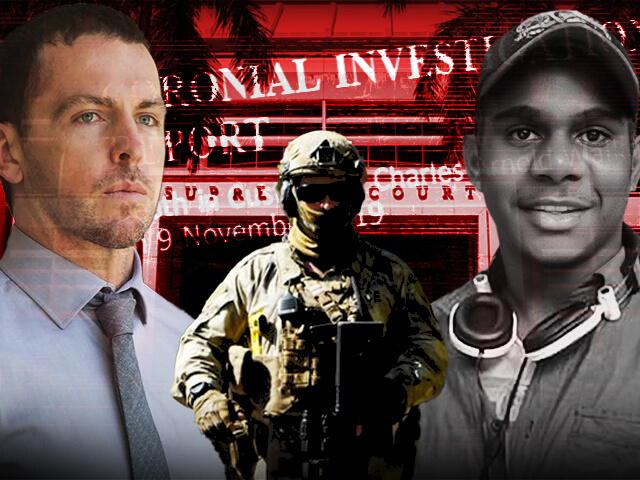
EXCLUSIVE: Kumanjayi Walker would “most likely” still be alive had NT Police followed proper training and policies in Yuendumu the night of November 9, 2019, a damning internal draft coronial report the Police Commissioner tried to suppress from the public, but obtained by the NT Independent, concluded.
The report found that the Immediate Response Team members called into Yuendumu did not have a designated leader, were guided by poorly drafted governing policies and procedures – no active operation plan – and that the members who responded had armed themselves with whatever firepower they felt they needed, including military-style automatic rifles, without adhering to standard police procedures.
It was also revealed that the IRT members dispatched that night had not completed their requalification training, with the last session occurring 19 months before the Yuendumu shooting.
The lapses of judgment, shocking failings of police protocol and miscommunication were laid bare in the report.
“A planned response, with a suitably experienced team leader in place, would have most likely avoided the death of Walker from occurring,” the report stated.
“The operations of the IRT were suspended by the Northern Territory Police following the death of Walker and are now subject to review.”
The report obtained by the NT Independent is understood to include draft findings from Superintendent Scott Pollock before he was controversially removed from the role of Commissioned Officer in Charge of the Coronial Investigation into the death of Mr Walker, with his findings ultimately suppressed from the public.
Police Commissioner Jamie Chalker had withheld the Pollock report from the public and Constable Zach Rolfe’s defence team, with its existence only being made public after a tip-off to the defence team last year.

The prosecution had made an application to the courts for any references to the Pollock reports – and claims the commissioner intentionally withheld them – be suppressed from being reported by the media before the murder trial, with a lawyer for Mr Chalker later refuting that “something nefarious has gone on”.
The report’s findings are scathing about how the Immediate Response Team functioned and the lack of policies around its operations, with the group painted as a cowboy outfit whose members had developed a “warrior mentality” and had no interest in conflict resolution.
The IRT was established in 2017 to give the NT Police’s Southern Command the capability to respond to serious incidents, specifically when the Territory Response Group was not available, made up of general duties officers who happened to have other training. But it was not intended to be used for “high-risk” operations, which the arrest of Mr Walker was later classified as.
“Once the IRT SOP (Standard Operating Procedures) was ratified in 2017, it became apparent that strict adherence to the SOP was not maintained,” the report stated.
Former assistant commissioner Narelle Beer was highly critical of the IRT and its lack of standard operating procedures in the report.
“There is no overarching policy that establishes the functionality, objectives, or scope of the IRT … Based on the lack of apparent governance, consultation, and promulgation of these procedures (and in the absence of any specialist skills, abilities or expertise …) I cannot evidence base appropriate rigour around the development of these SOP’s,” she said.
The report found that while the IRT members were recommended to take in five days of supervised training by the TRG every year, it had been 19 months since any requalification training had occurred.
The poorly drafted standard operating procedures stated that “each IRT member must requalify” every six months for different tactics including range shooting and “close quarter tactics”.
“The training records for IRT members appear to have been poorly maintained,” it stated.
“The IRT training records indicate that this annual training requirement was conducted once in April 2018 and not at all in 2019.
“If this is the case then no IRT member in Alice Springs would have been qualified under the SOP’s and therefore all would have been unavailable for selection for IRT duties at the moment in time when the IRT were deployed to Yuendumu in November 2019.”
The poorly maintained training records showed Constable Rolfe had five training attendance dates recorded between 2017 and 2019, “when he was rostered to attend IRT training every five weeks”. Records appeared to show he had completed an “IRT qualification shoot” on July 13, 2019, but TRG did not assess that or validate it.
While the report concluded the IRT should not have been deployed to Yuendumu, Assistant Commissioner Travis Wurst and Superintendent Jody Nobbs deployed them anyway, with both men admitting they did not understand how the group functioned and neither had identified Kumanjayi Walker as a dangerous offender, despite him having charged at police three days earlier with an axe.
The draft coronial report also found that the NT Police’s procedures for incidents involving dangerous offenders – known as “ICENCIRE” were not followed the night of November 9, 2019 when Constable Zach Rolfe and Constable Adam Eberl approached house 511, that contained Kumanjayi Walker.
“With Walker’s family members present there was an ideal opportunity to properly call in all members to cordon the house and negotiate the (then unknown) male from the premises,” the report stated.
“By entering the premises in haste both Constable’s Eberl and Rolfe place themselves in a situation best described as ‘officer created jeopardy’.
“This action was not consistent with IRT training or the ICENCIRE model. A planned response, with a suitably experienced team leader in place, would have most likely avoided the death of Walker from occurring.”
The report also highlighted repeatedly how the Yuendumu health clinic had been closed earlier that day following a spate of break-ins in the town, incorrectly attributed to Mr Walker, and that the IRT had been informed of the closure.
A medical expert said in another report, referenced in the draft coronial report, that Mr Walker “might have survived his wounds” had the clinic been opened with nurses but added that “this is not certain”.
Communication Failures and ‘warrior mentality’
The draft coronial report found the IRT members were not clearly instructed on what weapons to take with them to Yuendumu to arrest Mr Walker and that a proper operational plan was not provided to them before they left Alice Springs.
“…Their mission was to simply arrest Walker,” the report stated.
“The rationale and purpose behind their ‘general duties’ deployment was lost. The message from Superintendent Nobbs to take their ‘full kit’ [of weapons] was also not passed on to the extent that the IRT members took whatever equipment they felt necessary with Constable Eberl electing to not even take his taser.”
Under NT Police general orders relating to operational safety training and procedures, all officers “must carry a [taser] whenever they carry a firearm”.
Instead, the IRT members hand-picked whatever arsenal they felt like, with some taking military-style AR-15s to the remote community.
The report also made specific reference to concerns about the “para-military” attitude the IRT adopted in 2017, when its previous incarnation, the “Cordon and Containment Team” ceased operations.
“The IRT adopted a para-military role focussing on weapons training and tactics …” the report stated.
“The IRT did not train or deploy with negotiation in mind but rather adopted a mission orientated ‘warrior mentality’.”
Deploying the team with military-style weapons was identified as an “extreme response in the circumstances, particularly when they have been given the specific instruction to wear their regular uniform”.
“Carrying exposed weapons in a remote community without justification was a classic military type response to a possible enemy threat. In ordinary policing circumstances a drawn firearm requires a member to submit ‘use of force’ documentation under existing policy … (However there appears to be an anomaly in policy where a member can carry an exposed ‘long-arm’ weapon in a community environment without any requirement to justify their action).
“There was no apparent justification for police in Yuendumu to be carrying an exposed military type weapon at the time, particularly in an area where women and children had gathered.”
When questioned about why police had the automatic rifle by Yuendumu resident Leanne Oldfield prior to the shooting of Mr Walker, Constable Eberl replied: “We don’t have a holster for that one so we have to carry it, so, someone probably shouldn’t run at police with an axe, hey”.
Immediate Response Team’s lack of leadership a ‘major failing’
Of the 39 deployments of IRT members since 2017, only nine had a team leader assigned to them.
The report found that both the officer in charge of the IRT and the second in command were on leave at the time of Mr Walker’s death.
“Deploying the IRT to Yuendumu to arrest a high risk offender without a nominated senior officer in charge was a major failing,” the report stated.
“The IRT should not have been deployed from Alice Springs on such a high risk operation without at least consulting a TRG team leader and with a prepared arrest plan in place.
“Ordinarily the most senior member of the group would assume this responsibility by virtue of seniority of rank. In this case that was Constable First Class Anthony Hawkings. Hawkings stated in interview that while no-one was specifically appointed as team leader Rolfe provided the briefing around the arrest of Walker stating to the team; ‘there’s not much … intel that we’ve been given’.”
The draft police coronial report concluded that “accountability for approving the IRT deployment to Yuendumu rests with the (then) Acting Assistant Commissioner (Wurst) and Divisional Superintendent (Nobbs)”.
“While now one of those members ultimately faces a murder charge the reality is they should never have been deployed as an IRT by their superiors without strict protocols in place for the apprehension of a ‘high risk’ offender,” the draft coronial report stated.
A three-month coronial inquiry into Mr Walker’s death will begin on Monday September 5.
Constable Rolfe was found not guilty of murder in the death of Mr Walker in March.


0 Comments