

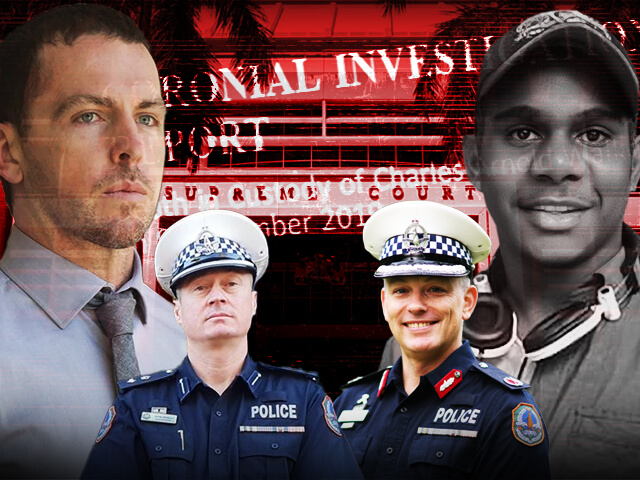
EXCLUSIVE: A draft coronial report prepared by the NT Police and obtained by the NT Independent has revealed the shocking extent of police failures in the hours before the shooting death of Yuendumu man Kumanjayi Walker in November 2019, including that two of the senior officers in charge of deploying the taskforce that raided his home did not understand how the Immediate Response Team functioned nor how it should be deployed.
The report concludes those senior officers, Assistant Commissioner Travis Wurst and Divisional Superintendent Jody Nobbs, should never have deployed the IRT “without strict protocols in place for the apprehension of a ‘high-risk’ offender”, while the report at another point stated that IRT should not have been deployed at all.
The document is understood to be a later draft of a report by Superintendent Scott Pollock investigating the death of Mr Walker for the coroner, a death which will be the subject of a three month coronial inquiry beginning on Monday.
Supt Pollock was designated the Commissioned Officer in Charge of the Coronial Investigation three days after Mr Walker was shot and killed by Constable Zach Rolfe – who was part of an IRT mission – during a failed arrest, in a house in Yuendumu on Saturday, November 9, 2019.
But Supt Pollock was later controversially removed from the role before he could finish. Some of the sections of the report are redacted with claims of legal privilege, and it comes with an annotation that Commander David Proctor was officially delegated the role on August 10, 2020. The document quotes from the Constable Rolfe committal hearing which finished in the first week of September 2020.

The Rolfe defence team alleged Supt Pollock was stopped from completing the report by then-Assistant Commissioner Nick Anticich, the document was then “seized” and edited by the officer in charge of the criminal matter, Detective Acting Superintendent Kirk Pennuto, and purposely suppressed by Police Commissioner Jamie Chalker. They subpoenaed it after they learned of its existence sometime before May 2021.
The report found Yuendumu officer-in-charge Sergeant Julie Frost requested ‘specialist’ extra officers from Supt Nobbs in Alice Springs to assist with general police work because of officer fatigue, but also to arrest Mr Walker who had broken out of a alcohol rehabilitation facility at the end of October, and had run at two local police officers in a house with an axe when they attempted to arrest him three days earlier.
Sgt Frost had agreed with Mr Walker’s family to allow him to attend a family funeral on the Saturday, and then hand himself in, but had made a back-up plan to arrest him at 5am on Sunday morning, with the help of a local officer who knew him and the IRT.
READ: Chalker involved every day after Walker’s death leading up to Rolfe’s charging, documents show
READ: Analysis: Public inquiry into Walker-Rolfe affair needed as ICAC office implicated too
The IRT is a part-time unit, which draws from a pool of up to 16 more specially trained Alice Springs general duties officers selected with a preference for having military backgrounds, who volunteer when needed for special deployments, especially when Territory Response Group officers from Darwin cannot be deployed in time.
Four of the IRT went to Yuendumu: Constable Rolfe; Constable First Class Anthony Hawkins; Constable First Class Anthony Eberl; and Constable James Kirstenfeldt. Along with non-IRT dog handler Senior Constable First Class Adam Donaldson.
The report said the request was also made in the context of health staff saying they were leaving the town because of home break-ins, including the home of at least one nurse, and the report states Supt Nobbs sought approval from Mr Wurst to sanction the use of the IRT based on Sgt Frost’s mistaken belief Mr Walker was responsible for the break-ins.
“No request for a trained negotiator to accompany the IRT was made or considered at the time,” the report said.
Constable Rolfe was charged with murder four days after the shooting, which police investigating the shooting expressed grave concerns about because the brief of evidence was not finished, and they also questioned the early and pressing involvement of the Department of Public Prosecutions.
Constable Rolfe was acquitted of murder, manslaughter and engaging in a violent act causing death by a Supreme Court jury in May this year.
Weeks later, the Independent Commissioner Against Corruption Michael Riches announced he would investigate allegations of political interference in the charging of Constable Rolfe, a claim which has been denied by Mr Chalker and then-Chief Minister Michael Gunner.
‘High-risk offender’: The fatal failures in the deployment of the IRT
The operations of the IRT are prescribed in the standard operating procedures, which was formulated in 2017, and the force was established to give the NT Police’s Southern Command capability to respond to critical incidents where tactics of ‘cordon, contain and negotiate” had failed, the TRG was not available, and where an urgent police response is required to prevent loss of life or serious injury.
However, the report said, they do not require a detailed risk assessment for an arrest target prior to deployment, if it is of a general duties nature, and the senior officer should never have deployed the IRT “without strict protocols in place for the apprehension of a ‘high-risk’ offender”.
“An independent risk assessment was conducted on Walker, post death, and he was classified as a ‘high-risk’ arrest target,” the report said.
“As such the IRT should not have been deployed without the consultation of a TRG tactical commander…
“The IRT policy states that ‘planned high risk operations are the responsibility of the TRG’.
“It is evident that Walker, with alerts against his name warning that he may try to escape, may be suicidal and may use violence, was always going to be considered a high-risk candidate for apprehensions and, therefore, planning for a possible high-risk episode should have been mandatory….”
The report said the IRT also should not have been deployed without a designated team leader or prior to a prepared operational order.
“The behaviour Walker demonstrated towards police in the days proceeding his death, combined with his status of an absconding felon and known propensity for violence, warranted a high level response that should have included an appropriate risk assessment,” the report found.
“The accountability for approving the IRT deployment to Yuendumu rests with the (then) Acting Assistant Commissioner (Wurst) and Divisional Superintendent (Nobbs), neither of them seemed to have knowledge of the details contained in the SOP (Standard Operating Procedures) required for a planned high-risk deployment.
“In this regard the IRT SOP is clear; ‘Planned high-risk operations are the responsibility of the TRG. Any requests to the IRT for support in a high-risk planned operation must be referred to the OIC TRG who can then make the appropriate assessment of the task and the risks, and determine the role of the IRT in operation’.”
Wurst had never read deployment protocols, Nobbs read them once
The report stated that Mr Wurst had said he had never seen the standard operating procedures for the IRT, and Supt Nobbs said he had read the document when he had started in the job, which he said in the Supreme Court trial was about two and a half years before the shooting.
Reproduced in the report is the content of a statutory declaration signed by Mr Wurst showing an interview exchange with him and an investigator about his knowledge of the IRT SOP.
“Are you aware of any, um, standard operating procedures or policy with regards to the IRT?” a police interviewer asked.
“Ah, I know that when I left it was being developed…and I don’t know what happened post my departure from Alice Springs,” Mr Wurst responded.
“Have you seen any SOPs or any drafts of SOPS since then?” the interviewer asked.
“No,” Wurst responded.
“To your knowledge how are IRT deployed, i.e. what is the process?”
“Well I couldn’t give you any great detail,” Wurst said. “Ah, other that I can only assume now with my knowledge, that they, it requires commander approval for deployment based on a…on a need..”
The report then reproduced the contents of a statutory declaration signed by Supt Nobbs with an exchange between him and the same investigator.
“And you mentioned, um, SOP, standard operating procedures with regard to the IRT, um, how familiar are you with those?” the interviewer asked.
“Look, when I first got here, I think the first deployment, I had to look at it, um, but to, to be honest, I haven’t looked at it since then, other than post this event, um, so I, I was familiar enough to, to satisfy myself that, I had a good understanding of what a deployment looks like in terms, or um, level of authority um etc,” Supt Nobbs said.
“…Member welfare, community confidence, community safety, are subjectively serious, or matters that are political, environmental and internally serious,” he is quoted as saying.
“While I certainly don’t constrain or link the term critical incident to high-risk incident in isolation, I recognise that a high-risk incident will more often than not be considered a critical incident and equally that there is generally a heightened sense of urgency attached to an event while I utilise the term,” he is quoted as saying.
In another exchange he refers to Mr Walker being a high-risk arrest.
“How would you describe the um, the risk level of Mr Walker as an arrest target?” the interviewer asked.
“Certainly a, a, high-risk ah target, um, but yeah, particularly in the context of ah, this engagement, with police on Wednesday [the axe attack], it’s, it’s clear it’s high-risk ah and it was on that basis that we established the mitigations around that to mitigate that risk.”
The report found that during her committal hearing evidence, Sgt Frost gave the reason why she wanted to arrest Mr Walker early in the morning, as being “a safer time for a high-risk arrest.”
The report went on to state that had Supt Nobbs properly assessed the arrest of Walker as a ‘high-risk’ incident he would have been aware that TRG assistance would then be required and that the IRT would not have been an option.
In his testimony to the Supreme Court Mr Wurst said he had approved the deployment after a 10 to 15 minute conversation with Supt Nobbs but had actually not looked up Mr Walker’s criminal history in the NT Police PROMIS system, despite having been told of the axe attack on the day it happened. He said he did not watch the vision of that attack until after Mr Walker shot.
Legal argument over the Pollock report
In early June last year, Justice Dean Mildren rejected a move to ban the publication of allegations Mr Chalker and senior executive members intentionally withheld evidence from the defence team and the DPP in the Rolfe murder case.
The DPP moved for the suppression order after allegations were made by the defence that the Pollock report was “seized” and “edited” by police and later “buried”.
Constable Rolfe’s lawyer David Edwardson told the court that coronial reports compiled by Supt Pollock would refute evidence expected to be given by the prosecution’s star witnesses, use of force experts, Professor Geoffrey Alpert from the United States, and the NT Police’s own Detective Senior Sergeant Andrew Barram.
Mr Edwardson said the reports were not provided to the defence team until they became aware of them and subpoenaed the reports, which were handed over in part not long before the hearing, with large sections redacted.
He said Mr Chalker had refused “not only the existence, but also the production of these materials on the basis that we could not demonstrate a legitimate forensic purpose”.
“Not only was there a legitimate forensic purpose, but patently they should have been disclosed, they should have formed part of the prosecution brief, and Mr Pollock should be a witness who’s presented by the DPP as a matter of fairness to the accused,” Mr Edwardson told the court.
He said that Mr Pollock had considered reports made by the prosecution’s two expert witnesses and had set out in his own report for the coroner “why those expert opinions were misconceived, ill-informed and wrong”.
“But it gets much worse than that. Assistant Commissioner [Nick] Anticich, it would seem, who was instrumental in the charges preferred against my client, is the person who ultimately stopped the progression of that report because it was inconsistent with the case that they wanted to present, that is, the prosecution case.”
Crown prosecutor Sophie Callan made an application to the court for any references to the Pollock reports – and claims that they were intentionally withheld – be suppressed from being reported by the media due to concerns it could taint a potential jury in the trial.
Mr Edwardson further said that the Pollock reports for the coroner that were in draft form were “seized” and edited by the officer in charge of the criminal matter, Kirk Pennuto.
“The coronial inquiry was the province of Mr Pollock, who created the report or the draft reports, they were then seized by Mr Pennuto, and it’s Mr Pennuto who then sought to try and, as it were, edit the Pollock reports,” Mr Edwardson said.
Justice Mildren rejected the prosecution’s argument for suppressing the publication of the details presented in court.
Ms Chalmers refuted claims that Mr Chalker had intentionally withheld the reports.
“That’s simply not the case,” she said. “The assertion is refuted to the extent that there’s a suggestion that something nefarious has gone on.”


0 Comments