

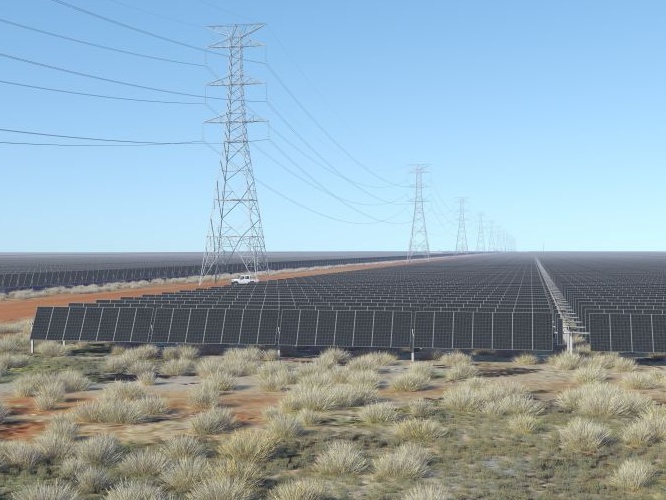
The Finocchiaro Government is proposing six solar power plants and a battery to produce electricity to be built by the private sector near Berry Springs.
In late June the Northern Territory’s independent electricity regulator, the NT Utilities Commission, released its annual Electricity Outlook Report, which said the electricity system was in a “prime but precarious” position and there would be blackouts within four years unless there was large spending in infrastructure, with one of the main problems being the pending retirement of the ageing gas-fired generators at the Channel Island power station near Darwin.
“Without timely solutions to address the expected retirement of 185 megawatts of generation capacity … customer demand may not be met within four years,” the report said.
NT Renewables Minister Gerard Maley said the solar project would help provide more affordable, secure and cleaner energy for households and businesses on the Darwin-Katherine electricity system, with its development anticipated between 2025 and 2030, pending a final investment decision.

He said there would be six large scale solar farms, producing between 180 and 210 MW of energy, accompanied by a battery of undisclosed size, all located on 940 ha of Crown Land, about 19km south of Palmerston and 4km north of Berry Springs.
The development area within the proposed site is approximately 500ha.
“A key priority of the government is economic development through job creation, and this project represents a considerable injection into the Territory’s economy. It is expected to generate over $400 million in local supply chain spending during construction and large-scale private investment in generation and energy storage,” Mr Maley said.
“It is great for the economy and great for the environment, but the Darwin REH [renewable energy hub] will also enable enhanced energy security and grid resilience, as well as place downward pressure on electricity bills.”
Mr Maley said the proposed site for the hub had been identified as being for industrial use under the Darwin Regional Land Use Plan, but the government was holding consultations to provide information about the project and to allow the public to provide feedback.
He said the final project design and final investment decision will be informed by the feedback.

Four solar plants built by private companies, one each at Manton Dam and Katherine, and two at Batchelor, sat idle for about four years, with the government not connecting them to the grid, and with former chief minister Eva Lawler saying the government would consider buying them.
The last media reporting on them was done in February by Sky News which said three of the stations were connected to the Darwin-Katherine electricity system late last year, but two were not yet providing power, while the other was running at just a quarter of capacity.
The Sky News report said the grid was unable to handle the intermittent power supply, and that the company that owns the three stations, Italian business Eni, had been told by the government to resolve the issue. Another solar plant at Batchelor is owned by Melbourne-based Merrick Capital, but it remains unclear if that is connected.
The government has not publicly provided an update on whether they were producing electricity.
In June the Federal Government announced $250 million in renewable energy spending for the Northern Territory, and while it was not specified exactly how it would be used, the Australian Conservation Foundation said it expected it would in part go toward connecting those solar plants to the grid.

Utilities Commissioner Lyndon Rowe told the ABC in June there needed to be a large amount of public and private investment in the electricity system to “make sure the lights stay on”.
“It’s a message we’ve been giving for a number of years now,” Mr Rowe was quoted as saying.
“We take a little more comfort in the past 12 to 18 months that there’s been some more action. But the commission’s view is that we don’t have a lot more time.”
The Utilities Commission said there needed to be more investment to reach the NT Government’s target of 50 per cent of electricity generated from renewables by 2030.
The Climate Council of Australia’s September report, titled “Race to the Top: Australia’s Clean Energy Momentum,” said the NT was sourcing just 6.7 per cent from renewable sources, compared to the Australian Capital Territory’s 100 per cent, Tasmania’s 98 per cent, South Australia’s 74 per cent, Victoria’s 40 per cent, New South Wales’s 36 per cent, Queensland’s 27 per cent, and Western Australia’s 18 per cent.
The NT has three separate regulated networks, the Darwin-Katherine interconnected system, the Alice Springs power system, and the NT is not linked to the National Electricity Market.
Several other large scale solar projects are also underway in the Territory, notably, Sun Cable’s Australia-Asia PowerLink, which aims to produce between 17GW and 20GW of solar capacity and connect Australia to Singapore through a 4,300km subsea cable.
It recently received government approval.
Public consultation for the proposed solar plants will close at 5pm on Friday, February 28.


That might work for 6 hours a day. You will need at least 4 times the generation that you are replacing. The battery bank won’t fill in all of the hours that the sun doesn’t shine unless it holds 18x the 150 Mwatts that it is replacing.
Given the amount of available gas in the NT we should be looking at making sure we have base load power as a solar farm won’t work when we have monsoon conditions.