

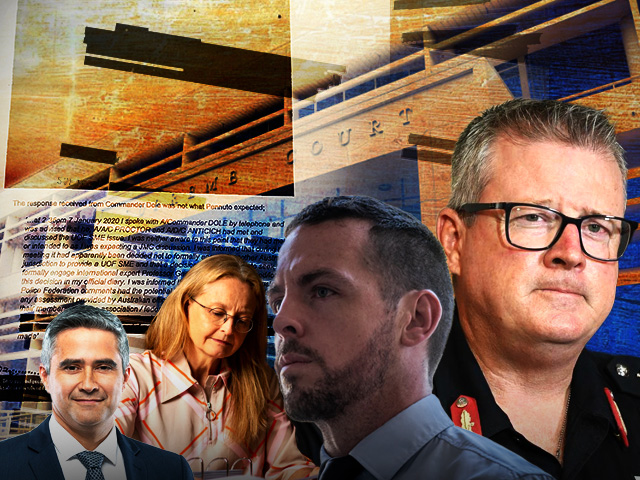

EXCLUSIVE: A damning coronial report that NT Police Commissioner Jamie Chalker attempted to hide from the public for more than a year and a half has been obtained by the NT Independent with previous redactions lifted, that shows detectives building the murder case against Constable Zachary Rolfe ignored legal advice from the Office of the Director of Public Prosecutions in their pursuit to lay a murder charge.
Excerpts from the Proctor report that were previously redacted have raised serious questions about the integrity of the NT Police’s investigation, the Office of the DPP and Coroner Elisabeth Armitage’s ongoing inquest into the death of Kumanjayi Walker.
The NT Independent previously reported on partial findings of Commander David Proctor and Superintendent Scott Pollock’s draft reports, but those were redacted with critical information suppressed under claims of “legal professional privilege” by Mr Chalker that has now been revealed for the first time.
It shows that senior police investigators collected evidence from use-of-force experts “contrary to the advice provided them by the DPP” and that “critical decisions” about the investigation were made by senior officers outside of official joint management committee meetings and not recorded in accordance with proper procedures.
The unredacted report also shows that Mr Chalker’s office directly influenced a “critical decision” to use a compromised use-of-force expert against legal advice, adding further evidence of Mr Chalker’s involvement despite his repeated claims he was not involved in the murder investigation.

The existence of the Pollock/Proctor report was first discovered by Constable Rolfe’s defence team in May 2021, two months before the trial was set to begin, issuing subpoenas for the secret documents.
Mr Chalker, who had not disclosed the existence of the draft report, then moved to have sections redacted before releasing it to Constable Rolfe’s defence team, under the auspices of “legal professional privilege”, however, it is unclear how Mr Chalker could enact that when it was the Office of the DPP that had provided the advice.
The now unredacted final report, dated August 2021, was ultimately received and viewed by Coroner Elisabeth Armitage ahead of her coronial inquest that started last September, although no mention of its redacted critical findings have been raised during the inquest, despite senior figures involved having provided evidence.
Legal arguments ensued last September over why the other legal parties to the coronial were not permitted to view the unredacted version, with Ms Armitage acquiescing – after Mr Chalker suggested through his lawyer Ian Freckelton that he had “waived privilege” – and later releasing it to the parties at the coronial, but not publicly, for unknown reasons.
The NT Independent’s documents did not come from a party to the proceedings.
Under the section of a previously obtained draft coronial report entitled “Investigative Bias”, the NT Police executive redacted the entire contents of an email from Acting Superintendent Kirk Pennuto to “the Overall Investigator in Charge of the Operation Charwell”, understood to be then-assistant commissioner Nick Anticich, in which Supt Pennuto provides the “advice” he had received from then-deputy director of public prosecutions Matthew Nathan.
The now unredacted email, dated January 6, 2020, was written as police were frantically attempting to secure use-of-force expert witnesses to build their murder case, and shows that then-deputy Director of Public Prosecutions Matthew Nathan held grave concerns about using NT Police Senior Sergeant Andrew Barram because “his experiences in the area of fatal police shootings cannot compare with those of his contemporaries”.
The email went on to relay calls for an “independent” use-of-force expert review to be conducted by someone outside the NT, but still in Australia, with Mr Nathan reportedly telling Supt Pennuto that “such a review will only be of meaningful value if conducted by a current practitioner who has worked in a similar context, risen through the ranks and now reviews UOF whilst being actively involved in UOF policy/training within Australia”.
“Mr Nathan is also of the view that an interstate review is necessary to support any work undertaken by D/S/Sgt Barram (regardless of the position he ultimately adopts at the end of his review)”, the email stated, adding that Mr Nathan was concerned about Barram coming “under hostile attack in any cross examination”.
However, the document reveals that investigators did not approach anyone interstate for independent expertise despite being given names, and appear to have relied on Mr Chalker’s office to find a suitable expert.
Sgt Barram, who was “ensconced” in the investigation unit, later produced a report that was critical of Constable Rolfe’s firing of the second and third shots on the night he killed Mr Walker and was ultimately used as the prosecution’s star use-of-force witness at the trial.
Another senior officer had also raised a “conflict of interest” in using Sgt Barram as the use-of-force expert early on because of his closeness to the investigation, while the report also found the “pressure” put on him was done in haste and “potentially compromised his integrity”.
Mr Nathan resigned suddenly from his role in the Office of the DPP along with former director Jack Karczewski in June 2021, weeks before the murder trial was originally slated to start.
Mr Nathan did not respond to questions for this story, including why investigators and the prosecution ultimately used Sgt Barram against his advice.
Mr Anticich, who led the criminal investigation, also announced his resignation from the NT Police the same month, after taking extended leave, but it was reported that he would be staying on through the trial.
Sgt Barram’s evidence at the trial last year that Constable Rolfe should have subdued Mr Walker with his hands after he stabbed Rolfe in the shoulder and was wrestling with his partner on the floor, was refuted by former AFP assistant commissioner Ben McDevitt, who had nearly 40 years of police service and had formulated the de-escalation model of training the NT Police use, who told the court that Sgt Barram’s testimony was “ludicrous” and “goes against the very training … that apparently Sgt Barram has given to so many officers”.

International ‘expert’ brought in to secure murder trial against DPP’s advice; Chalker’s chief of staff told investigators Barram was only ‘expert’ available in Australia
Mr Nathan, in his role as deputy DPP, also reportedly told senior detectives that bringing in an international expert “would be very informative in the Coronial setting, [but] in the criminal court this is a large risk to the prosecution”, for reasons including that an international expert would not understand the local context, would have “relevancy” issues and would be “portrayed as an ivory tower academic”.
Nevertheless, senior police held a secret meeting the same day to hire US-based professor Geoffrey Alpert as an international use-of-force expert. Previously blacked-out notes in the Proctor report show an email from Pennuto, in which he said he had shared the DPP’s view with Commander Martin Dole but that Cmdr Dole and Mr Anticich – along with Cmdr Proctor – had met and determined “not to formally approach another Australian jurisdiction to provide a UOF SME (subject matter expert)”.
“Despite a number of highly regarded police ‘Use of Force’ experts from within Australia being nominated to Pennuto no attempt was made to engage them due to public comments made by the Police Federation of Australia that they were supportive of Zachary Rolfe’s behaviour,” the previously redacted section of the report stated.
“Instead a critical decision was made to engage an overseas expert, contrary to the advice of DPP.”
That statement carried a previously redacted footnote which stated that “this critical decision was not recorded on [police database system] PROMIS”. It was unclear how a note about not recording a “critical decision” could be redacted under legal professional privilege.
Commander Dole, a senior officer in the criminal investigation who had deep ties to Mr Walker’s relatives, was told by Jamie Chalker’s chief of staff “Commander O’Brien” that he had “received information that other Australian Law Enforcement Jurisdictions may also be problematic” for obtaining a use-of-force expert, the report shows.
Cmdr O’Brien reportedly based this opinion on the national union’s stated support of Constable Rolfe after he was charged and that NSW Police had allegedly denied a request from Mr Chalker’s office for a use-of-force expert. It appears no other jurisdictions were contacted.
However, the Proctor report discounted the claims from Mr Chalker’s office that the Police Federation of Australia had influenced the opinion of use-of-force experts across the country, finding the claim was “unfounded”.
“Clearly Detective Senior Sergeant Barram was not averse to provide his impartial ‘expert’ opinion despite being a member of both the Northern Territory Police Association and the Police Federation of Australia,” the report concluded.
Despite being told not to use Sgt Barram or an international expert, both played critical roles for the prosecution in securing Constable Rolfe’s committal to stand trial for murder, which a Supreme Court jury ultimately found him not guilty of in March of last year. The report had found both were not given all of the facts of the case before finalising their respective reports.
“…It is difficult to accept that either Barram or Alpert could claim their ‘neutrality’ as an expert,” the report stated.
“Barram was firmly ensconced within the investigation team and Alpert was contracted to provide evidence by the NTPOL executives who formed part of the Operation Charwell (Rolfe) investigation and who approved his selection … contrary to the advice of the DPP.
“Not surprisingly both Barram and Alpert provided identical opinions given access to the same restricted information.”
Prof Alpert and Sgt Barram both arrived at the same conclusion and worded their reports similarly that “the firing of shots 2 & 3 in rapid succession at Walker was not justified because it was not reasonable, necessary, proportionate and appropriate in the circumstances”.
The NT Independent previously revealed that Prof Alpert’s report had been “edited” by investigators to suit their narrative and that taxpayers paid more than $100,000 for his report that was used only at the committal hearing and not at the murder trial.
Prof Alpert also is not listed as a witness in the ongoing Coronial Inquest into the death of Kumanjayi Walker, despite the DPP’s suggestion that he could be used in that setting.
Counsel Assisting the Coroner Peggy Dwyer refused to say why he was not on the witness list or if she acknowledged that his report was compromised, and if so, why that had not been mentioned at the inquest.
Barram presented to Coronial Inquest as ‘expert witness’ despite report and discounted testimony at trial
Ms Dwyer, who has also seen the unredacted Proctor Report, interrogated Sgt Barram on November 18, 2022 as part of the Coronial Inquest, in which she referred to him as an “expert witness” without mentioning that the Office of the DPP had advised police not to use him because he was unqualified.
Ms Dwyer instead sought to establish Sgt Barram’s qualifications at the inquest, having him reject the assertions that he was unqualified because the training he was knowledgeable in was obsolete and encouraged him to provide his previous evidence to the inquest. He also denied being a part of the investigation and ever having attended a meeting in Yuendumu between police and Walker’s family.
Despite the police investigation into Constable Rolfe being listed as a topic to be explored at the inquest, the redacted sections of the Proctor/Pollock report have not been addressed to date despite witnesses with knowledge already providing testimony.
Ms Dwyer refused to say why the issue has not been raised and had another lawyer warn the NT Independent about publishing the information contained in the unredacted report.
Mr Proctor was not asked about the previously redacted sections during his evidence, with counsel assisting suggesting to him that Sgt Barram was a suitable witness.
According to the NT Coroner’s Act 1993, if the Coroner determines during an inquest that any illegal conduct has occurred, she is not permitted to include it in her final public report and must refer the issue to the Director of Public Prosecutions and the Police Commissioner.

0 Comments