

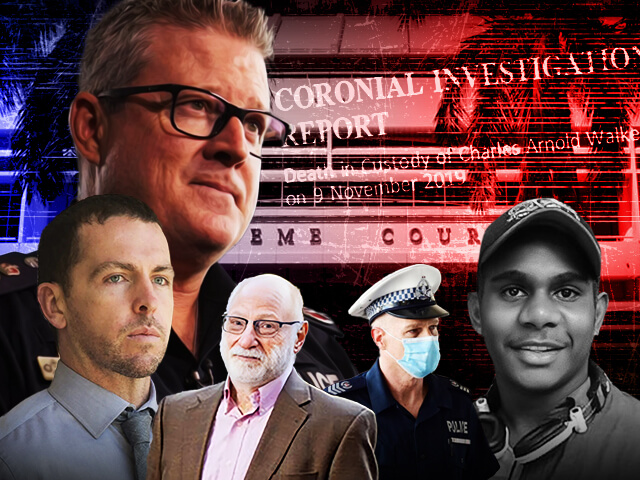
EXCLUSIVE: Police Commissioner Jamie Chalker and the DPP were aware the star witness at the murder trial of Constable Zach Rolfe had his integrity “compromised” by investigators, had involved himself in the investigation due to “pressure” exerted by unknown parties and was found not to understand the law around use of force, but they put him on the stand at the jury trial anyway, according to an internal coronial report Mr Chalker attempted to suppress ahead of the trial.
The draft police coronial report, recently obtained by the NT Independent, also shows that an American use-of-force witness that helped the prosecution team secure the murder trial at the committal stage had also not been given all the facts relating to the shooting death of Kumanjayi Walker before forming his “expert” opinion that was “corrected” by investigators building the case against Constable Rolfe.
Further shocking details in the report show that investigators blurred the lines between a criminal investigation and a coronial investigation, with police using coronial powers to threaten witnesses to build their murder case, resulting in a “confused approach to obtaining evidence” that should be “reviewed” and prevented from happening again.
The coronial report was compiled in part by Superintendent Scott Pollock before he was controversially removed by the police executive from investigating the police response to the shooting death of Kumanjayi Walker, allegedly for being critical of the investigators’ use of compromised witnesses.

Senior Sergeant Andrew Barram, who had trained recruits at the NT Police College which was earlier found not to have adhered to Australian standards, was the star use-of-force witness at the murder trial of Constable Rolfe, with Sgt Barram testifying that Constable Rolfe was not justified in firing the second and third shots at Mr Walker while he was struggling on the floor with Constable Rolfe’s partner Adam Eberl.
In his statement to investigators Sgt Barram concluded that “the firing of Shots 2 & 3 in rapid succession at Walker was not justified because it was not reasonable, necessary, proportionate and appropriate in the circumstances having regard to the Force Philosophy.”
However, the report found that Sgt Barram had misunderstood legislation, including relating to the “legal justification for police to resort to the use of firearms”, which the report found was “remarkable” given his role as the officer formerly in charge of Operational Safety and Tactics Training at the Police College.
The report stated that Sgt Barram’s flawed interpretation of the law around use of force, referencing material in his statement that was “archaic and ha[d] been replaced”, shockingly indicated that he had not trained police recruits properly.
“Of concern is that since the introduction of Section 208E in 2006 all police, including Constable Zachary Rolfe and his fellow recruits, did not receive any contemporary training regarding this important piece of legislation specifically relating to law enforcement officers,” the report concluded.
“This is in contravention to what is mandated in the Australia, New Zealand Police Advisory Agency (ANZPAA) Use of Force (UOF) principles.
“…There is the potential for the embarrassment for any charged individual and for the NTPF in any coronial investigation when members’ training is examined.”
The report found that Sgt Barram’s claims, on top of being based on incorrect information, were also subject to “confirmation bias”, however were blindly accepted by the investigative team.
“There was no challenge or peer review by investigators conducted on the statement of Barram. It was accepted as reliable without being subject to any scrutiny by investigators,” the report stated.
It also found Sgt Barram was pressured to testify by unknown parties in the police, which “potentially compromised his integrity”.
“The pressure brought to bear on him to provide his ‘expert’ opinion was done so in haste and, similar to [American use-of-force expert] Professor [Geoffrey] Alpert, prior to all available and relevant evidence, including possible exculpatory evidence, being made available to him for consideration,” the report found.
“The pressure placed upon Barram was compounded when he was required to form part of a visiting police delegation to Yuendumu on 5 December 2019. This police delegation, which included the Assistant Commissioner Crime and Integrity ([Nick] Anticich), Commander Crime ([Martin] Dole) and the Senior lnvestigator, Acting Superintendent [Kirk] Pennuto, met with a ‘select committee’ answering questions from family regarding aspects of the investigation. It was highly inappropriate for Barram to attend a meeting of this type and it potentially compromised his integrity and independent status as an ‘expert’ by doing so.”
The officers mentioned in the report were working to charge Constable Rolfe within hours of the shooting as part of “Operation Charwell”.
It was also later revealed in news reports that Martin Dole was like a “little brother” to Mr Walker’s grandparents, but was somehow allowed to have his name on the murder indictment against Constable Rolfe.
The coronial draft report is understood to be a late draft of a report by Superintendent Scott Pollock into the death of Mr Walker, but it comes with an annotation that Commander David Proctor was later officially delegated to the role of officer in charge of the coronial investigation, controversially replacing Supt Pollock in August 2020.
The version obtained by the NT Independent was circulated within the police executive after Constable Rolfe’s committal hearing.
Professor did not have ‘all the facts’, had report ‘corrected’ by investigators
A report prepared by American use-of-force expert Geoffrey Alpert from the University of South Carolina that was also critical of Constable Rolfe’s actions was used at the committal hearing to find him fit to stand trial for murder but Prof Alpert was inexplicably never used at the murder trial.
The draft police coronial report found that while he had provided evidence at “death in custody” coronial inquests in Queensland, he had never provided evidence in an Australian criminal matter.
He had relied on investigation materials sent to him by NT Police detectives, including body-worn camera footage and statements from police officers involved.
“It was clear Professor Alpert did not have a clear appreciation on all facts,” the report found.
“He was also not provided with all materials of relevance in reaching his opinion that Rolfe’s use of force was exactly the same as what Barram had concluded, as not ‘reasonable, necessary, proportionate and appropriate to the circumstances’.
“Professor Alpert provided his statement well before statements from other medical experts became available. In doing so he did not have the opportunity to properly consider all evidence potentially relevant to his own area of expertise.”
The coronial report also found that Prof Alpert’s findings were being manipulated by investigators.
“The email correspondence between investigators and Professor Alpert suggested that the investigation team were editing (correcting) the draft statement of Alpert,” the report stated.
It also found that Prof Alpert was “adverse to other ‘use of force’ experts who may potentially challenge his opinions and, by default, is subject to contextual bias”.
“The investigation team made no effort to consult [another expert] in preference to employing Professor Alpert as their ‘ivory tower expert’.”
Professor Alpert was not given the testimony of Sgt Eberl, who a medical expert had found had an injury consistent with “the movement of a sharp or pointed edge across the skin surface”, which was suspected as occurring from the scissors Mr Walker had in his hand while struggling with Constable Eberl on the floor just before Constable Rolfe shot him the second and third time.
Police witnesses threatened with disciplinary action to provide statements
The report also questioned what “powers and policy” investigators were relying on in their quest to build the murder case against Constable Rolfe.
“Having a police officer charged with murder in a ‘Death In Custody’ scenario is a rare event,” the report stated.
“There is no clear NTPFES policy guideline for dealing with such a scenario in either the ‘Major Crime, Major Investigation and Critical Incident Response’ Instruction or ‘Death In Custody and Investigation of Serious Incidents and/or Fatal Incidents Resulting from Police Contact with the Public’ General Order.
“In a case where the police officer is charged with ‘murder’ then the usual rules of evidence relating to the collection of witness evidence for a criminal investigation should be maintained.”
However, the report found the “usual rules of evidence” collection were not adhered to as police sought to blur the lines between a standard investigation and a coronial investigation, emailing witnesses to tell them if they did not participate they would be subject to disciplinary measures, which may have affected the admissibility of the evidence they collected.
Former assistant commissioner Narelle Beer raised the issue with investigators after she was threatened with disciplinary action if she did not provide a statement.
“Assistant Commissioner Beer, in her defence, makes a valid argument around what powers and policy the investigators are relying upon in their efforts to obtain admissible evidence from witnesses for the criminal prosecution case against Rolfe,” the report stated.
“It is unknown why the criminal investigation team elected to refer to or attempt to use powers contained within the Coroners Act 1993 [NT] when gathering their witness evidence.
“In the case of a criminal investigation there is no rule of law that compels a police witness to answer questions or to provide a statement. During a coronial investigation or at inquest however this may not be the case.
“Following the trial of Rolfe it may be prudent to review how criminal evidence from police and civilian witnesses is best obtained in future and thereafter provide clear and unambiguous policy advice to investigators.
“Any suggested use of the coercive powers of the Coroners Act 1993 [NT] should only be employed under the direction and with the authority of the Coroner.”
It is unclear whether police have reviewed how they collected evidence.
Chalker tried to ‘bury’ coronial report that was highly critical of murder investigation: Defence team
Police Commissioner Jamie Chalker attempted in June last year, ahead of the murder trial, to have the court ban the publication of allegations he and senior executive members intentionally withheld the Pollock draft reports from the defence team.
It was suggested at the time by the defence that senior police had “seized” the report and “edited” it, later moving to have it “buried” because it did not help the prosecution.
Constable Rolfe’s lawyer David Edwardson told the court that coronial reports compiled by Supt Pollock would refute evidence expected to be given by the prosecution’s star witnesses, use of force experts, Prof Alpert and Sgt Barram.
Mr Edwardson said the reports were not provided to the defence team until they became aware of them and subpoenaed the reports, which were handed over in part not long before the hearing, with large sections redacted.
He said Mr Chalker had refused “not only the existence, but also the production of these materials on the basis that we could not demonstrate a legitimate forensic purpose”.
“Not only was there a legitimate forensic purpose, but patently they should have been disclosed, they should have formed part of the prosecution brief, and Mr Pollock should be a witness who’s presented by the DPP as a matter of fairness to the accused,” Mr Edwardson told the court.
Mr Chalker had a lawyer claim in court that he did not intentionally bury the report that was critical of the police’s experts and their case.
“The assertion is refuted to the extent that there’s a suggestion that something nefarious has gone on,” Mary Chalmers claimed in court.


0 Comments