The Territory Government is still promoting the production of fertilisers, explosives, paper, plastics and chemicals – energy intensive industries – at the proposed Middle Arm industrial precinct to investors, despite the Chief Minister repeatedly saying there will be no petrochemicals produced at the site, offical records show.
Low emission petrochemicals production is described in the terms of reference of the environmental impact assessment for the Middle Arm site to the Environmental Protection Agency, which was most recently announced on October 11, by Environment Minister Lauren Moss.
However, on radio on November 1, Ms Fyles categorically stated there would be no petrochemicals at the site, before stating the same thing in the NT News on November 7. She went so far in the article to talk about the use of gas in the past tense.
“We know we can’t afford to continue that with fossil fuels. Gas was a step but we know renewables and sustainable energy is the way of the future and so green hydrogen comes to mind for this project.”
On Tuesday this week on ABC radio, Ms Fyles said the site would be “based on renewable energy.”
“But we are trying to provide an opportunity that the Territory uniquely has because of solar mainly, as a renewable energy,” she said.
The EIS terms of reference ticked off by the Environment Minister does not mention solar power.
On Saturday, Ms Fyles was cited in an ABC article – primarily about the government removing references to petrochemical production at Middle Arm from some government websites – saying she would not say if petrochemicals would be excluded from the site.
“What I’m saying is we don’t know the industries that will go there,” she said.
Ms Fyles said this week the petrochemical references on the website were removed because of “scaremongering” by the Environment Centre NT, who have run a campaign about the potential health and environmental impacts of petrochemical manufacturing.
What NT Government websites still say about petrochemicals and Middle Arm
Whether an oversight, or for some other reason, the government only removed a small amount of the references to the manufacturing of petrochemical production at Middle Arm from its websites.
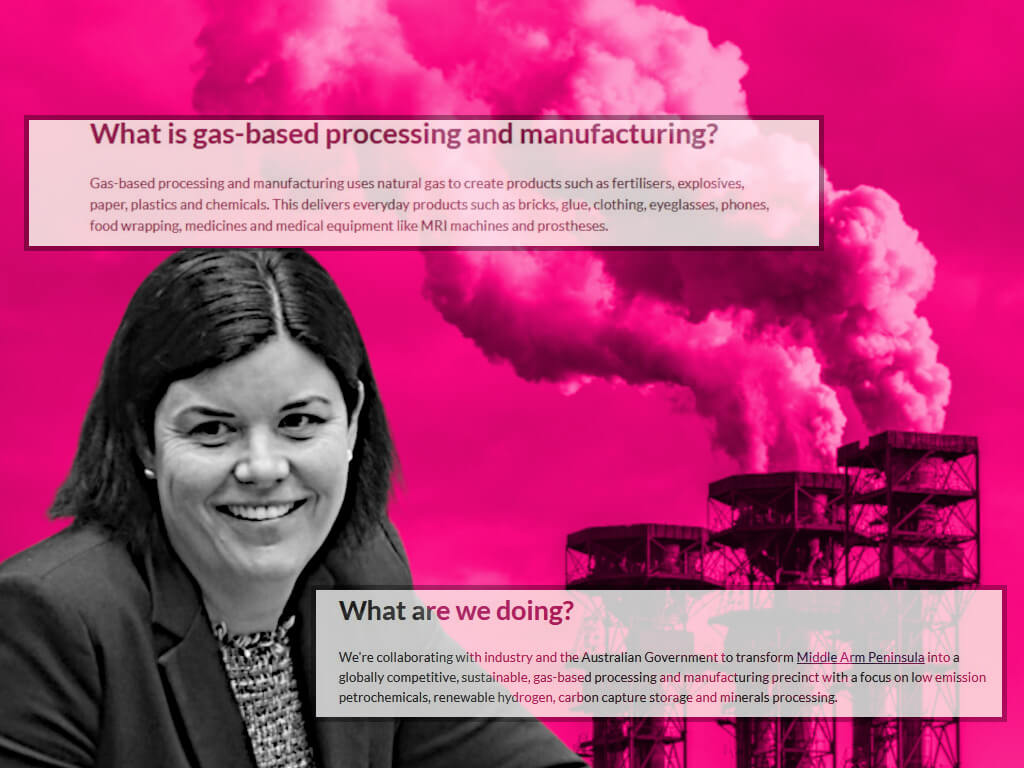
On one page called Our Territory, Our Gas Strategy, the government explains what gas-based processing and manufacturing is, by specifically saying it is the production of fertilisers, explosives, paper, plastics and chemicals.
“This delivers everyday products such as bricks, glue, clothing, eyeglasses, phones, food wrapping, medicines and medical equipment like MRI machines and prostheses,” it still states.
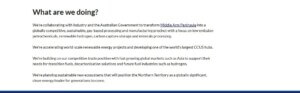
Under the heading “What are we doing?” it states: “We’re collaborating with industry and the Australian Government to transform Middle Arm Peninsula into a globally competitive, sustainable, gas-based processing and manufacturing precinct with a focus on low emission petrochemicals, renewable hydrogen, carbon capture storage and minerals processing”.
While the words Middle Arm Peninsula in that sentence are hyperlinked, the page that it links to has been taken down.
On another page on the same website it states: “The Northern Territory Government is working to deliver a precinct that will have the ability to cater for a range of industries, including a low emission petrochemicals, renewable hydrogen, carbon capture storage and minerals processing hub, opening the door for significant future-focused local industry development”.
“The Territory’s abundant natural resources are the launch pad for expanding beyond our gas-export expertise to establish sustainable gas-based processing and manufacturing, a key component of the Northern Territory’s Gas Strategy vision to develop a world-class gas production, manufacturing and services hub by 2030.”
While on another government website, entitled Investment Territory, it mentions a new downstream petrochemical precinct that would include energy intensive industries.
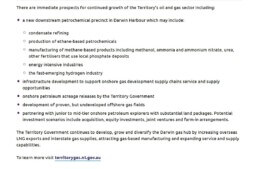
“There are immediate prospects for continued growth of the Territory’s oil and gas sector including: a new downstream petrochemical precinct in Darwin Harbour which may include:
“Condensate refining; production of ethane‑based petrochemicals; manufacturing of methane‑based products including methanol, ammonia and ammonium nitrate, urea, other fertilisers that use local phosphate deposits; energy intensive industries; the fast‑emerging hydrogen industry.”
Ms Fyles and Ms Moss refused to answer a series of detailed questions about Middle Arm and the Chief Minister’s recent comments about it, including giving her the chance to put the record straight about whether petrochemicals would be excluded from the site, and on what basis the government could exclude such companies.
The NT Independent also asked the chief minister if she could explain her contradictory statements, saying in one interview there would be no petrochemicals, and in another several weeks later, that the government did not yet know what sort of industries would be there.
She was also asked to clarify the contradictions inherent in her talking about gas in the past tense and that Middle Arm will be about solar, yet then talking about the massive extraction of gas in the Beetaloo Basin.
Ms Fyles was also asked whether the Australian Petroleum Production and Exploration Association has raised concerns about her exclusion of petrochemical production from Middle Arm and if there were any implications for the exploration of the Beetaloo.
In her first interview after becoming Chief Minister in May, Ms Fyles told the NT News that her government would “seek – at first – for continuity rather than change”.
“There’s major projects that are starting to come out of the ground, so providing that certainty to business is really important,” she said.
The NT Independent also asked her how she thought her comments contradicting previous government statements and current websites provided certainty for business.
The NT Government’s stated vision for Middle Arm on the back of gas
The Chief Minister’s statements that petrochemicals would not be part of the Middle Arm industrial precinct run contrary to the stated aim of the NT Government to see Middle Arm being purposely turned into a gas manufacturing hub development. It would also form a centerpiece of the government’s plan to have a “gas-led economic recovery”, based around exploration and extraction in the Beetaloo basin, following the Gunner government’s lifting of the fracking moratorium in 2018.
In 2019, the then-chief minister Michael Gunner unveiled what was called the NT Government’s 5-Point NT Gas Strategy “aimed at driving Government’s vision for the Territory as a world class hub for gas production, manufacturing and services by 2030”, specifically referencing a proposed plant to turn gas into methanol, another to turn gas into “cleaner” fuel, and another LNG processing plant, all at Middle Arm.
In December 2020, an economic recovery strategy was drafted by the Territory Economic Reconstruction Commission. The commission had been set up by the NT Government and co-chaired by Andrew Liveris, who was the former chief executive of one of the world’s largest chemical manufacturers, Dow Chemical Company.
Upon its release, Mr Gunner said he accepted all of the TERC report’s recommendations which included supporting petrochemical manufacturing plants at Middle Arm to convert natural gas from the Beetaloo into products such as plastics, paint, detergents and fertilisers.
The ABC reported at the time NT Government tender documents showed details about potential interest in the Middle Arm site for ammonia production, and a urea and a methanol plant, using gas.

0 Comments