


Darwin Mayor Kon Vatskalis will not say how the design for the controversial Cyclone Tracy memorial was selected, or how it represents the disaster, with one survivor pointing out its similarity to the artist’s earlier works said to represent temptation in the Garden of Eden, while an international transparency organisation has criticised a gag order signed by the committee that approved the design.
Federal Member for Solomon Luke Gosling has also said if the monument does not achieve the aim of commemorating the disaster, the NT Government should ask council for the Federal Government’s $300,000 in funding back.
The controversial kinetic sculpture called Coriolis will be unveiled today at what was formally the Lord Mayor’s secret invite-only VIP function at Bundilla Beach where survivors are largely excluded, despite council receiving the government funding for the memorial for the 50th anniversary of Cyclone Tracy, which hit Darwin on Christmas Eve 1974.
It has been described as looking like something from Dr Suess, or like “ripened ovaries on fallopian tubes”, a “kids’ playground”, and a “mango tree”.
Despite the fact the Federal Government gave the council the money to create a cyclone memorial, Mr Vatskalis has said in the media at least four times, once as recently as last week, that the sculpture is not a memorial, arguing that another memorial, one created by the Remembering Cyclone Tracy committee being installed at East Point, was the “real memorial”. He infamously said his VIP event was not an “event” but did not explain what it was instead.
However, Mr Vatskalis’s latest claims are in direct conflict with a statement from council that the Bundilla Beach memorial is a memorial for the deadly cyclone.

Cyclone Tracy survivor Antony Bullock, who is organising a protest against the sculpture at tomorrow’s event, and at another community event on Saturday, said there are serious questions about how the design was chosen, and why it looks so similar to New Zealand artist Phil Price’s other works. Those works include one called Big Snake in Canberra, and one called Snake in Denmark.
“The first obvious question is the similarity of the kinetic structure the council has purchased which remarkably resembles many of his other sculptures, yet with very different descriptions all around the world,” Mr Bullock said.
“Questions raised, include, did the council provide a specific brief for this art, or was Phil Price given unrestricted reign over the design?
“If so, why are so many Phil Price sculptures so similar, but with significantly different meanings? This doesn’t pass the pub test and perhaps leads on to the conclusion that the funds may have been spent inappropriately.
“The other consideration is that someone senior in the council saw the similar art work by Phil Price in Canberra, and specifically wanted that over and above anything that may have been proposed at the Cyclone Tracy Commemorative Advisory Committee.
“Unfortunately at this point in time, the council has considered all discussions surrounding the selection of the monument confidential as not in the public interest to know how the process was carried out. This information is currently going through an FOI [Freedom of Information] process with the council.”

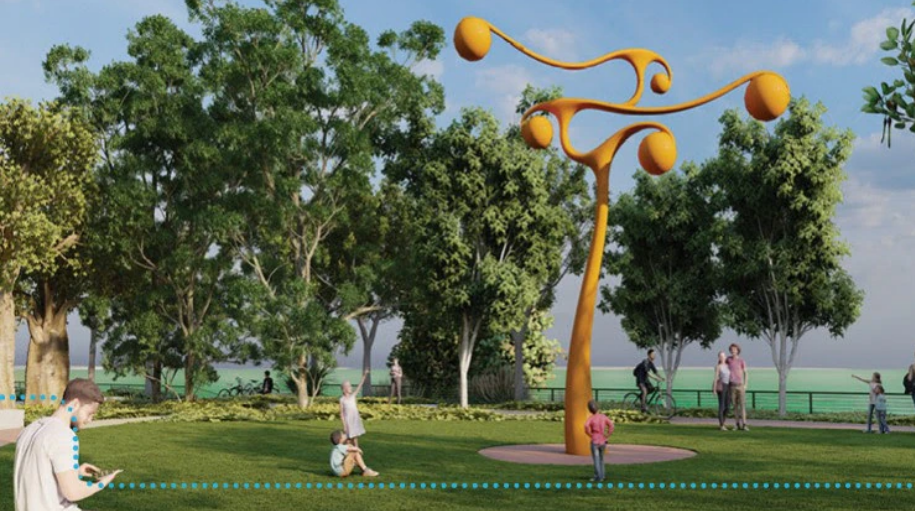
Snakes versus Tracy
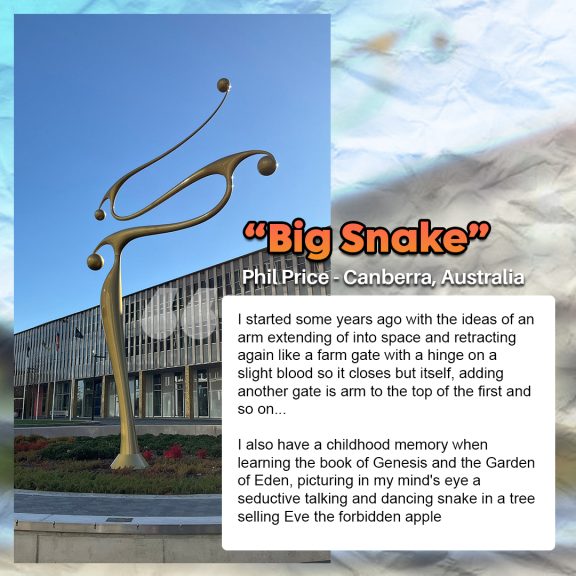 There are at least two similar works by Price to his work being installed at Bundilla Beach.
There is a sculpture, that seems to go by the name Snake or Big Snake, in the Canberra CBD, and an identical one that also seems to go by the same name in a park in Aarhus in Denmark. The second piece was an exhibit in Sculpture by the Sea in Sydney in 2012, and Sculpture by the Sea in Aarhus the next year.
There is a photo online of the plaque beneath the Canberra sculpture that has the artist’s statement.
“I started some years ago with the idea of an arm extending out into space and retracting again like a farm gate with a hinge on a slight bias so it closes by itself, adding another gate or arm to the top of the first and so on…I also have a childhood memory when learning the book of Genesis and the Garden of Eden, picturing in my mind’s eye a seductive talking and dancing snake in a tree selling Eve the forbidden apple.”
While there is no representation of a plaque online for the Danish sculpture, the Århus Stiftstidende newspaper reported on the purchase of the sculpture by the Aarhus council in 2014, stating it represented the Biblical account of the temptation of Eve by the serpent in the Bible, while the Aarhus Sculpture by the Sea Facebook page offers the same meaning for the piece.
When unveiling the design of Coriolis, a Darwin Council press release said it was designed to pay respect to the history of Cyclone Tracy, and represented the forces of nature affecting the Darwin environment.
“The theme of Coriolis is ‘momentum capturing the power of wind’. Its movement is dictated by the force of the wind and the sculpture will have expanding and retracting branches that represent themes of growth, resilience and regeneration,” the press release said.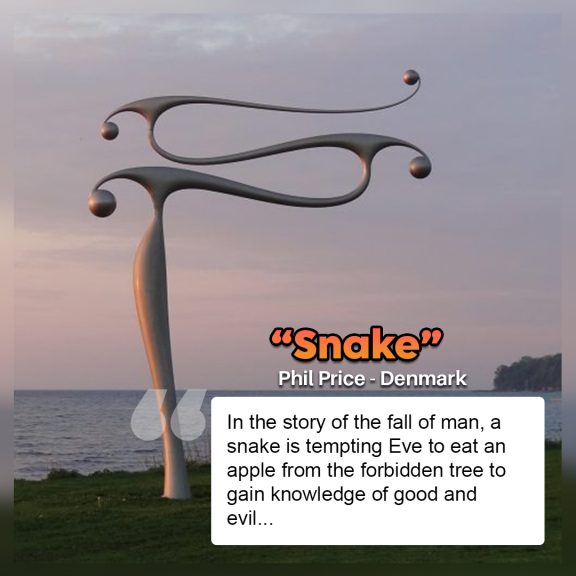
It went on to say Price had a distinctive style, which is translated in the uniqueness of each of his works.
Price did not respond to questions from the NT Independent including about the brief he was given by council instructing his design, and whether he was asked to create a sculpture to resemble the Snake sculptures.
He was also asked how he had become involved with the Cyclone Tracy memorial project and whether he was told it was a memorial or just a work of public art.
Price was further asked about the difference in meaning behind the Snake sculptures, and Coriolis, considering how similar they look, how he came to these interpretations, and who wrote the description of the meaning of Coriolis used in the Darwin Council press release.
The question of how the design was chosen
The Lord Mayor would not answer questions about why the design looked so similar to Price’s earlier works and whether the council had asked him to replicate them. Council would also not provide the brief that was given to Price or say where the idea to use Price for the memorial came from.
The Cyclone Tracy Advisory Committee, which the Lord Mayor chairs, voted to recommend the Price design to the council for official approval, in a meeting on January 24, “subject to funding and community consultation”.
A lot of the committees’ deliberations about the 50th anniversary commemoration activities have generally been held under confidential sections of meetings, for reasons that have never been explained by Darwin Council.
The minutes for the January meeting show the discussion was held in a confidential session and states it would be contrary to the public interest to make it public as it deals with information provided to the council on condition that it be kept confidential. The minutes only state that the committee resolved: “That the Cyclone Tracy Commemoration Advisory Committee recommends progressing the design, construction and installation of a Cyclone Tracy commemoration monument at Bundilla Beach, Fannie Bay, subject to funding and community consultation”.
There are no details on what other potential designs the committee members had to choose from. It is also unclear if Price’s design was the only one committee members saw. There is no explanation why the members chose Price for the work, and whether a concept design had actually been produced at that point, or if they were going off the ‘vibe’ of the artist’s other work.
In an email sent to Mr Bullock, and seen by the NT Independent, Darwin Council chief executive officer Simone Saunders said committee members considered options at the October 16, 2023 meeting, for a monument, “and requested officers to come back at the next meeting with options for a kinetic sculpture”.

An ABC report from June this year carries a statement from an unnamed Darwin Council spokesperson saying Price’s design was the only one that fit the specifications sought by the committee.
“The Cyclone Tracy Commemoration Advisory Committee agreed that a sculpture should be developed to educate the community about Cyclone Tracy, provide people with a place to gather, be kinetic and move with the wind,” they said.
“The only artist who could develop a piece of artwork to fit this brief was Phil Price, as his pieces are the only kinetic sculptures that are made of carbon fibre and can withstand Darwin’s environment.”
There has been no explanation provided over where the idea came from that it had to be kinetic, and when the committee came to that conclusion, and further, when the committee concluded the memorial had to be carbon fibre, two components which ruled out local artists and left Price as the only option.
It is unclear why an expression of interest was not put out to attract a range of designs.
Mr Vatskalis and Price would not say if anyone on the council or the committee knew Price before the process began or was aware of the Snake sculptures.
While the council said the committee members voted unanimously eight-zero to adopt the design, it seems there were 13 members on the committee at the time of the voting.
On June 24, despite a strong public backlash to the design, and the selection committee’s approval of the design being “subject to community consultation”, a Darwin Council list of contracts exempt from normal procurement processes shows a $535,000 contract awarded to Price on that basis that there was “only one supplier available”.
The council has said it will cost $700,000 all up, including landscaping.

Richard Creswick, who was on the selection committee, and is also chair of the Remembering Cyclone Tracy Committee, told the NT Independent he was told he had to sign a confidentiality agreement and obliged. However, the NT Independent has seen an email to Mr Bullock in which a council employee denies that members signed confidentiality agreements.
Transparency International Australia CEO Clancy Moore said the confidentiality agreement raised serious questions about public accountability and good governance, when public projects funded by taxpayer dollars are hidden from public scrutiny.
“Confidentiality agreements and a lack of response to Freedom of Information requests can hamper public trust in the 50th anniversary commemorations,” Mr Moore said.
“The community would benefit from open decision-making and transparency from Darwin Council, particularly when Cyclone Tracey is of such historical significance.”
Mr Bullock said he filed a Freedom of Information application to Darwin Council for information relating to the design and how it was selected, but did not receive a reply from council, and made a complaint to the NT Information Commissioner.
Mr Creswick’s organisation also received $300,000 from the Federal Government for their own memorial created by a local artist, and told the ABC in June he was aware “mostly of criticism” about the council’s memorial design and said he didn’t believe the work should be affiliated with Tracy.
“My concern is the linking of that sculpture to Cyclone Tracy…we’ve always believed that a memorial should be designed by a local artist and should be designed locally,” he said.
“If the council decides that it wants a kinetic sculpture at Bundilla Beach, that’s great, but…my committee and the people we represent, survivors of Cyclone Tracy, want a memorial that is reflective of Cyclone Tracy.”

A changing story in the face of public criticism
The council announced Phil Price’s design on June 7, in a release that quoted Mr Vatskalis saying the “the monument was a fitting tribute to recognising one of the most significant events in Darwin’s history”.
“The Cyclone Tracy commemoration monument aims to recognise the effects this devastating event had on our community in a meaningful and permanent way,” Mr Vatskalis said.
“The monument will offer a focal point for solace, solidarity and communal reflection and provide a space for collective grieving, remembrance, and healing.
“It will be a symbol of resilience and perseverance amidst adversity, honouring the memories of those lost, validating the experiences of survivors, and reflecting the spirit of the Darwin community.
”It will serve as an educational tool, ensuring visitors and future generations understand the impact Cyclone Tracy had on the Darwin community.”
After a vocal public backlash against the design, Mr Vatskalis was quoted in the NT News on June 12 saying it was a “public artwork” and will accompany a separate, “proper memorial”.
There had been no public mention of it being public artwork before that point.
Mr Vatskalis then went on Katie Woolf’s Mix 104.9 radio on June 18, and again changed the story of the work, saying it was not a monument to commemorate the 50th anniversary of Cyclone Tracy but public art instead, and the description of it being a monument was a “stuff up” by the council’s announcement.
He had not made this claim about the “stuff up” on June 12.

“Public art is always controversial,” Mr Vatskalis said on Mix 104.9 on June 18.
“This is not a memorial for Cyclone Tracy. [The earlier council press release] was a stuff up because it was mentioned as a monument and it’s not going to be a monument.
“It’s not going to be a monument, it’s going to be a public art … that shows the forces of nature. The only link [with Cyclone Tracy] is it moves with the wind.”
The council was forced to later issue an extraordinary statement correcting Mr Vatskalis’s bizarre claim.
“We wish to clarify recent commentary relating to commemorative activities for the 50th anniversary of Cyclone Tracy. City of Darwin recently released the design of a kinetic sculpture – which we have formerly referred to as a monument – that we will install at Bundilla Beach Reserve and will commemorate the 50th anniversary of Cyclone Tracy,” the statement said.
“The change in language from ‘monument’ to ‘kinetic sculpture’ was intended to clarify the difference between the City of Darwin-led kinetic sculpture and the Remembering Cyclone Tracy Inc-led memorial at East Point. Despite the change in language to describe the installation, the purpose and intent behind the kinetic sculpture remains unchanged.
“However, we acknowledge this has caused some confusion, and wish to assure the community that we are operating in line with both our legislative requirements and the grant requirements.”
Despite this, Mr Vatskalis claimed at least another three times publicly that the kinetic sculpture was not a memorial to Cyclone Tracy, or not the real or official memorial. He also made the claims in an email seen by this masthead.
As recently as a November 20 NT News article, the Lord Mayor said Coriolis was not the ‘official monument’.
“The real monument will be at East Point,” Mr Vatskalis said.
The question of government funding
Prime Minister Anthony Albanese and Infrastructure Minister Catherine King visited Darwin in March specifically to announce the funding.
They have ignored questions about Mr Vatskalis’ continued denial that the memorial is a memorial and how they felt about Cyclone Tracy survivors being largely excluded from the unveiling of a memorial to a natural disaster they lived through, that was paid for with public money.
They have also refused to answer questions about the similarity of the Darwin memorial’s design with Price’s other pieces in Canberra and Denmark, and whether they thought it represented Cyclone Tracy.
Mr Gosling would also not talk about the similarity of the designs and whether he thought council had ripped off the government.

“When I heard of the Lord Mayor’s comments on Mix FM [on June18] regarding the nature of the art installation, I was of course concerned as the way the interview was relayed to me did not fit with the former description as a Cyclone Tracy Monument that I had sought and achieved a $300,000 federal contribution towards,” Mr Gosling said.
“I wrote to Kon that day seeking clarification and he replied saying: ‘I can confirm that the City of Darwin kinetic monument (sculpture) is a permanent monument to commemorate the 50th anniversary of Cyclone Tracy….The monument (sculpture) will provide a focal point for the whole Darwin community and visitors alike’.
“This fits with the intent for which the funds were allocated.”
Mr Gosling did not respond to whether he thought the Lord Mayor was lying to him, considering Mr Vatskalis had, at least two times since that interview, told the media the sculpture was not a Cyclone Tracy memorial.
“I made the point during a radio interview with Mix FM that if the Bundilla monument failed to achieve this aim of commemoration and does not fulfil the requirements of the funding agreement between the NT Government and the City of Darwin, then the Northern Territory Government should seek to recover the funds and return them to the Commonwealth,” he said in his initial statement.


Kon’s explanations have as many twists and turns as that sculpture would make. Changes his story to suit the audience like any other Labor politician.
Get the ICAC on board – delayed outcome by 2 years and when everyone has forgotten they will report no corruption – its what the office was designed to do.
I’d like to believe that with NT public input and discussion that somewhere out in our Territory community, our schools and other learning facilities there is a real creative mind(s) with a vision to forever mark this occasion best. Let’s ignore the fact $700000 left the NT public purse and went to NZ and the fact we spent $408Million dollars on interest to cover the Territory debt 2023-24!!!
What’s Lia finnochiaro’s wages bill given she has 23 staff plus a photographer( kids no how to take selfies as do the media unless a propagander mindset is in da house