

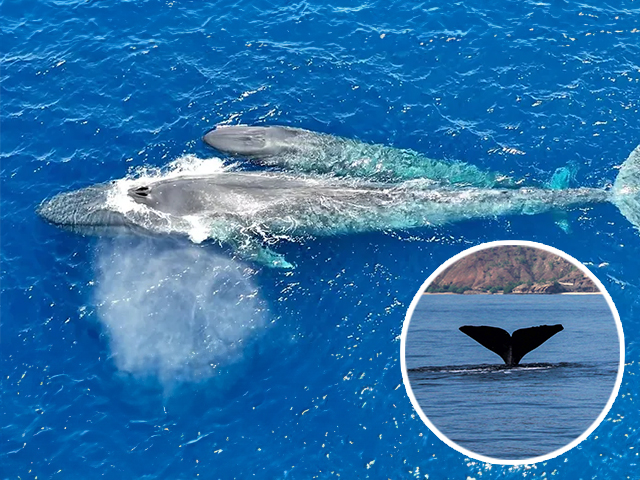
Researchers have captured on video amorous adult blue whales in courtship, as well as a mother nursing its calf, on the north coast of Timor Leste, revealing previously unknown behaviour a Charles Darwin University academic has said.
The footage was taken as part of an international project with research – which draws on more than a decade of observations and datasets – published by the Scientific Committee of the International Whaling Commission, and
Program leader CDU adjunct senior research fellow Dr Edyvane, who is also an Australian National University associate professor, and a UN-recognised expert on the Arafura and Timor Seas, has been conducting research in Timor Leste since 2006.
“From newborn calves and nursing mothers to amorous adults in courtship, the waters of Timor Leste really are providing blue whale scientists with some of our first glimpses into the private lives of one of the world’s largest but most elusive animals,” Dr Edyvane said.
“Our decade long research and ‘citizen science’ program has documented some of the lesser known, intimate reproductive behaviours of blue whales, some for the first time.”
Dr Edyvane said the findings confirm Timor Leste’s waters as a major migration corridor for blue whales and an unprecedented location for blue whale research and would help safeguard and preserve the whales as they pass through Timor-Leste’s waters and beyond.
“Timor-Leste’s deep, nearshore waters, particularly in the narrow Ombai-Wetar Strait along the north coast of the country, provide one of the most accessible and best locations for blue whale research in the world,” she said.
“Since 2014, our program has sighted over 2,700 blue whales in Timor Leste’s waters, monitoring their annual migration along the country’s north coast. On a global level, these numbers are truly extraordinary.”
Australian Antarctic Division researcher Dr Elanor Bell said long-term blue whale monitoring in Timor Leste provided valuable insights into whale movements and behaviours in tropical waters.
“This evidence suggests that these waters are important foraging areas for blue whales and critical for reproduction. Until now, it has been a mystery when, where, and how blue whales reproduce,” Dr Bell said.
Dr Capri Jolliffe, who has been studying blue whales in Australian waters for over a decade, said thes research highlights that the life history characteristics and patterns of habitat use of pygmy blue whales differ significantly from their Antarctic blue whale counterparts.
“They really are tropical animals. Now, we need to use this valuable new information to ensure we fully protect and conserve these animals when they pass through Timor Leste’s waters and beyond,” she said.
“These animals undertake long ocean migrations, crossing maritime waters and international boundaries – we share these animals. Understanding of this population and the threats they face throughout their entire migratory range is fundamental for ongoing conservation and recovery of this species. For effective species management, support for Australia and Timor Leste research cooperation must be a major priority.”


0 Comments