

By Justin Tutty
The Northern Territory Government had a good National Cabinet.
Lia Finocchiaro emerged declaring a “win-win for Territorians”. The Territory maintained its refusal to participate in the Commonwealth’s national gun buyback, while the Commonwealth’s proposed rules for AI data centres acquired the flexibility the NT wanted on fossil fuels: specifically, fracked gas.
That’s an impressive performance from perhaps the least powerful government in Australia.
The strange source of Ms Finocchiaro’s leverage is illustrated by another long-running feature of the Commonwealth-Territory relationship.
The disadvantage dividend
The NT Government receives 72 per cent of its revenue from the Commonwealth. GST alone supplies about 42 per cent of all NT Government revenue. The Territory receives an extraordinary amount of GST because it is extraordinarily expensive to provide services here.
In 2026–27 the NT will receive about $19,122 in GST per person. The Commonwealth Grants Commission explicitly points to the NT’s remoteness and its large First Nations populations as reasons its assessed service costs are so high.
This arrangement has a history.
In 2017, The Yothu Yindi Foundation examined the GST system and estimated that as much as $500 million accessed on the basis of Aboriginal needs had been spent on other priorities. It revisited the unaddressed problem in a 2023 Productivity Commissioner submission.
GST arrives in the Territory untied. Disadvantage increases the Territory’s entitlement, but once the money arrives, the Legislative Assembly decides where it goes. Yothu Yindi Foundation argued that this creates an ugly incentive: money generated by remote disadvantage can be redirected towards urban political priorities.
Its conclusion deserves repeating:
“There is no penalty for failing to address disadvantage, only reward.”
The story has not gone away.
In 2023, CDU political economist Rolf Gerritsen estimated that about $600 million a year generated because of Aboriginal disadvantage was not actually spent addressing it. He pointed to spending on things like boat ramps, football and Darwin CBD projects.
Last month, Aboriginal organisations were again calling on the Commonwealth to change funding arrangements and hold the NT Government accountable.
And at this year’s Senate youth justice inquiry, the same institutional absurdity surfaced again. The Commonwealth supplies most of the money, while the Territory can, as Senator David Shoebridge put it, “thumb the nose at the Commonwealth”.
This is not because Territorians hold power over the feds: they most certainly do not. Canberra simply keeps choosing not to use the power it has.
Now, hold that thought as we return focus to last week’s ‘win’ on AI centres.

Before National Cabinet, Chris Bowen was threatening to legislate over jurisdictions that refused a national renewables standard. After meeting with Ms Finocchiaro, he insisted there were still “no exceptions and carve-outs”.
Which is true: the concession made is worse than a carve-out. It is national degradation.
Under the rule Mr Bowen is now defending, if a state-owned electricity company believes it can power an AI centre more cheaply with fossil generation, it can make its case to the Commonwealth. The Australian Energy Regulator will assess it. Canberra will decide.
The Territory did not merely win permission to pursue its own 20th-century energy policy. It provided the political cover to make that policy available nationally.
This matters because there is an increasingly silly idea taking hold in the debate around AI centres: that these enormous new electricity loads will simply be powered by renewables. Anyone prepared to do the maths will calculate that no gigawatt-scale AI centre with hyperscale reliability requirements will be powered by solar panels alone.
Take Weddell for example. The NT Government is supporting a proposed hyperscale AI development with up to 2GW of on-site gas-fired generation. The proponent says the AI centre itself would require about 2GW of power.

Running at 2GW continuously requires 48GWh of electricity a day. To maintain that output through a 12-hour night would require 24GWh of stored electricity.
Australia’s largest operating battery by energy-storage capacity is Western Australia’s 500MW/2.4GWh Collie Battery Energy Storage System, which cost over $1.6 billion.
Getting a 2GW AI centre through one ordinary 12-hour night would require the energy-storage capacity of 10 times the largest battery currently operating in Australia.
That’s before factoring normal losses: before reserve margin; before degradation; before maintenance; before allowing for a cloudy day, let alone two cloudy days.
And most of all, that’s without factoring the redundancy expected by an industry whose entire product depends upon extremely reliable electricity – reliability so important that the International Energy Agency describes uninterruptible power supply batteries and backup generators as necessary infrastructure.
Project Ares, currently under environmental assessment in the Barkly, specifies Tier III firm power requirements. Its own proponent is unusually frank about what that means: “At this scale, solar and batteries alone cannot yet deliver that guarantee.”
Energy North says gas is the most technically and commercially viable firm-power option available to it.
That’s the commercial reality behind the renewable rhetoric. Hyperscaler customers require extremely high availability, and service level agreements routinely attach financial consequences to outages. Flexibility for the grid competes directly with the obligation to keep the customer running.
This shows what disappears when comparisons are reduced to “renewables are cheaper.” Solar generation is cheap. Firm electricity is something else. A renewable system capable of feeding gigawatts into AI hardware through nights, weather events and equipment failures is not a solar farm. It is a gigantic generation, storage, transmission and firming system.
Mr Bowen’s test is not really comparing gas with solar. It is comparing gas with the entire system required to make solar behave like firm power. Which is why his latest formulation deserves close attention.
The national rules will apparently use renewable energy certificates to establish “100 per cent renewables back by gas firming”.

There is quite a lot hiding inside the word ‘backed’.
A renewable energy certificate can establish that renewable electricity has been generated somewhere in the accounting system. It cannot make the sun shine at 2am.
The IEA explicitly distinguishes the contractual energy mix claimed by the data centre operators from the electricity physically consumed by their facilities.
That distinction is about to become very important in Australia. Because once gas is permitted to provide the firm electricity required when renewable generation is unavailable, the meaningful question is no longer, is renewable energy cheaper than gas, but rather, is 24/7 firmed renewable power cheaper than gas?
Those are very different questions. Far from guiding transition, Mr Bowen’s test preserves the incumbent. If new infrastructure expected to operate for decades may default to gas whenever the renewable system costs more today, we effectively lock in the fossil generation which transition was supposed to move away from.
Thousands of Darwin households already demonstrate what ‘solar powered’ normally means.
They have solar panels installed, but most still rely on the electricity grid when the panels aren’t producing. Almost none have disconnected from it. A 2GW ‘solar-powered’ AI centre has exactly the same problem, except that its night-time load is industrial in scale, with a vastly lower tolerance for interruption.
The question isn’t just whether you can bolt enough solar panels onto the energy system. It’s what replaces the grid’s dispatchable generation when the panels aren’t producing.
Mr Bowen side-stepped that nuance when reframing his capitulation; states may now make the case for non-renewable power on the basis of cost.
He offered the expectation that it would be practically difficult to do so, saying: “Given the amount of information that renewables are the cheapest, I think that’s a big call”.

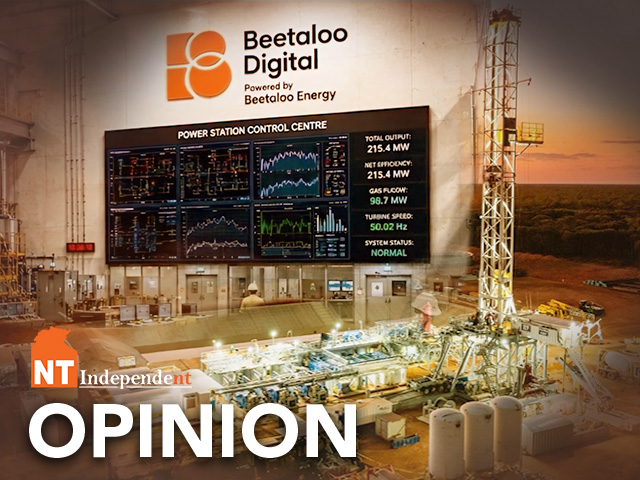
Apparently the CLP has a much clearer understanding. The Weddell proposal does not hide behind certificates: it proposes gas piped from the Beetaloo Basin to gigawatt-scale generation beside the data centre.
Project Ares would also build its own methane turbines. Energy North says its realistic gas-supply options include the Beetaloo Sub-basin, although no binding supply agreement exists.
So did the CLP really get their way? Or did they simply provide political cover for a retreat Canberra was willing to make?
Ultimately, the NT cannot dictate Australian energy policy. National Cabinet has itself agreed that the new data-centre regime will be established through Commonwealth legislation. Mr Bowen stresses that “the Commonwealth will decide”.
The Territory has very little leverage. We have two (single-term) senators; two members of the House; a tiny economy; and a government overwhelmingly funded by Canberra.
Yet the same Commonwealth that has spent years watching money generated by remote disadvantage migrate towards other priorities has now watched the NT demand fossil-powered AI, and adjusted its national policy accordingly.
The tail is not wagging the dog. The dog keeps handing over the lead. Only this time the beast on the other end is an electricity whale.
Justin Tutty is a Darwin-based environmental activist who works in cloud computing. He has campaigned against fracking in the Northern Territory and previously pleaded guilty in court after a non-violent protest action targeting equipment bound for the Beetaloo Basin.

0 Comments