

By Justin Tutty
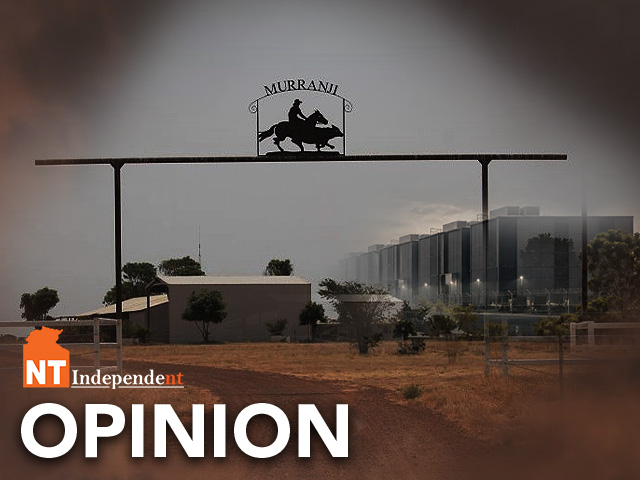
OPINION: On a cattle station in the Barkly, north-west of the small town of Elliott, a company proposes to build a power station bigger than the one that keeps the lights on across the entire Top End. It would run a single building.
That is the arithmetic at the heart of Project Ares, a hyperscale data centre for artificial intelligence, proposed by Energy North at Murranji Station. It has been awarded Commonwealth major project status and referred for assessment under national environment law. The company’s founder describes the project as “the specialised engine room for the AI economy … designed to Formula 1 pit-lane specifications, not a suburban garage”.
Strip away the branding, though, and the referral describes something the Northern Territory has not seen before: a gigawatt of computing power, with its own gas-fired power station, borefield and gas pipeline, dropped into remote country that has none of those things today.
The scale is hard to picture, so it is worth doing the sums, because the proponent’s own figures raise questions the assessment has not yet answered.

A power station with a data centre attached
Project Ares would draw about 1 GW, or 1000 MW, of electricity at full build. For comparison, the entire Darwin-Katherine grid, which powers around 165,000 people from Darwin to Palmerston to Katherine, has roughly 476 MW of generating capacity. This one data centre demands more than twice the generating capacity of the network that runs the Top End.
Because there is no grid in the Barkly, Ares would build all of it itself: around 3,000 megawatts of solar panels, 16 gigawatt-hours of battery storage, and about 1,038 MW of gas-fired generation. That gas power plant alone would be roughly three times the size of Channel Island, the Territory’s main power station.
The company calls the gas a “reliability mechanism,” a backup to a project “designed to transition to renewable-powered operations.” The numbers tell a harder story. The gas station could run the data centre with no sun at all; the solar and battery could not run it for a day without the gas.

Over a full day, the panels generate roughly a third less energy than the data centre needs, so something must fill that gap every day, before a single cloudy wet-season week is even in the picture. A 16 GWh battery sounds huge, but it can only store energy, not create it. On the company’s own figures, the gas is not a trickle held in reserve. It is a co-primary source, sized to run the whole site, and likely to run hard.
How hard? The referral does not say. The public documents state no run-hours and quantify no emissions. But the plant’s size lets us estimate, and the estimate is sobering.
Run as the arithmetic implies, and applying standard efficiency assumptions, Ares’s gas station could burn somewhere in the order of 30 to 40 petajoules of gas a year. That is comparable to the entire Gove alumina refinery at Nhulunbuy: the single largest industrial gas load the Territory has known, a demand so large it justified building a thousand-kilometre pipeline across Arnhem Land. Ares, too, depends on a new gas pipeline.
A project sold as a renewable data centre may in practice be one of the largest new gas developments in the Territory’s history, with a data centre attached.
The renewable question
None of this is hidden, exactly; it is simply not reconciled. The company’s project description leans on alignment with national policies that expect new data centres to invest in renewable generation. Yet it offers no emissions profile, and sets no date or trigger for the promised “transition.” Plans specify the gas plant as “hydrogen-ready” – a technology not commercially available at this scale, and to which no binding conversion is committed.
This sits awkwardly with emerging policy, which Energy North invokes. In March 2026, the Commonwealth issued its Expectations of data centres and AI infrastructure developers, the second of which asks them to make “a positive contribution to Australia’s energy transition” and to “minimise their energy demand and emissions,” with aligned proposals granted priority in assessment. The referral duly claims alignment.
Ares does add new solar and storage, but it pairs them with 1 GW of new gas that, on its own figures, would run at least a third of the year and could power the centre full-time. Solar bolted onto 1 GW of new gas is not a positive contribution to an energy transition, and a project that never counts its emissions is not minimising them. The expectations are, in any case, non-binding.
These are the questions a rigorous assessment exists to answer. What share of the plant’s power, over its life, would actually come from gas – in year five? Year 10? Year 20? What are the emissions, in tonnes? What happens to the “transition” if green hydrogen never arrives? The referral is silent, and silence, at this scale, is not reassuring.
The water and what lies downstream
Then there is water. Ares would pump up to four gigalitres a year (about 1,600 Olympic swimming pools) from the Cambrian Limestone Aquifer, the great limestone groundwater system beneath the Barkly. And it would not be pumping alone. The same company’s separate green-ammonia project, Project Sol, is proposed on the same station, drawing on the same borefield.
A pastoral company has applied to take more than 10,000 megalitres nearby for cotton. The water plan already reserves another 10,000 ML a year for frackers.
The region is managed as “arid zone” country – a category that permits drawing down stored groundwater over decades, on the assumption that little depends on it. But something does.
The creeks the project’s eastern works would cross drain, inland, toward Lake Woods – a wetland of national importance that fills, in good years, with up to 116,000 waterbirds and the migratory shorebirds of the East Asian–Australasian Flyway. The aquifer itself is a living, connected system, home to subterranean fauna described only recently.
The cumulative effects – Ares plus Sol plus cotton plus fracking, converging on one aquifer and one wetland – are unaddressed in the company documents. Each is being treated as a separate matter, for someone else, later.

Unresolved
“Later” is a theme. The referral is candid that it is preliminary: field surveys not yet done, footprint not yet fixed, cumulative impacts deferred, significant-impact conclusions to be reached “through the EIS.” It has been submitted, in other words, with the most difficult questions still open.
And that is exactly why the next stage matters.
The NT’s environmental impact assessment is where the water, the gas, the emissions, the cumulative load and local and cultural knowledge are meant to be examined in full – and where Territorians get their real say. The danger is that a project this large, and this consequential for the Barkly’s water, arrives wrapped in the language of a clean-energy future and is waved through before the arithmetic is checked.
The Territory is being offered a great many of these projects. Ares is reported to be one of around a dozen data centres now proposed for NT. Each will come with the same promise of investment and the same reassuring adjectives.
Before we build a second power system bigger than our own in the middle of the Barkly, we are entitled to some plain answers to plain questions. How much gas? How much water? At what cost, to whom, and – downstream – to what?
Those answers are not in the referral. They should be demanded of the assessment.
Justin Tutty is a Darwin-based evironmental activist who works in cloud computing. He has campaigned against fracking in the Northern Territory and previously pleaded guilty in court after a non-violent protest action targeting equipment bound for the Beetaloo Basin.

the project is speedrunning at the approvals process, proceeding to the NTEPA even before the Feds get to set the scope of assessment. For more detail: https://nt-ai-dc.info