

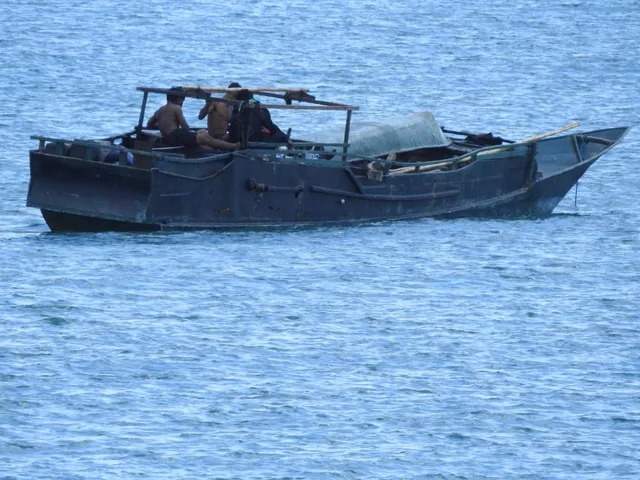
A new partnership between the Australian Border Force and ranger groups led by Indigenous communities to address “shared border protection challenges” in the NT has been raised in response to a rise in illegal fishing activities off the Territory coast, but the rangers are seeking more enforcement powers to help curb the issue.
Recent data from the Australian Fisheries Management Authority shows prosecutions for unlawful fishing in the Territory have more than tripled over the past year, with rangers reporting a concerning increase in incidents.
Aboriginal ranger groups and the Northern Land Council are seeking enhanced enforcement powers to combat the growing issue after last year’s troubling increase in the number of foreign fishers unlawfully entering Territory waters, with dozens apprehended in the remote Top End.
The Australian Fisheries Management Authority has reported a significant rise in the prosecution of foreign fishers in the Darwin Local Court, with 237 cases recorded since July 2024.
It’s a sharp increase from 75 prosecutions in the previous year and just 36 cases documented in 2022-23.
Foreign fishers have been illegally entering Indigenous Protected Areas in pursuit of the region’s valuable marine resources, including trepang (sea cucumber) and shark fins, which are considered delicacies in China.

Over the past year, rangers have encountered not only unauthorised fishers but also instances of people smuggling, including a notable case where a group of suspected Chinese nationals were found stranded in the bush.
Dhimurru Aboriginal Corporation executive officer Stephina Salee said her ranger group manages an extensive area encompassing over 550,000 hectares, equating to approximately 42,000 hectares for each ranger.
“That’s equivalent to the size of the urban setting of Singapore. Rangers are there to manage land and sea … for their people, and that in itself is a massive role,” Ms Salee told the ABC. “And on top of it, now we’re having to do border security, which is very difficult. It’s a massive problem.”
An ABF spokesperson told the ABC it is working with rangers to co-create a partnership led by Indigenous people to tackle common border protection issues collaboratively.
“Specifically, the partnership will lead to more effective operational cooperation through coordinated coastal patrols and intelligence sharing,” the spokesperson said.
“Ranger groups involved in operations will focus on information gathering and surveillance, not apprehensions or arrests.”
The representative also said that the ABF will conduct training programs in the coming months to “quickly enhance the skills of ranger groups,” focusing on “intelligence gathering, personal safety, and operational planning.”
Meanwhile, Dhimurru leaders have raised concerns regarding the under-resourcing and lack of legal authority for rangers to tackle the growing problem of illegal foreign fishing in the Territory. The ABF is currently managing the situation through Operation Lunar but has been criticised for its slow response.

Ms Salee highlighted the necessity for rangers to be given more powers to directly confront fishers or smugglers on-site, rather than just reporting incidents and relying on ABF to arrive and deal with it.
“A bit of power to actually enact and re-enforce some of the laws here, within these waters.”
NLC chairman Matt Ryan said the matter is of national security and biosecurity and that traditional owners are sick and tired of their hard-fought sea rights being disrespected.
“Aboriginal ranger groups must be better equipped with compliance powers, appropriate training and proper resources in order to continue protecting the northern Australian coastline,” he said.
“Authorities and agencies must work closely with Aboriginal ranger groups and land councils to determine what powers would be most appropriate and effective in dealing with these matters.”


0 Comments