

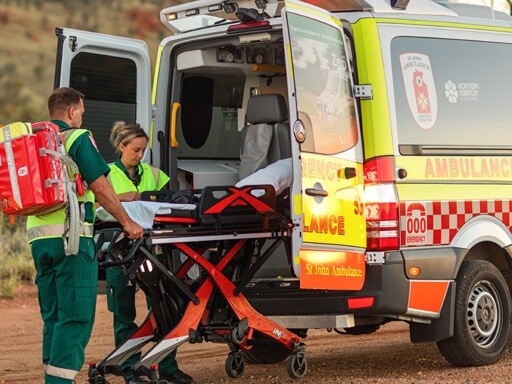
The NT Health Department has appointed an inaugural chief paramedic officer, which comes after a government-ordered review of St John Ambulance NT found multiple failures and poor decisions resulted in harm to patients and significant risk to staff, while also raising concerns patients had died from treatments.
The government did not issue a press release about the appointment to the role which was advertised in September 2024 with a remuneration package of between $173,000 and $188,000 a year offered.
Instead the NT News was given an “exclusive’ interview with Michelle Piercy, who has been appointed as the first chief paramedic officer. It said she had a paramedic and specialist nursing background, and had worked in Indigenous communities across North Australia, New Zealand and Vanuatu.
The article made no mention of the government-ordered review which resulted in the Report on the Clinical Governance of St John Ambulance Australia (Northern Territory), completed in June last year by Dr Craig Ellis, but instead quoted Ms Piercy as saying the NT was “heading in the right direction”.
In December, in response to the Ellis report the Australian Medical Association NT said it held concerns the government contractor could not conduct a safe ambulance service.
Dr Ellis made 16 recommendations in his report, and found multiple failures and poor decisions resulted in harm to patients and significant risk to staff and that while there were serious concerns raised about processes that may have resulted in the deaths of patients, it was impossible to determine the veracity of those claims.
St John Ambulance did not explain why it would be impossible for Dr Ellis to determine if patients had died, considering the ambulance services said it had fully cooperated with the review.
Dr Ellis also found management used lawyers to intimidate and silence staff from speaking out, and said St John Ambulance claimed lawyers needed to be involved in his review for the purpose of “protecting the St John brand”.

In a statement to the NT Independent, after the paper revealed the findings of the report in late Novermber, St John Ambulance NT chief executive officer Andrew Tombs had said many of the issues that Dr Ellis deemed urgent in his report had been addressed by St John Ambulance in its “continued efforts to improve patient safety and clinical governance systems.”
He gave no specific details of what changes have been made and St John Ambulance would not specifically say if it had accepted all the recommendations.
Also at that time Health Department chief executive officer Chris Hosking refused to answer direct questions about the serious failures identified in the governance review, including about the deaths of patients.
However he did however say it was “disappointing” that the NT Independent had made the “confidential” report public, exposing the failures of St John Ambulance to Territorians, saying it was done “without consideration of the impact it may have on the staff and hard-working frontline paramedics at St John NT”.
The report was confidential because the government chose to make it confidential, rather that being transparent with the public about the ambulance service.
The NT News reported that Ms Piercy is based in Darwin and will be responsible for workforce planning, and provide expert advice on paramedicine services, as well as pre-hospital care across the Territory.
It also reported that last month the Productivity Commission released its Government Services 2025 report, which showed St John Ambulance NT responded to Australia’s highest levels of incidents per capita, which emergency calls almost doubling since 2019-20, and with St John receiving 100,000 calls in 2023-24.
In the article the paper further took the focus away from the St John Ambulance’s failures, reporting Ms Piercy “maintained paramedics could provide services beyond” the “blue and red sirens”, with paramedics working in oil and gas, privately, in the air, in aged care, prisons and out on remote sites.
She cited distance, poor roads, and natural disasters being issues for remote communities seeking healthcare, with “tension between patients travelling for healthcare or paramedics travelling to patients” but said the NT was heading in a “really good direction”.
“There’s really good research to show us where health assets should best be placed to support communities and what good health and community looks like – trying to enable workforces to meet those needs is always going to be a struggle,” Ms Piercy was quoted as saying.
“The Territory has a high Indigenous population and it’s geographically really dispersed which creates barriers, but the initiatives we have are really progressive in the way it’s looking at (those challenges).
“So it’s a beautiful time to be jumping in as a professional and help the work that’s being done.”


0 Comments