

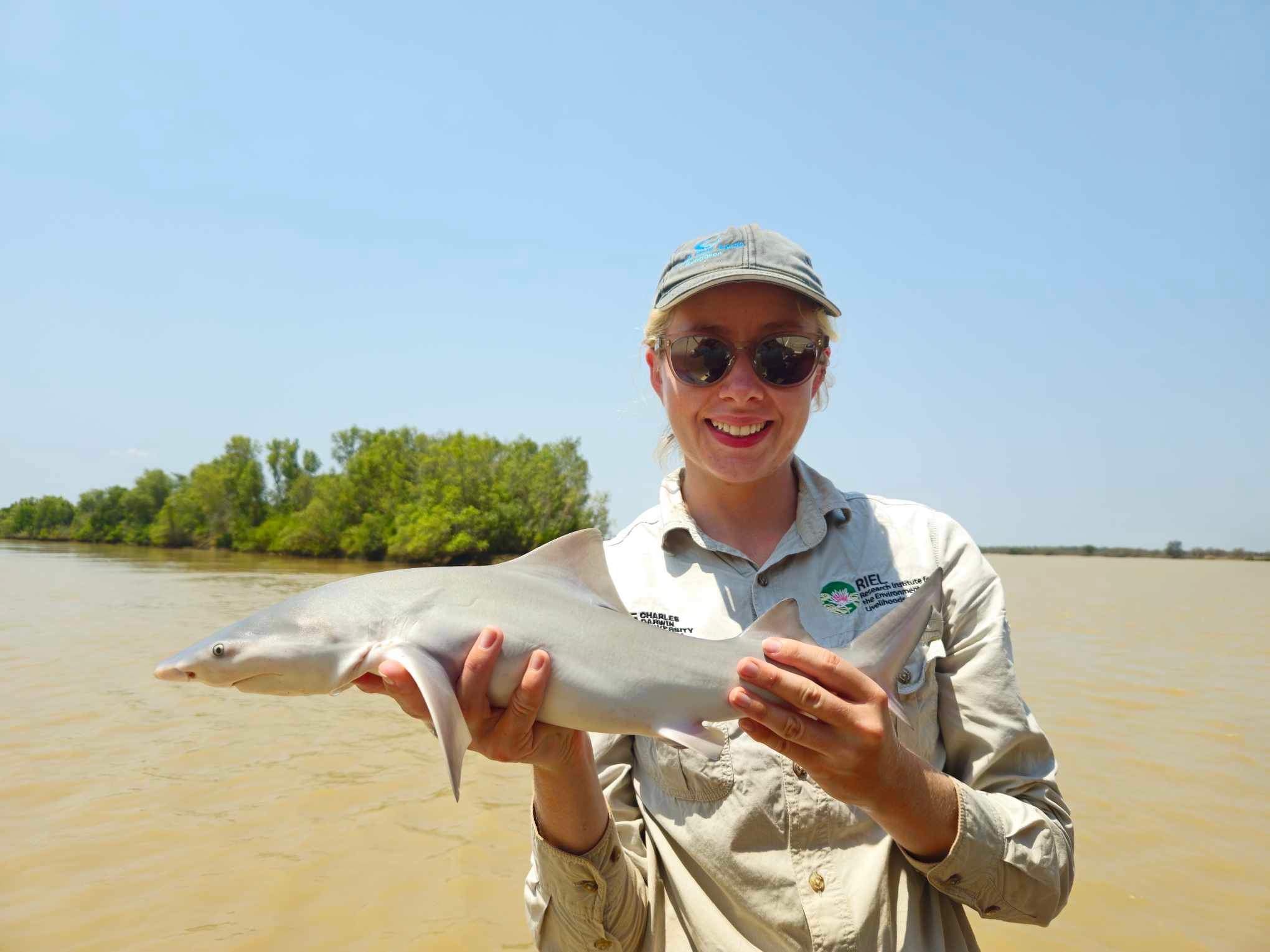
A rare and critically endangered shark species that has been found in the Roper River for the first time, could be threatened in that area by massive water extraction under the Georgina Wiso water allocation plan, Charles Darwin University has said.
CDU PhD candidate Julia Constance, who is studying the movement ecology of the Speartooth shark, also known as Glyphis glyphis, said it had been found in the Roper River for the first time as part of a study.
She said it was a rare species of river shark – was one of only a handful of sharks around the world that live in rivers – that inhabits only a small number of tropical rivers and adjacent marine waters in northern Australia and southern Papua New Guinea, and was listed as critically endangered under Australia’s national environmental legislation.
“The Speartooth shark is quite elusive and occurs in very particular habitats. This can make them susceptible to changes in their environment,” Ms Constance said.
“We do know that female adults return to the same rivers they were born, to pup, and that juveniles spend their early years in rivers, so it makes understanding their river habitats all the more important.”
The CDU press release said the Roper River was a unique environment fed by ground water during the dry season and by runoff from surrounding catchments, and rivers such as the Wilton River in the wet season, and was also home to threatened sawfish.
And that recently, the aquifer which supplies the river, was given the go ahead for a massive water extraction known as the Georgina Wiso allocation.

CDU’s Research Institute for the Environment and Livelihoods senior research fellow Dr Peter Kyne said a greater understanding of this species’ environment was needed to learn what impact these changes will have.
“The results of our survey showed that the Speartooth shark occur in a limited stretch of the downstream Roper River, and the population could decline rapidly in the face of threats, so we need to determine how these environmental changes impact them and come up with ways of managing them,” Dr Kyne said.
“If we don’t, then this unique and isolated population that call the Roper River home could be lost forever.”
In mid-November the then-Fyles Government released its water allocation plan for the Georgina and Wiso basins, which was a requirement to permit fracking in the Beetaloo basin, but the government has manipulated the aquifer re-fill data produced by a hydrologist it employed, to only include the last 50 years, which is skewed by an extremely large recharge caused by Cyclone Tracy.
The allocation plan covering 2023-2031 was signed off by Acting Water Minister and now Chief Minister Eva Lawler, and allocates 1.68 trillion litres of water, or 1.68 teralitres (TL) over eight years for the area covering 155,000 sq km, or more than twice the size of Tasmania.
That is 210 billion litres of water or 210 gigalitres (GL) per year, equating to 84,000 Olympic-sized swimming pools, in an area mostly made up of cattle stations with a population of roughly 1200 people The plan also allocates 10GL for fracking and 20GL as an Aboriginal water reserve.
Ms Constance said she worked closely with the Yugul Mangi rangers from Ngukurr who joined the researchers on fieldwork to share knowledge of the river and help the survey efforts.
“The rangers will play an important part in helping to protect and preserve these species by helping with recreational fishing compliance and identifying any environmental changes,” Ms Constance said.
Yugul Mangi Ranger Davin Hall said this discovery was exciting for the rangers.
“That’s good we found the Speartooth Shark in the Roper River because we didn’t know they lived in the muddy and brackish water here before,” said Mr Hall.


another soupy shark fin story from CDU.