


Northern Territory firefighters are being exposed to serious risks because of inadequate training and operational direction, poor equipment, and the lack of a dedicated training facility, the union says, but the NT Fire and Rescue Service maintains it deals with hazards in accordance with nationally recognised incident management principles, risk assessments, and work health and safety frameworks.
Firefighters have been bargaining with the NT Government over the next enterprise agreement for about nine months. Earlier this month, the United Workers Union said firefighters voted in favour of industrial action and, three days ago, announced they had rejected the government’s latest pay offer.
A graphic circulating within NTFRS alleges failings in confined space rescue, shipboard firefighting, advanced hazmat response and strategic planning.
Firefighters say problems with technical rescue were first raised in 2014. They claim there are no formal policies, rescue plans or safe rescue procedures endorsed by the NTFRS executive. They also allege that in complex industrial rescues, equipment is outdated and often unsuitable, and while some junior crew have basic training, they are not trained on the specific equipment.
In a statement, NTFRS acting chief fire officer Wayne Green said the agency recognised that “low frequency, high risk incidents present operational challenges” but maintained firefighter and community safety remained its highest priority.
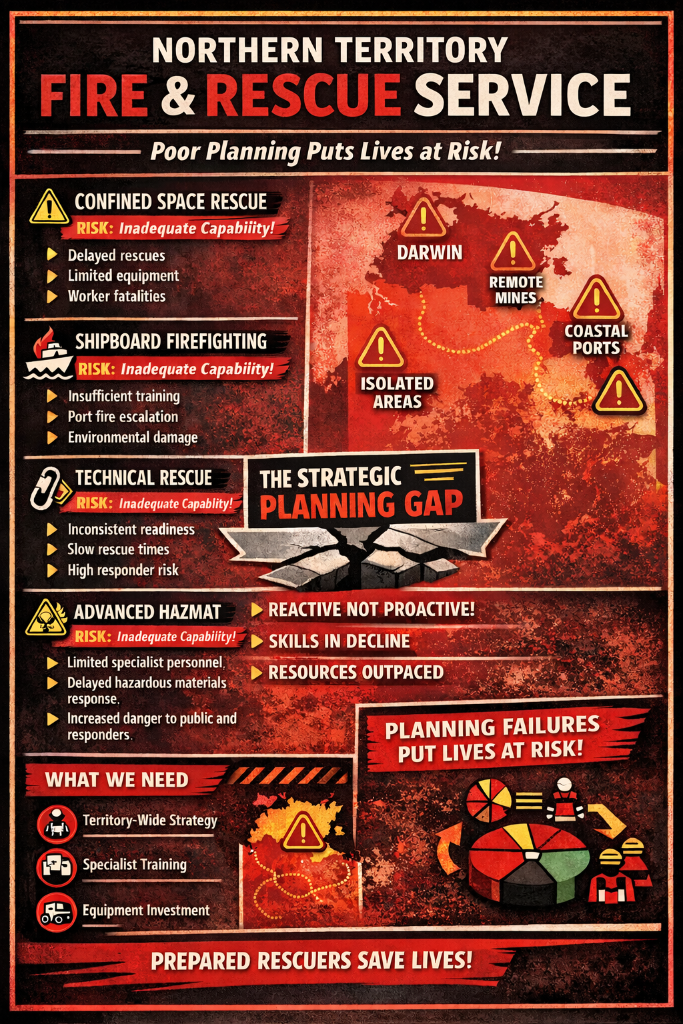
Mr Green said NTFRS dealt with risks under nationally recognised incident management principles, risk assessment processes and work health and safety frameworks used across emergency response environments.
“All frontline firefighters are trained under the nationally recognised public safety training package, supported by internal development pathways and ongoing skills maintenance,” he said.
“Specialist and technical capabilities are developed progressively and prioritised based on assessed risk, frequency of demand, interagency arrangements and available resources.
“Operational equipment, including rescue and hazardous materials assets, is subject to scheduled inspection, maintenance and lifecycle review in accordance with Australian Standards, manufacturer requirements and operational risk profiles. Equipment suitability and training needs are reviewed as part of ongoing capability planning.”
United Workers Union NT secretary Erina Early said the concerns had been raised repeatedly for years with little meaningful change.
“For more than a decade, firefighters have been urging NTFRS to recognise critical operational risks and to implement proper policies, procedures, and training,” Ms Early said.
“Despite these sustained efforts, NTFRS still has no strategic plan to address these issues.”
She said while some firefighters had independently sought additional training, there were still no formal policies, endorsed rescue plans or safe rescue procedures in place.
“Instead of taking responsibility, the executive continues to miss opportunities and shift the risk directly onto firefighters, relying on their commitment to the public, knowing they will never leave someone in danger,” Ms Early said.

Firefighters further claim the training facility they use is the NT Emergency Services Darwin volunteer unit facility, which has effectively displaced the volunteers without consultation, and question when they will have their own facility.
“NTFRS utilises a combination of internal and shared training facilities, which is standard practice across many jurisdictions, particularly for specialised and low‑frequency training,” Mr Green said.
“NTFRS continues to consider opportunities to enhance training capability as part of longer‑term planning in collaboration with government and partner agencies.”
The acting chief fire officer said the NTFRS remained committed to continuous improvement.
“Feedback from our workforce, lessons identified from incidents, and alignment with national standards all inform ongoing review of training, equipment, and operational guidance to ensure our firefighters are supported to operate safely and effectively,” Mr Green said.
However, NTFRS sources, who requested anonymity to protect their jobs, told the NT Independent the agency’s public response to safety concerns was “fanciful and idealistic” and “not based in reality”.
They said crews were being left exposed without training, equipment or strategic and tactical direction, and that the agency’s approach to firefighter safety was “woefully inadequate” and relied completely on firefighters’ own initiative to keep themselves safe.
They said nothing in the NTFRS response was factual.

Following the notice of the protected action, the Office of the Commissioner for Public Employment put the government’s latest offer out to a vote, which Ms Early said was designed to avoid “genuine engagement”.
Ms Early described the latest enterprise agreement offer as an attempt to undermine conditions and ignore calls for health and safety provisions for cancer protections, alongside flexibility, attraction and retention measures and safe staffing levels.
“It is deeply disrespectful for the Commissioner NTFRS and [the] Office of the Commissioner for Public Employment to circulate glossy videos and promotional material that misrepresent the situation and mislead both firefighters and the public,” Ms Early said.
“This offer is effectively unchanged from the one already rejected. It does not reflect good-faith bargaining and is a waste of taxpayers’ money.”
Public Employment Commissioner Nicole Hurwood said in February that NT firefighters were among the best paid in the country, despite the three per cent annual salary increase over four years falling below what police and public servants recently received.
She told the NT News the latest offer improved emergency duty rostering to “remove ambiguity and prevent exploitation of multiple call-outs”, clarified higher duties payments, helped with recruitment and addressed critical vacancies.


0 Comments