

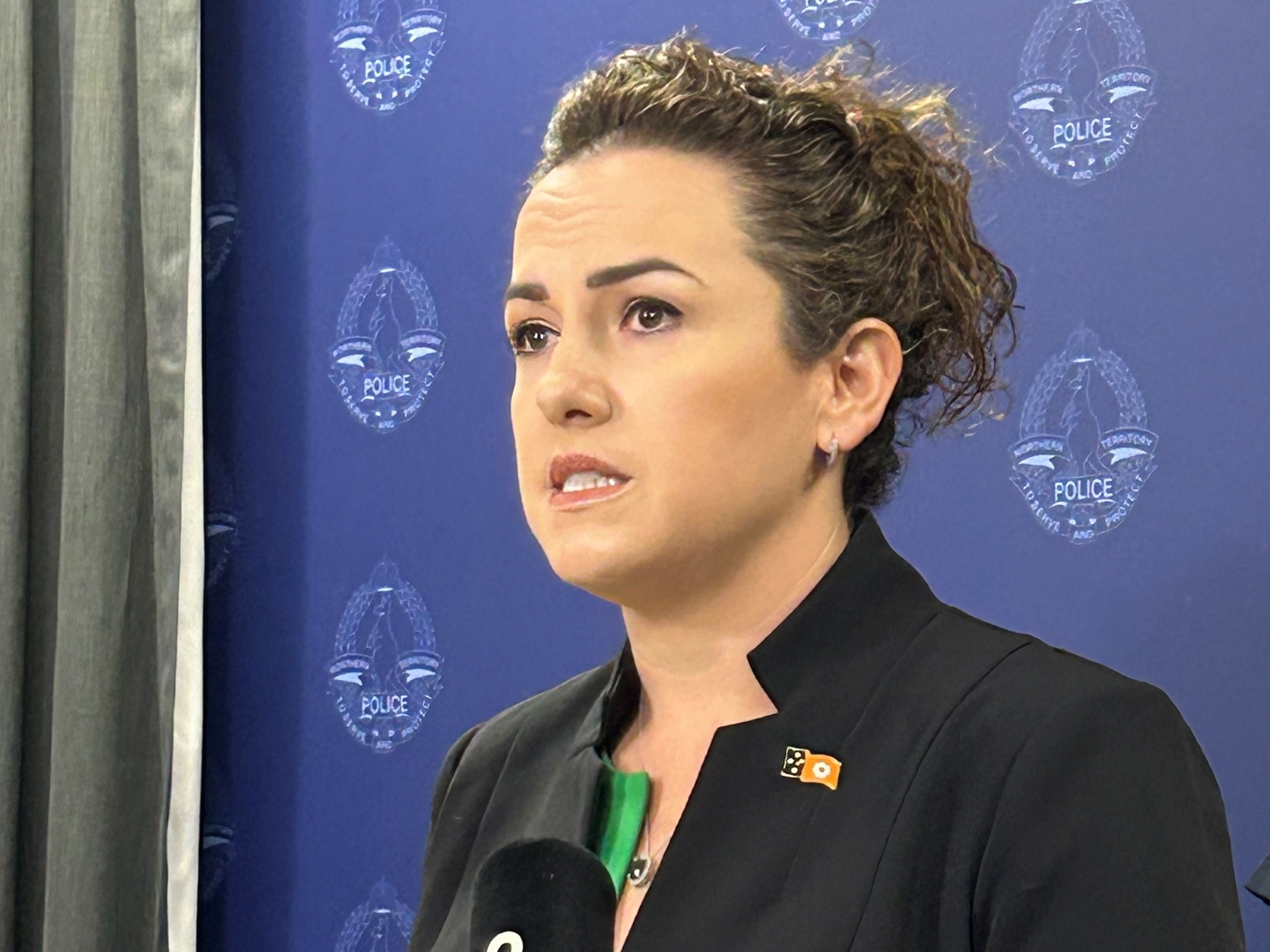
The Finocchiaro CLP Government’s use of police crime statistics to publicly claim its ‘tough on crime’ policies are working is misleading Territorians, new research has found, while raising further concerns about changes to how certain crimes are recorded that the government is using to sell its distorted crime reduction and community safety claims.
A new report examining crime data in the NT by the Jumbunna Institute at the University of Technology Sydney was released last week and follows previous reporting in the NT Independent that showed Chief Minister and Police Minister Lia Finocchiaro was misrepresenting reductions in crime by comparing figures that should not be compared, raising questions about her and her government’s credibility.
The researchers concluded that the “CLP messaging is not presenting an accurate and complete picture through data of the prevalence of crime in the NT and of the efficacy of, and therefore necessity for, its ‘tough on crime’ policy approach”.
The report found the government was cherry-picking certain crime data to share in government press releases, while ignoring other data that would present the full picture of crime.

The report highlighted two administrative changes it says have had a direct impact on the way data is collected and interpreted in the NT: the introduction of the SerPro system, which replaced the PROMIS system in late 2023, and updates to the Australian and New Zealand Standard Offence Classification (ANZSOC) codes pertaining to how certain crimes are recorded.
“…The published data extracted from SerPro is not an accurate representation of actual crime rates, with up to a five-month delay in transitioning data from ‘provisional’ to ‘finalised’,” the report stated.
It added an example of the delay in finalising figures could be seen in the August 2026 crime stats, warning that only the data up to March 2026 “should be considered valid as data [from] April to August could increase by up to 15 per cent” by the time it is finalised.
“…The introduction of the SerPro system significantly limits meaningful comparisons between current data and data collected under the PROMIS system,” it said.
The report found the introduction of the new ANZSOC codes meant that data series collected prior to March 2025 “cannot be compared with more recent data series, as the ANZSOC codes are not directly comparable”.
“This is an important caveat as it means that only data from January 2024 onwards can be used to establish ‘trends’ in crime and victimisation,” the report stated.
Ms Finocchiaro claimed in an August media release, marking two years in office, that her government had brought crime rates down to 2017 levels, but knew at the time that comparing older statistics with newer ones was not accurate.
The changes to offence classification is affecting the monthly crime stats shared by police and published by the Attorney-General’s Department, the report found. Threats to kill, for instance, are now excluded from the ‘assault’ category and included under ‘threatening behaviour’, so any claims of decreased assaults “must be interpreted with caution”, the report states.
Abduction, harassment and other dangerous or negligent acts endangering people now fall under the ‘harm or endanger persons’ category, which were previously listed under ‘assault’. Certain property offences have also been reclassified as ‘disruptive conduct’, “leading to some decreases in property offences”.
“…Changes to the way assaults and property offences are classified may lead to apparent reductions when they actually reflect a shift in the numbers across crime classification codes,” the report said.
Concerningly, the report noted that NT Police data indicated a decrease in family and domestic violence offences in the Territory between 2024 and 2025, even as court finalisation data revealed a “marked increase.”
Using additional data sources such as court statistics, the Australian Bureau of Statistics (ABS), and figures from the North Australian Aboriginal Justice Agency (NAAJA)—which the authors said offer a more comprehensive view—the report concluded that victimisation rates have risen, imprisonment rates and court listings have increased, and demand for legal services has surged since 2024.
NAAJA CEO Ben Grimes said the report’s findings aligned with what his organisation was seeing on the front line and raised concerns about the government’s credibility.
“Everyone wants crime rates to go down, but Territorians deserve honest and accurate information,” he said in a statement Monday.
“When serious offences are increasing in communities, the CLP should tell people about it, not just highlight the figures that make its policies appear successful.”
Mr Grimes added the real data show increasing demand across the criminal justice system, with total court matters across the NT increasing significantly, which means a greater number of people are coming into contact with the criminal legal system, “which sits in contrast with the CLP’s narrative of falling crime rates”.
“The CLP continues to claim that ‘all offences’ are falling, yet several offence categories are excluded from published police crime statistics, including drug and weapons offences, which accounted for 54 per cent of adult Local Court lodgements in 2025-26,” he said.
“Our own data shows we’re seeing more people entering police custody, not fewer.
“If the CLP could arrest its way out of crime, we’d expect to see an initial surge in arrests followed by a dramatic decline. Instead, more than two years into this government’s term, we’re still seeing elevated arrest rates.
“This is no marginal increase. We’re seeing around 15 additional people being arrested daily. This is not evidence of crime dropping. Instead, it suggests crime is steadily increasing.”
CLP doubles down on crime stats
Ms Finocchiaro did not provide comment on the report’s findings when contacted by the NT Independent on Monday, with her office instead sending out lines attributed to a “government spokesperson” that appeared to double down on the misleading claims and ignored the key factual findings from the report.
She was also not asked about the report during a radio appearance on Mix 104.9 Monday morning.
“Crime and court statistics are publicly available so Territorians can see for themselves that, after eight years of Labor losing control of crime, our record investment in police and strong law and order measures are beginning to deliver results,” the government statement said.
“Crime statistics in the NT show that the Finocchiaro CLP Government is reversing Labor’s crime crisis.
“Crime is going down, but there is much more work to do, and community safety remains our number one priority.”
The report found the data since 2008-09 did not support the “argument that crime was at a crisis point prior to 2024” or that offending declined following the CLP’s “tough on crime” policies.
The report’s co-author Tatiana Corrales told the ABC over the weekend that the CLP’s claims it is successfully dealing with Labor’s “crime crisis” was not backed up by facts.
“So when the government stands up there in front of the community and uses that data to make claims about reductions in crime, that data is not reliable and shouldn’t be used,” Ms Corrales said.
“Claims that the government is addressing the crime crisis created under Labor, we can’t even test that. Despite what some of the more popular messaging may be, there’s actually no clear trend.
“I’m not convinced that that’s unique to the NT Government … but I think it’s particularly problematic in the NT because the government has pushed through such punitive legislation that is really having a negative impact on communities across the NT.”


0 Comments