

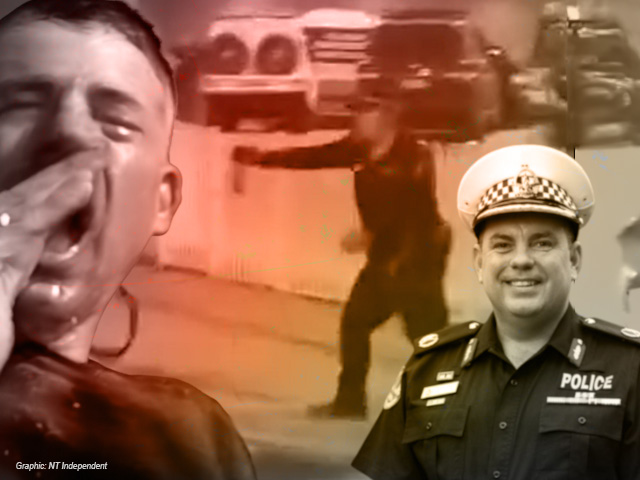
A television cameraman says he was doused in the face with capsicum spray by a police officer without warning while covering last week’s riot outside Alice Springs Hospital, where officers also threatened to arrest members of the media, but Police Commissioner Martin Dole has flip-flopped on his stance that it should not have happened, now saying the attack on the cameraman was “appropriate in the circumstances”.
Police used tear gas and rubber bullets to disperse the crowd of hundreds who had assembled outside Alice Springs Hospital last Thursday to demand vengeance against alleged child killer Jefferson Lewis that saw some members of the crowd launch rocks at police with a police car and bins set on fire.
Lewis was found earlier that night at Charles Creek Camp by a “group of vigilantes” who allegedly bashed him before police were called.
Network 10 Adelaide cameraman Matt Bonser said he and a reporter were filming the chaotic scenes that unfolded after Jefferson’s arrest at the hospital when he was hit with OC spray as he moved backwards while recording.
“I was filming the NT Police arresting a lady who had tried to set alight a police vehicle, when, as I was walking backwards a police officer came from the side of me and sprayed me with capsicum spray,” Mr Bonser said.
“I was sprayed in the face and arms, and the immediate effect of the spray took about 30 seconds to hit me, I then felt a severe burning pain and was unable to continue filming the activity that was occurring at the hospital.”

He said he was taken aside by other members of the media who helped him flush his eyes with water.
“I believe it was quite obvious that I was part of the media covering the event,” Mr Bonser said.
“There was a small group of photographers and myself operating to the side of the main activity and we were very clearly not part of the protest pack.
“I had a large TV camera on my shoulder, which is easily identifiable and at no stage was I a threat to the police.
“There was no warning for me to move and I was sprayed without any hesitation by the police officer involved. During the protest, I saw other members of the media physically moved away and also prevented from doing their job.”
The attack by police was captured on video. After Mr Bonser is sprayed, the video shows another aggressive officer physically pushing back a member of the media and threatening to charge them.
“Attacking the working media at a rapidly changing situation like this removes our ability to provide fair and balanced coverage on this event,” Mr Bonser said.
“I had to remove myself from the area for nearly an hour while I recovered and put on a new shirt etc, during which time a lot occurred outside the hospital that I was unable to capture.
“When I returned to the scene there continued to be a high level of aggression from the NT Police towards a number of members of the media, with many threats of arrest for simply doing our job.
“This level of aggression was very unwarranted and appeared misdirected, when you consider the many other people that were nearby attacking the police with rocks and other projectiles.”

Mr Bonser said Mr Dole and the superintendent of the officer who attacked him later apologised and admitted that what happened should not have occurred, while pledging the matter would be investigated.
“At this stage a formal complaint hasn’t been made, but it is being considered,” Mr Bonser said.
“I believe there does need to be some accountability for what occurred that night.
“I can understand that the media are sometimes caught in the ‘crossfire’ of a situation like this, however what happened to me appeared to be a targeted and direct attack on a person who was no threat and just doing their job.
“It does not assist in accountability of the authorities or press freedom in the Northern Territory.”
Mr Bonser said in an “ironic request” the police told him the next day that they wanted his vision of the riot at the hospital to assist in their own criminal investigation of rioters.
When asked about the incident at a press conference the next day, Mr Dole said Mr Bonser being sprayed was “unfortunate, and that shouldn’t have happened”.
“And you know, when police are heightened and using force and defending themselves, emotions are high, and I can only apologise that your cameraman was sprayed, and that’s not an appropriate use of force,” Mr Dole said.
“That shouldn’t have happened, but police shouldn’t be attacked when they’re doing their job.”
However, in a statement to the NT Independent on Friday, Mr Dole said police had conducted a “use of force review”, which is required every time force is used, with the reviewing officer deeming the conduct “not inappropriate in the circumstances”.

There was no explanation as to why it was considered appropriate. Mr Dole said in his statement that OC spray was being used as an “attempt to quell the volatile riotous situation” and said at the press conference that the OC spray was being used against people attacking police.
The video shows Mr Bonser was clearly not attacking police or involved in the riot.
In response to being asked if the officer would be retrained in the use of OC spray, or disciplined or charged, Mr Dole replied, “no”.
He pointed back to his assessment that the officer did not act inappropriately in a “highly volatile situation.”
The NT Police Code of Conduct and General Orders states members may only use force that is lawful and reasonable in the circumstances, but the use of force guidelines do not appear to be published online.
The ABC reported in 2018 that NT Police had concealed its guidelines for how officers use their weapons from public view.
The Australia New Zealand Policing Advisory Agency use of force guidelines stipulate police should only use force that is reasonable, necessary, proportionate and appropriate to the circumstances and individual police officers are accountable and responsible for their use of force and must be able to justify their actions at law.
“For the public to be informed, journalists must be safe at work, including when covering protests and other potentially volatile situations,” Ms Derrick said.


0 Comments