

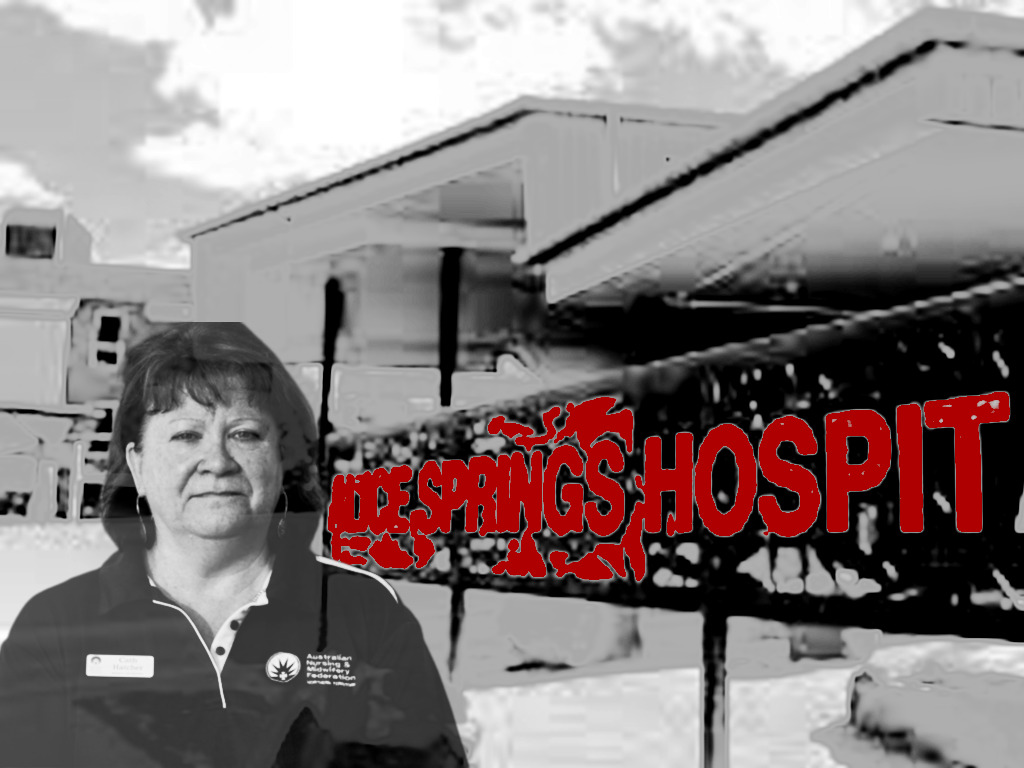
Nurses and midwife staffing numbers at Alice Springs Hospital are down by about 130 full-time equivalent positions, or by about 30 per cent, with some leaving due to violence in the town and fatigue, with casual agency nurses in remote central Australian health clinics being paid $1500 a day, Australia Nursing and Midwifery Federation NT branch secretary Cath Hatcher said.
The union boss was on Mix 104.9 on Monday to announce the hospital was 130 full-time equivalent positions short for nurses and midwives based on data from last week, and was another 28 nurses and midwives short in surrounding central Australian community health clinics.
She also described the injuries of people going into the emergency departments as being like a “war zone”.
“Alice Springs hospital was short 130 nurses and midwives mainly because of the crime problem,” she said on radio.
“Sometimes it’s successful, (recruitment) depending on which ward you’re looking at, but they haven’t worked with full capacity for quite some years now… and it’s gotten worse in the last six months. Starting during the COVID-19 pandemic period, they (medical staff) had a huge workload daily, and it’s been continuous.”
She said the remote health clinic positions were being filled by casual staff from agencies, who were getting $1500 a day, but the agreement for that rate of pay ended at the end of the month, and she questioned if getting paid less would stop nurses wanting to go to those places.
Ms Hatcher was also interviewed about the issue on Sky News on Friday.
“The executives are trying to fill those positions with casuals and agencies but unfortunately because of, perhaps media, and what’s been going on over the last three to six months, nurses and midwives don’t want to come to work in Alice Springs because they’ve heard about the violence,” she said.
Chief Minister Natasha Fyles, who is also the Health Minister, did not respond to questions confirming how many nurses and midwives were short in the region, and would not say how much the NT Government had spent over the last six months employing casuals.
Or what they were doing to solve the problem.

It comes as the government on Monday announced alcohol bans would be reinstated for an unspecified number of Aboriginal town camps and communities across the entire NT until communities can vote whether or not to opt-out, under new legislation pledged by Ms Fyles, while the Federal Government had promised $250 million for unspecified projects over an unspecified period of time in central Australia.
In a media release on Monday, Ms Fyles said the NT Government would introduce legislation next week temporarily banning alcohol in town camps and communities.
The ABC reported last Wednesday that NT government data showed there was a 50 per cent spike in alcohol-related cases in the Alice Springs Hospital emergency department since the alcohol bans were lifted by the government in July last year.
It said the NT Health data showed both Alice Springs and Darwin emergency departments hit their highest levels since 2018, with alcohol-related cases in Alice Springs rising from 856 cases in the second quarter of 2022 to 1,299 in the final quarter of the year.
“It was certainly that November, December period where we saw an increase – and that is why we continue to be agile with policies and put in place different measures,” the ABC reported Ms Fyles as having said about the data.
Ms Hatcher also said a lot of nurses and midwives had left their profession permanently, or left for 12 month to two-year breaks.
“They may be coming back, or they may be going to other areas resulting in the deficit of nurses and midwives. Also, with the continued violence happening in Alice Springs, these nurses and midwives might choose to go elsewhere,” she said.

Ms Hatcher said nurses were also subjected to the often-aggressive behaviour of patients caused by delays in their treatment due to the huge workload of other health staff.
“The aggression has certainly increased because of the workload. The hospital’s nurses and doctors have to do the extra care since the allied health staff aren’t there so there’s extra aggression when patients don’t get their care promptly,” she said.
Ms Hatcher said the hospital has already increased security, but the medical staff were instructed to always travel in pairs outside, and need to be aware of their surroundings.
“There are also some incidences of violence in Katherine, and towns around the Territory, but not to the extent of what’s happening in Alice Springs,” she said.
“While we don’t have members coming to us, we know that violence has also increased in and around Katherine, and I am sure that it won’t be long before members come to us with situations just like what is happening in Alice Springs Hospital.”
“Hospital managers would like to see more recruitment of medical staff to be done by the Department of Health within the Territory and from interstate by offering better pay and incentives.
“To be able to retain the current staff, which are either on sick leave or on long service leave, who are perhaps looking at not coming back to work in the Territory. They’re looking for other jobs within other states and they are very tired and they’re very fatigued and they like I said just don’t have the energy to continue perhaps.”


0 Comments