

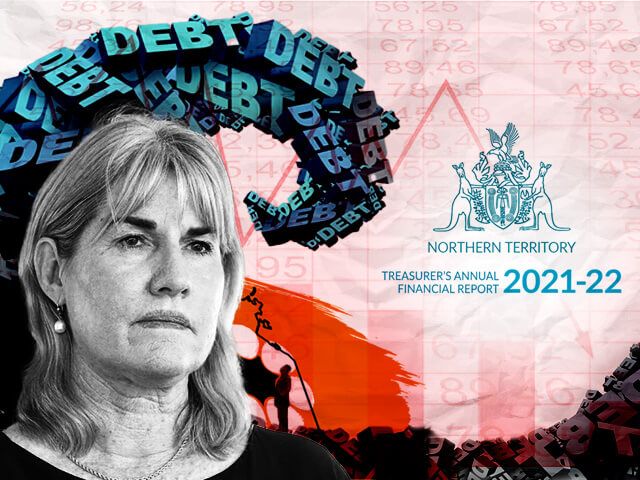
An unexpected surge in GST payments of more than half a billion dollars, enhanced taxation, and increased mining royalty revenues helped but were not enough to unburden the Territory’s fiscal position, which has come in with a $330 million deficit for 2021-22 and a massive $7.6 billion net debt.
The Treasurer’s Annual Financial Report, released in Parliament this week, revealed that last financial year’s deficit stood at $330 million – and improvement of $524 million from the revised figure – but that rising inflation, caused by a surge in the cost of living and persistent increases in interest rates, have curbed efforts to put the deficit at more manageable levels.
The Northern Territory’s overall net debt for the year came in around $7.6 billion – $1.36 billion better than forecast in the 2021-22 Budget – but still the highest net debt in the history of the NT.
Net debt-to-revenue ratio dropped from a forecast 122 per cent to 96 per cent, however interest payments increased from $364 million to $374 million annually between 2020-21 and 2021-22.

“Labor has added nearly a billion dollars of debt to the Territory every year they’ve been in Government,” Opposition Leader Lia Finocchiaro said.
“This is a very small improvement on what was predicted and it is still a $7.6 billion debt that will be an eye-watering amount next year.
“The Government has no plan to get out of it or grow the economy.”
Ms Finocchiaro added that the perceived improvements were not what they appeared.
“A closer look at the detail soon reveals how projects have been moved from year to year to put a better spin on the result,” she said.
“Two-thirds of the lowered estimates for debt are a result of shifting $242 million of costs from last year into this year.”
The May Budget forecast the debt this financial year will be $8.7 billion and $9.2 billion next year.
Treasurer Eva Lawler said the slightly improved figures “positions the Territory to tackle and overcome uncertainty and challenges ahead”.
Figures show the GST payments increased by $584 million “due to a significant improvement int he national GST pool associated with improved economic conditions”.
The annual financial report also shows that taxation revenue increased mainly because of higher stamp duty on conveyances on the back of enhanced housing sale volumes and values combined with several large, unpredicted commercial transactions like the $418 million sale of Casuarina Square to Sentinel Property Group.
Additional government revenue for the period in review came from mineral production, which showed the second-highest increase in own-source revenue for the government.

The mineral production value was pegged at 4.86 billion in 2021-22, marking a 14 per cent increase from last year’s $4.28 billion. The figure is just below the ever-highest value of $4.92 billion in 2018-19.
The increase was due to improved manganese production which went up 21 per cent to $1.78 billion and zinc-led concentrate which recorded a big increase of 27 per cent to $1.15 billion.
The annual report also indicated a two per cent rise in the volume of gold produced to 15.2 tonnes, and a four per cent improvement in the value of gold production to $1.24 billion on the back of higher gold prices.
“The minerals sector is a vital contributor to our economy, and this increased production value shows that there is no better place than the Territory for resource development,” Mining Minister Nicole Manison said.


0 Comments