

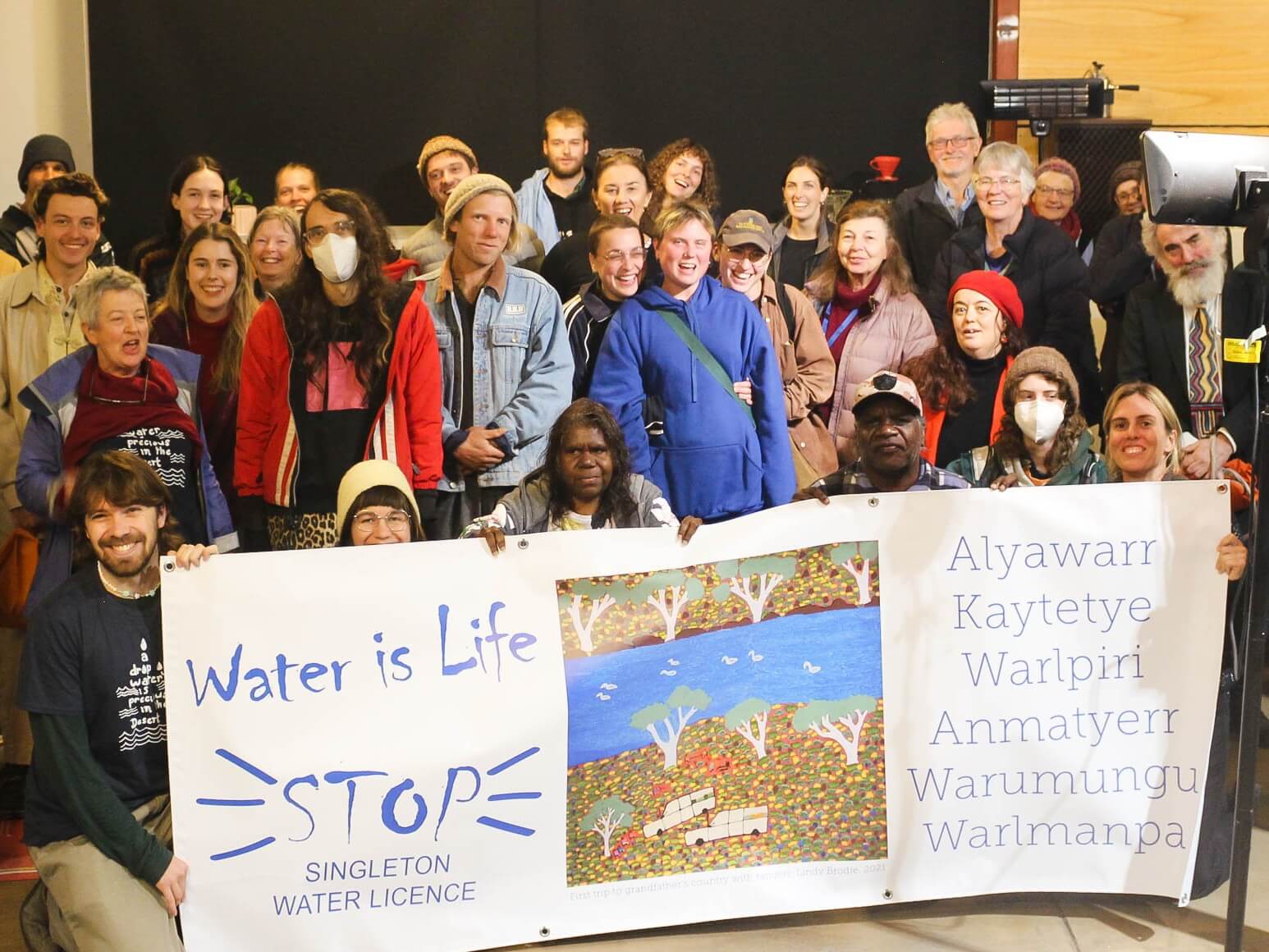
Traditional owners and the Arid Land Environment Centre will have their legal challenge against the NT Government over the granting of the massive Singleton Station water licence, which they say disregarded technical evidence and Aboriginal cultural rights to the water, heard in the Supreme Court on Wednesday.
The group want the single largest water licence ever awarded in the Territory of up to 40,000 megalitres of groundwater a year overturned.
The court action was launched in February and will be heard tomorrow in Alice Springs.
The Singleton Station water licence awarded to agribusiness company Fortune Agribusiness grants the company a free 30-year right to extract the groundwater from aquifers under Singleton station, about 400km north of Alice Springs.
With the licence’s staged 30-year life span, Fortune Agribusiness will have extracted more than 1 trillion litres of water from Kaytetye country, which the group says will destroy up to 30 per cent of the region’s groundwater-dependent ecosystems.
The licence was granted to Fortune Agribusiness in 2019 for free because the Territory does not charge for large-scale commercial water use like its interstate counterparts. In other jurisdictions, the licence could be worth up to $300 million, estimates suggested.

Lawyers for the Mpwerempwer Aboriginal Corporation claim that Territory Families Minister Kate Worden – who was delegated the powers to make the licence decision because Environment Minister Eva Lawler had a conflict of interest – failed to properly consider 1,600 pages of technical evidence and disregarded Aboriginal cultural values in her decision to grant the licence.
Lawyers said Ms Worden re-granted the license just a few days after being delegated by the Environment Minister due to a conflict of interest.
“Given the short time between delegation and decision, and the volume and technical nature of the materials, it may be inferred the Minister cannot have properly considered key evidence,” the lawyers wrote in their originating motion.
“The Minister’s decision to grant the licence was seriously irrational as no rational minister would have treated the [evidence] so irrationally.”
Ms Worden told the ABC that she did read the review and other submissions before awarding the licence and that the decision was “reasonable”.
The Arid Land Environment Centre, also alleged that the Minister for Environment’s initial decision to issue the licence was “legally unreasonable” because it did not follow the Water Act.
“The licence was not assessed against the relevant water allocation plan. It was granted using a separate set of guidelines that allowed for environmental damage. No reasonable decision maker could be satisfied that the Proposed Decision was following the Water allocation plan,” ALEC said in a statement.
An earlier report commissioned by the Central Land Council (CLC) on behalf of traditional owners indicated that the Singleton business case claim on employment benefits was “largely illusory”, particularly for Aboriginal people.
Economists from the University of South Australia business school said Singleton is likely to generate only 25 to 36 full-time equivalent jobs in the Territory, and only five to eight of those would go to Aboriginal people in the Barkly region.
This is contrary to Fortune Agribusiness’ claim of creating 110 permanent and 1,350 seasonal jobs, and providing an economic benefit to the Territory worth about $100 million a year.
The report also said that based on analysis of the information given in the Fortune Agribusiness business case, a realistic estimate of economic benefit to the Territory would only be between $13 million and $28 million annually.
“The NT government appears to have decided to gift a public asset worth between $70m and more than $300m for a project likely to create very limited NT employment and likely adverse impacts on the social and economic wellbeing of Aboriginal traditional owners, residents of neighbouring remote communities and the environment,” the report said.
Professor Quentin Grafton, director of the Centre for Water Economics, Environment and Policy at the Australian National University, who reviewed the report said “providing a large subsidy of free water to Singleton horticultural projects was not justified from either public interest or a cost-benefit perspective and did not constitute free prior and informed consent by traditional owners”.
Fortune Agribusiness rejected the CLC’s report and has said it has stringently followed every process required of it by the NT Government, and that it will be working closely with traditional owners to provide jobs to the region.
“Over the years, a considerable amount of investigation and scientific work on water resources, horticulture potential and environmental management in the Western Davenport region has been undertaken by Northern Territory Government, Geoscience Australia, and Fortune Agribusiness,” told the ABC.
The case will be heard again on September 7 in Alice Springs. A large group of people affected by the licence is expected to walk from the Parsons St lawn to the Supreme Court building to attend the start of the hearing and will be speaking about the effect the water licence will have on sacred sites, cultural values and local communities during the lunch break.


0 Comments