

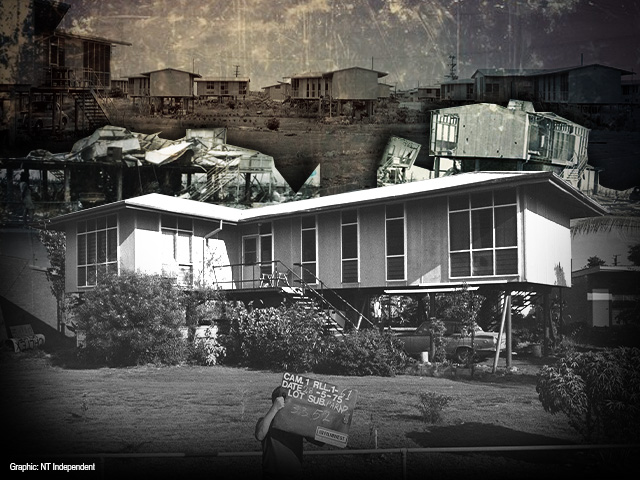
By Steven Andrews
To elevate or not to elevate. That is the question that has dogged government and private builders of housing for more than 70 years in the Top End.
“…a land of heat, and in which mother nature has bestowed abundant beauty…As I write this letter, I am wet with perspiration trickling down my chest, dripping off my chin…and the time is 8.40pm…I am burnt black alright, but my feet and bum are still white…it’s hot, damnable hot!”
So wrote Robert Rolph snr in 1942 while he was stationed in Mataranka, and later Darwin during the Second World War.
Mr Rolph found the brutal tropical heat unrelenting. The climate was foremost in his mind, a common focus for many who travelled to the Top End from temperate southern climates. Living comfortably in the tropics would soon be given the utmost consideration by authorities.
After their forced exile, fewer than half of all evacuees chose to return to Darwin after World War II. Those who did return found a town very different from the one they had left behind. Heavily bombed and savagely looted of anything of value, post-war Darwin was an unenviable place to find oneself.
Squatters and the government’s compulsory acquisition of surviving structures left little in the way of available accommodation.
People were forced to live in unpleasant and unsanitary wartime military buildings in the various town camps. They were hot and airless and flooring was often compacted dirt. Insects and inclement weather entered freely, and life within was generally miserable.
Toileting was via flaming fury latrines, a 44-gallon drum sunk into the ground to the desired height with a makeshift seat; usually housed in a stifling tin outhouse. At frequent intervals, kindling and kerosene were thrown in and set alight to burn off the effluent — the process that gave this hideous amenity its name. The resultant stench across neighbourhoods was diabolical. Most people were considerate and lit their fury late at night, but some thoughtless or deliberately aggravating folks did it at dinnertime, causing a ruckus.
Despite the ramshackle accommodation, the insects and the smell, Darwin persevered. The 1950s brought a new standard of living in the form of cheaply produced government houses, which were enthusiastically embraced because of earlier hardships.

But the houses were basic. As a result, a long and determined push began to make life in Darwin as modern and comfortable as possible.
Mr Rolph’s impression of the Top End climate was shared by the public servants who later poured into Darwin en masse at the behest of the Commonwealth Government to administer a new three-year development plan.
It was believed Darwin should showcase the best Australia had to offer as the nation’s contemporary front door. Government departments here underwent extraordinary and rapid growth; the development and population increase that followed would not slow until Cyclone Tracy in December 1974.
To ensure a stable and productive workforce, the government needed to provide modern accommodation, at work and at home, for its personnel.
Intrepid public servants were put to work in the most dreadful conditions.
At the Department of Works, they laboured tirelessly despite the department’s main office being a tumbledown wartime building with a leaking roof. The paper ceilings sagged, the floor was rough concrete and the roof had to be propped up to prevent it from collapsing on everyone. Designs and proposals for new office and residential accommodation were often dismissed by key Canberra officials who lacked an understanding of the unique challenges presented by Darwin’s tropicality.
Though new neighbourhoods were purpose-built, their development was beset with early problems. Water mains and hydrants were installed, but storm water drainage and sealed surfaces would not come until much later.
Residents suffered from noise and dry season dust on all household surfaces.
The wet season created muddy conditions making foot traffic impossible and driving hazardous. Cars become filthy and often bogged. Household stairs and floors required constant cleaning.
Complaints from those subjected to such conditions meant future works programs provided for the installation of critical infrastructure prior to the arrival of new residents.
By 1953, drawings for the linear, reduced-cost D-series of residences had begun. In total, eight designs were produced. The D1, D2, D4, D5 and D8 were all elevated.

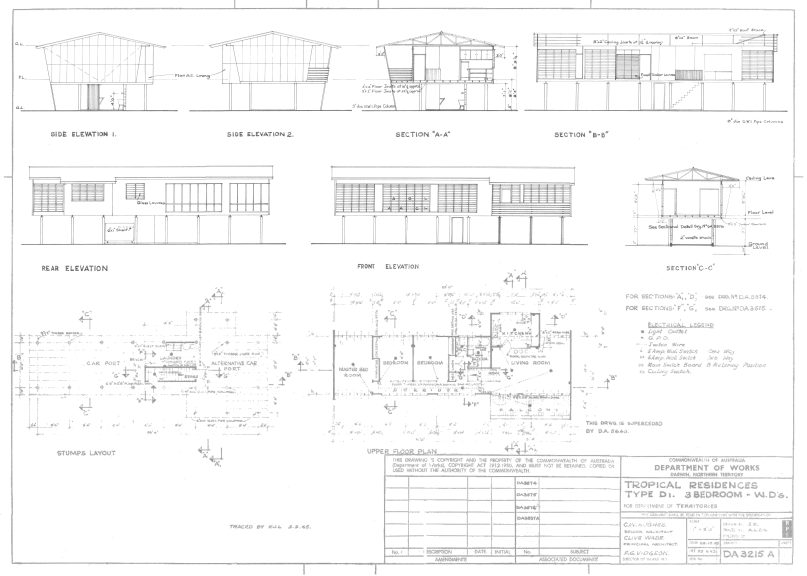
Tropical residence type D1 three bedroom from 1953. Source: Library and Archives NT
The D1 was the largest, most attractive of the series and the only design to feature a balcony, making it immensely popular. The D8 was a four-bedroom version of the D4, and only six were constructed. Four-bedroom residences required approval by Canberra’s Department of Treasury, which was often given reluctantly after much scrutiny and argument.
The D3 and D7 designs were split level, the latter being considered over the approved housing scale, and not approved for construction.
The D6 was the only ground level type of the series. Almost immediately, local discourse centred on the repetitive, temporary appearance of the houses.
A parliamentary delegation was sent to the Northern Territory in 1955 principally to examine the high cost of houses in Darwin. Canberra was convinced that costs could be drastically reduced.
So began a decades-long debate about significantly cheaper ground level construction versus the elevated option.
Development of what would become Darwin’s iconic upstairs houses was under threat from their earliest days.
But owing to their immense popularity, elevated house types would prevail through all early bickering over cost against climactic necessity.
Piers were initially steel and raised houses approximately 7 – 8 feet off the ground, sometimes higher depending on the rise and fall of the land. They were timber framed, iron roofed and ventilated by vast areas of glass and asbestos, or metal louvre windows. External walls featured sheets of unpainted fibrous asbestos cement, referred to simply as fibro. When wet, the cladding took on a grey colour that quickly saw the houses dubbed ‘government greys’ and Darwin’s suburbs ‘the fibro jungle’.
Every economy possible was identified, and enforced for the D-series and subsequent early C-series residences. Construction costs had been reduced from £6,825 for 1951’s discontinued ‘Tropical’ design to between £5,000 and £5,500 per D-type. The ground level D6 was particularly cheap at a meagre £3,800.
The houses were mere shells. Bare hardwood floors were unsealed, and avoiding stains from spillages and normal movement through the house was impossible. There was no letterbox, fencing, ceiling fans or fly screens.
Houses were not numbered, which proved to be a threat to life in emergencies. Some tenants took to painting their lot number on the street-facing floor joist, but in some cases, this looked unsightly if care was not taken. Concreting was not provided to clotheslines or the street.

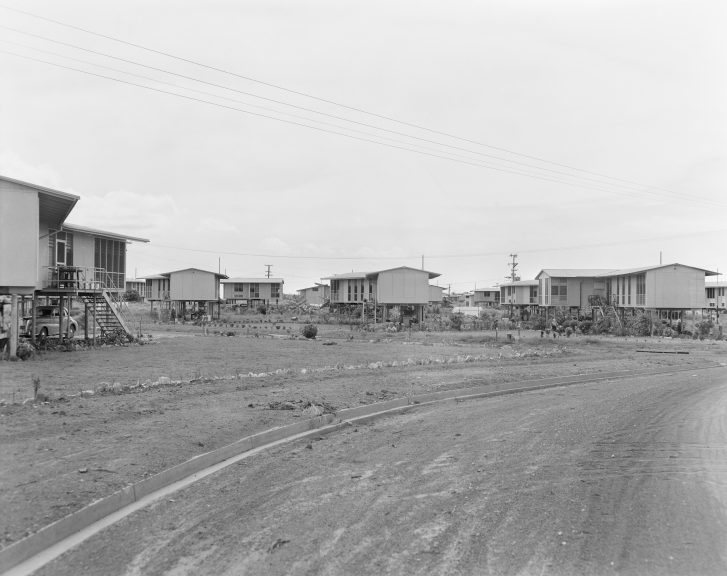
Government-built houses on Cooper Street, Fannie Bay photographed from Playford Street, looking east, c.1958. Picture: National Archives of Australia NAA: A1200, L25471
The roads were initially unsealed and there were no footpaths. The practice of not providing these until after residences were occupied was later changed. This meant that all infrastructure was largely in place or being installed before houses were allocated to tenants.
Residences were initially lined with hardboard treated with a fungicide wash and painted, which produced a harsh but mould-resistant finish. Its use was later abandoned when it was found to be a fire hazard. Fibrous plaster in earlier residences gave a softer, more appealing finish, but was prone to chronic mould attack.
Asbestos cement was used as a ‘stop-gap’ until something more suitable could be found. Eventually, a locally manufactured fibrous plaster became available, producing a sleek, modern appearance and finish.
There were no doors, shelves or drawers fitted to wardrobes and no doors provided for bedrooms two or three. Textiles were strung across openings to conceal contents and provide privacy. There was no hot water, no doors on kitchen cupboards, no exhaust fans or rangehoods and no linoleum or vinyl floor tiles.
These economies quickly led to complaints from tenants who demanded increased safety and comfort. Over time, all missing amenities would be approved as standard and the high cost of retrofitting meant that future economies were given more sensible consideration.
Tropical housing hit its stride in the decade to 1974.
Consideration of safety during a major cyclonic event came too late, so when measured against their objective to provide cheap and comfortable accommodation for government workers, the various series including the later C-, M-, T- and HE-types were all considered successful, not just by the commonwealth, but also by tenants who quickly purchased their homes when they were eligible.
Gardens exploded with life, softening the appearance of austere dwellings. Neighbourhoods prospered and people came together. Enduring friendships were easily established. An empowering feeling of having mastered the harsh tropical environment and the tyranny of distance prevailed until Cyclone Tracy. Every aspect of housing across Australia was questioned, and it was quite literally a case of back to the drawing board for the government. Tropical housing changed forever.
The repetitiveness and fragility of the pre-Tracy elevated houses cannot be denied. But for visitors from down south or abroad, they provided a wonderfully unique experience; a distinctive characteristic of a Darwin holiday.
Visitors now are more likely to stay in houses no different from their own back home and as a result, their experience of tropical Darwin is somewhat less remarkable, even if they do not realise it.
The look and lifestyle afforded by elevated houses was and is unique to any other Australian capital city — an enduring legacy still that remains proudly visible today.

Steven Andrews grew up down south in the 1970s, surrounded by similarly designed houses constructed by the commonwealth. Those houses were single-storey, ground level and fulfilled only the essential needs of occupants.
A 1980s high school project on severe weather led to research that included a mention of Darwin’s elevated houses and a lifelong passion began.
He found the idea that an entire house could be elevated on high stilts a fascinating concept but because he didn’t live in Darwin, and it was in the days before the internet, he found it difficult to find further information. That lack of available information only fuelled his interest.
He first came to Darwin in the late 1980s to gaze upon these architectural marvels in person, then explored Australia and overseas. He returned to Darwin permanently in 2012, and earlier this year published his life’s work as a book, Tropical Staff Housing – The Designs and Equipment in Darwin’s Iconic Upstairs Houses 1951–1974.
Robert Rolph snr was his grandfather.

Interesting article. Thanks.
Fascinating article. Thanks. And please forgive a tiny nitpick – “climactic necessity” should be “climatic necessity”, unless referring to the necessity of having a climax. I won’t go there.