

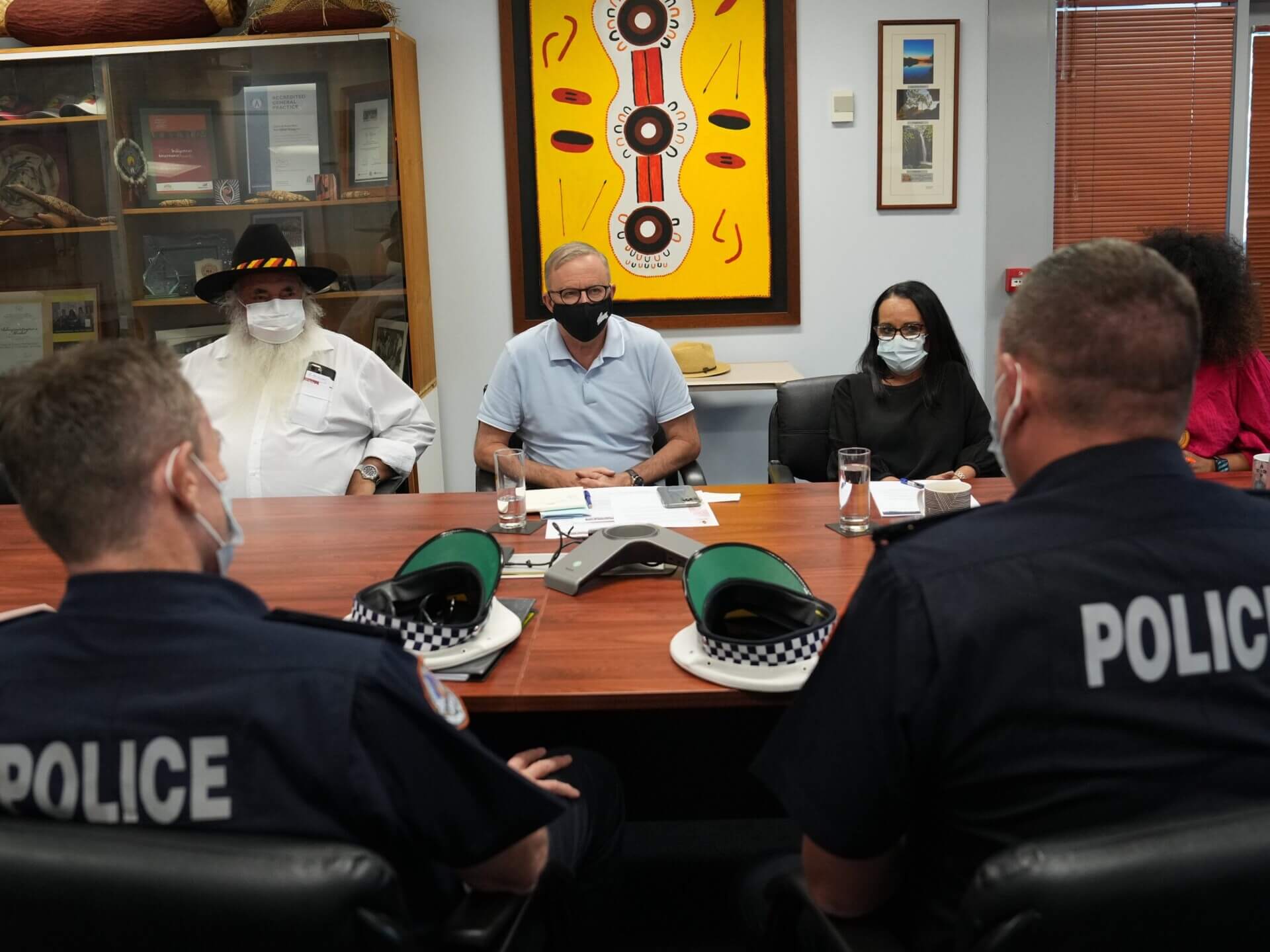
UPDATED: Prime Minister Anthony Albanese arrived in Alice Springs on Tuesday to hold meetings with community groups and police about the ongoing crime crisis that has exploded as a national issue in recent days, while the Chief Minister has announced new alcohol restrictions for everyone in Alice Springs for the next three months.
His last-minute visit was the result of growing political pressure and comes as the People’s Alcohol Action Coalition calls on either him or the NT Government to immediately reinstate Stronger Futures-equivalent grog restrictions, saying alcohol misuse in communities is leading to human rights issues.
Mr Albanese landed in Alice Springs with Indigenous Australians Minister Linda Burney and Labor MP Marion Scrymgour and Senator Malarndirri McCarthy on Tuesday, while NT Chief Natasha Fyles and Police Minister Kate Worden had also travelled to the Red Centre.
Federal Opposition Leader Peter Dutton had called on the Prime Minister to travel to the troubled central Australia capital.
The Territory Government has had little to say publicly about the out-of-control crime in Alice Springs in recent weeks, when it was mostly only being reported in the Northern Territory media. Just before Christmas, Ms Fyles blamed the previous Coalition federal government for letting the Stronger Futures legislation that restricted alcohol to Aboriginal communities end.
“It wasn’t our change in policy — it was the federal Coalition government’s change in policy,” she told the ABC.
“We deal with what we can — we’ve got interim legislation, we’ve got the BDR (banned drinkers register), we’ve got a floor price, we’ve got risk-based licensing.
“But I don’t think it’s fair to place blame when it was not our legislation that ceased.”
On Tuesday, she defended the government’s decision not to renew or replace the Stronger Futures legislation that had kept grog out of many remote communities but which came to an end last July.
“There is the ability for remote communities to opt in but there is also the ability to restrict the supply to those that cause harm remembering that it is a legal product right across Australia,” she told Sky News on Tuesday.
“The intervention, which is what the Stronger Futures legislation was, disempowered Aboriginal people based on their race.
“We put in place a measure that is not race-based.”
New alcohol restrictions for everyone
Ms Fyles announced changes to alcohol sales following the meeting with Mr Albanese that will now forbid takeaway alcohol from being sold on Mondays and Tuesdays in the town and daily sale hours restricted to between 3pm and 7pm.
Alcohol sales will also be limited to one transaction per person per day for the next three months.
A bureaucrat, known as a “central control officer”, was also announced to ensure better coordination between the federal and NT governments’ response to problems in the town.
Ms Fyles added she understood the pain the community was facing as crime cripples the town, saying that the NT Government has the ability to handle the situation.
Mr Albanese posted photos to his Twitter account Tuesday afternoon, showing him meeting with police, Indigenous community groups, while flanked by federal Labor and NT politicians. He also met with Alice Springs Mayor Matt Paterson, who had called for the military or federal police to restore order.
Prime Minister Anthony Albanese in Alice Springs on Tuesday.
Mr Albanese offered platitudes to accompany the photos of the meetings.
“All Australians deserve to live in safe and healthy communities,” he said on Twitter.
“I’m here in Alice Springs to meet with community groups, council, the NT Government and frontline services, to hear about the urgent challenges they’re facing.
“Because we know that the best solutions come from local communities themselves.”
He later said that alcohol was “clearly a factor” in the town’s troubles of late and that he had commissioned an “urgent report” to explore further options to reduce harm caused by alcohol misuse.
Ms Fyles reiterated that she is against a John Howard-style federal intervention which was implemented in 2007, which included those strict curbs on the sale of alcohol and the quarantining of welfare payments among a suite of measures. Many cite the Fyles Government’s decision not to extend alcohol bans covering more than 400 remote Aboriginal communities and outstations across the NT, affecting about 7000 Territorians, that expired in July, as the catalyst for the increase in crime in Alice Springs and other regions of the NT.
The flurry of movement to the town was sparked by both Mayor Paterson and Action for Alice Facebook page administrator and bakery owner Darren Clark attracting national media attention in the last week, about what they see as a crisis in the town.

NT police statistics show property offences jumped by almost 60 per cent over the past 12 months, while reported assaults had increased by 38 per cent along with reported domestic violence assaults by 48 per cent.
Federal Indigenous Australians Minister Linda Burney said the Albanese Government would be continuing to assess medium and long term solutions for the town.
“The important thing is we are here,” she said, “because there has been a desire from the community for action and we have responded to that.
“We will be working closely together in terms of addressing the issues here.”
Calls for more restrictions on alcohol to match Stronger Futures legislation
PAAC spokesperson Dr John Boffa said what was happening now was exactly what leading Aboriginal health, justice and community organisations, along with PAAC, predicted when alcohol was allowed back into most of the NT’s Indigenous communities in July.
“NT towns that were already battling with excessively high levels of youth offending, especially Alice Springs, are awash with take-away alcohol and the results are stark and horrific,” he said.
“The upshot is that the rights of Aboriginal women to be safe from violence, and for their children to be free from neglect and harm, and not to live in fear, have been thrown in the bin.
“In fact, the community in general is living in fear of violence and no longer enjoying the amenity of Alice as it once did.
“That is what happens when the privilege of access to alcohol is placed above fundamental human rights.”
He said there was more violence, and more fetal alcohol spectrum disorder cases on the way and a future looming where more kids have even greater developmental delay.
After the alcohol bans ended on July 17 last year, the NT Independent reported that in a 48-hour period after the ban was lifted, NT Police pegged 54 cases of domestic violence and a 300 per cent increase in alcohol sales reported by one liquor outlet in Alice Springs.

PAAC’s views on alcohol are similar to federal Labor Member for Lingiari Marion Scrymgour who told Melbourne’s 3AW radio station on Monday that locals had never seen crime in Alice Springs as bad and warned someone was going to be seriously hurt or killed.
“Let’s stop pussyfooting around the issue of alcohol abuse,” she said.
“The federal legislation lapsed, the Northern Territory Government did nothing to put in place its own legislation … at the moment it’s all open slather.”
Last week Police Minister Kate Worden told the NT News she was calling on alcohol retailers to stamp out the “black market” secondary supply of alcohol in Alice Springs by establishing voluntary limits.
This follows Mayor Paterson calling for a federal intervention, asking for the Australian Federal Police, or even the military to be brought to the town.
“The flavour of the month right now is edged weapons, but before that it was ram-raids of buildings,” he told the Today show.
“We have seen many businesses broken into and smashed up.”
Dr Boffa said many leading Aboriginal organisations, including the community-controlled health services and the Aboriginal legal service, NAAJA, wanted restrictions on alcohol to continue.
“They warned that what we are now experiencing would occur. They said that people from remote areas would be attracted into the regional centres to buy take-away alcohol, and this is exactly what has happened,” he said.
“It is very clear, as the Minister for Police and for Families Kate Worden has acknowledged, that alcohol is a major driving factor of violence and family dysfunction.
“Police and child protection agencies are doing their best, but are fighting a losing battle since this return of the ‘rivers of grog’.
“It’s also apparent that the Alice Springs Hospital is overwhelmed, with the Australian Nursing and Midwifery Federation claiming that staff are leaving, and that the hospital is now heavily reliant on agency workers.
“It is time to put back in place what we know works and accept that the harm that has been caused by the removal of these alcohol restrictions has been much greater than what the NT Government predicted.
“This can be achieved by either the NT Legislative Assembly or the Federal Parliament re-instating the Alcohol Protected Areas legislation. There is no time to muck around with anything new. We need to go back to the future on alcohol.”
The representative body for traditional owners of Alice Springs, Lhere Artepe, also issued a statement on Tuesday ahead of Mr Albanese’s visit imploring him to “look deeply” at the all of the issues affecting the town, stating that the situation was “truly out of control” with people coming in from remote communities.
“If [Mr Albanese] looks properly he will see that the current crisis in Alice Springs arises from the chronic and systemic neglect of our remote communities over many decades. He will see things that should shame our nation, the Parliament and its elected representatives,” the statement said.
“As Territory Police Commissioner Jamie Chalker said today: ‘there is something inherently broken at the front end’ and that you cannot ‘police away’ the problems. What Commissioner Chalker knows is that it is the long term failure of government policy in remote Australia which is seeing the destruction of remote communities by under-investment, lack of government attention and a non-existent economic base all of which has led to the flight of individuals on to the streets of Alice Springs.”


0 Comments