

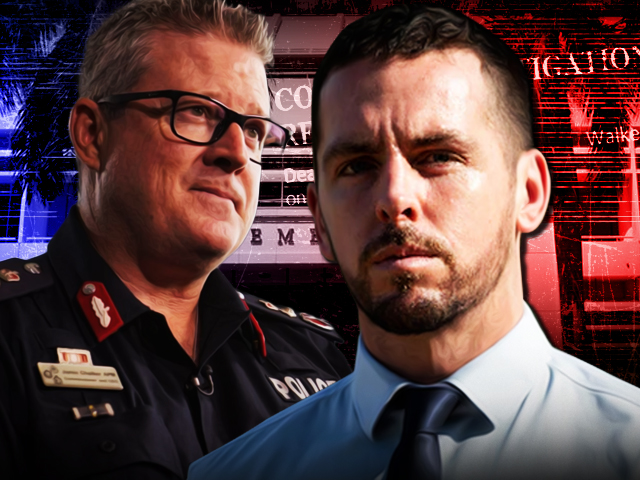
EXCLUSIVE: A damning coronial report critical of the criminal investigation into Zach Rolfe that former police commissioner Jamie Chalker tried to hide ahead of trial was significantly altered just two days after the NT Police brass discovered Mr Rolfe’s legal team knew of its existence, the NT Independent can reveal.
The seven draft reports, known as the Pollock-Proctor coronial reports, were finally publicly released last month by Coroner Elisabeth Armitage, eight months after her inquest into the death of Kumanjayi Walker commenced.
Those draft reports contained explosive findings, first reported by the NT Independent, including that the NT Police lied to Kumanjayi Walker’s family about his condition the night of the shooting in Yuendumu, refused to perform mouth-to-mouth resuscitation and highlighted significant internal failures by senior police to properly manage the Immediate Response Team the night they were deployed to Yuendumu in November 2019.
An unredacted final version of the coronial report also showed that investigators ignored legal advice from the DPP in their pursuit to lay the murder charge against Mr Rolfe, including that their two use-of-force experts were not reliable. It also found “critical decisions” about the investigation were made outside of official meetings and not properly recorded, including that Jamie Chalker’s office directly influenced one of those “critical decisions” to use compromised use-of-force experts against legal advice.
The released documents reveal the last draft before the final coronial report was altered substantially on April 19, 2021 – two days after police knew that Rolfe’s defence team had become aware of retired superintendent Scott Pollock’s draft coronial reports.

Mr Pollock was removed from managing the file by the top brass in November 2020, after his findings contradicted the criminal investigation and angered his superiors, the inquest has previously heard. He was replaced by then-commander David Proctor.
The police brass also attempted to shut down the coronial investigation outright the same month due to Mr Pollock’s findings, but it was reinstated after three days, understood to be at the request of former coroner Greg Cavanagh.
The NT Independent can now reveal that Zach Rolfe’s father Richard Rolfe made contact with Scott Pollock after hearing about the existence of his coronial report in April 2021 – a report that had not been provided to the defence team during discovery ahead of Zach Rolfe’s murder trial for the shooting death of Kumanjayi Walker.
Text messages show Mr Rolfe made contact with Mr Pollock via text at 12:47pm on April 17, 2021 asking if he would speak to him.
Mr Rolfe said Mr Pollock called him shortly after the text was sent and the two spoke about the report and its contents.
“Because he is a professional and was still working for the NT Police at the time, he notified me that he was going to make police aware that I had approached him,” Mr Rolfe told the NT Independent.
Two days later, the inquest records show the draft report – then under the control of Commander David Proctor – was substantially altered to include many of Pollock’s findings that were initially omitted from Mr Proctor’s first draft, including an entire section on the investigative bias against Zach Rolfe during the criminal investigation, training failures at the police college, failures by senior officers responsible for deploying the IRT to Yuendumu and the policing culture in Alice Springs.
It was not explained why those serious matters were removed from Mr Proctor’s initial report or why they were re-inserted days after the police became aware that Rolfe’s legal team knew of the reports’ existence.
During inquest hearings, Mr Pollock testified that the investigation into Mr Rolfe was the “most biased investigation” into a suspect he had ever seen and indicated he believed his report was going to be suppressed by senior police.
“I was going to document my concerns, so if it came out at a later time that we’d attempted to hide that information, well, here’s my evidence that I didn’t walk past what I saw,” he told the inquest in November.
The Coroner typically receives one final report and not all the drafts, making it unusual that seven drafts and one final report exist, that have all now been made public.
Judge criticised police brass for withholding documents ahead of murder trial
Two months before the trial was set to begin, in May 2021, Mr Rolfe’s lawyers issued subpoenas for access to the draft reports that Mr Chalker had failed to provide.
Zach Rolfe’s lawyer David Edwardson received a number of different drafts after Justice Dean Mildren ruled in their favour that month, with the judge stating that the “failure to provide” the documents to the defence team and possibly the DPP “may have caused the trial to miscarry”.
“Worse, if the documents are never revealed, it may be that an innocent person has been wrongly convicted,” Justice Mildren wrote in his decision.
“It is hoped that this situation will not occur in the future.”
Mr Chalker insisted on redacting certain sections of the drafts under legal professional privilege before they were released. Those redacted sections centered around police ignoring legal advice, which was removed entirely from Mr Proctor’s first draft report after he took over from Mr Pollock, but was re-inserted in his last draft before the final coronial report.
Here’s what was changed in the reports and when
Mr Pollock’s last draft report before being removed as senior coronial investigator was dated January 2021 and came in at 84 pages.
However, Mr Proctor’s first draft report, that was undated, after he took over as lead coronial investigator, was cut back to 60 pages and included none of the critical findings about the police failures on the night of the shooting in Yuendumu that Mr Pollock had in his draft reports.
Despite the revelations of police failures being removed from Mr Proctor’s initial draft report, it contained all critical findings against Zach Rolfe, including that he had lied on his NT Police application, had not disclosed a disciplinary matter while in the ADF, failed to also disclose another police matter in Queensland from years earlier and that a psychological evaluation had shown a propensity for aggression.
Mr Proctor’s second draft, dated April 19 – two days after Mr Rolfe’s discussion with Mr Pollock – was expanded to 84 pages, which included Mr Pollock’s findings that use-of-force expert witnesses Sgt Andrew Barram and U.S. “expert” Geoffrey Alpert were not suitable, that there was “influence and bias” in the criminal investigation, that training at the police college was below standards and may have been based on outdated laws around use of force, and that the decision to deploy the IRT to Yuendumu was flawed.
However, the scathing sections from Pollock’s report about senior officers Jody Nobbs and Travis Wurst’s lack of understanding of how the IRT operates was not in Mr Proctor’s draft report.
Criticism of the policing culture in Alice Springs and comments about the militarization of police were also not in the final draft report.
Also missing from both of Mr Proctor’s draft reports was then-assistant commissioner Narelle Beer’s concerns that officers were providing statements for the coronial investigation out of fear of disciplinary action if they did not, while those statements were then being used for the criminal investigation.
However, all of those issues were re-inserted in the 170-page final coronial report dated August 31, 2021, including that Mr Alpert’s “independent” expert opinion on use of force was being edited by investigators, including Sgt Wayne Newell, to better fit their case against Mr Rolfe. It also found Mr Alpert and Sgt Barram were not provided with all of the information from the case when they reached “identical opinions”.
The final coronial report contained serious concerns about “live issues” around the police’s criminal investigation, but repeatedly stated that many of those issues “may be explored in the trial of Rolfe”.
They have yet to be addressed and many of the issues raised in the draft coronial reports have not been canvassed at the inquest with relevant witnesses, despite assurances from the Coroner that the question of whether the police investigation was “compromised or impaired” would be examined.
Under the NT Coroner’s Act, Ms Armitage cannot include any evidence of illegal conduct in her final coronial report and must quietly refer any suspected illegal conduct to the Director of Public Prosecutions and the NT Police Commissioner.


It appears that the criminal investigation looks more like an investigation by criminals rather than an investigation of criminals. I would hope the if it becomes a referral back to DPP and the police commissioner that it will be properly investigated.