


By Bill Rowlings, CEO of Civil Liberties Australia
What a hoot! Australia’s supposed “anti-corruption” bodies sooled the NT Police on to a journalist who appeared to be the only proactive corruption-spotter attending a corruption conference in Darwin last week.
Those who actually called in the police ultimately produced a result that was dishonest, inappropriate, against the best interests of Territorians and Australians…and contrary to both law and good practice, according to my lights. Transparency and openness is the best disinfectant for corruption; failing to expose it to educational media coverage was an opportunity gone south.
One of the Keystone Kops of the NT, seemingly illegally, issued a trespass notice against the editorial-seeker-of-justice who managed to make it to the outer doors of the “anti-corruption conference” venue at the Darwin Convention Centre. The Kop’s written and signed trespass warrant claimed (and claims) to ban the journalist from that conference and from any event of any type in the convention centre for a further year.
Problem is, the Kops didn’t read the plain English on their own Trespass Warrant. If issued by a Member Of the Police Force (MOPF), police are obliged to cross out the very clauses that allow them to ban someone in such a way for such a period. It says so on the warrant.
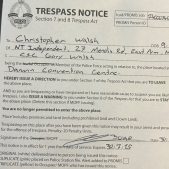
On the face of it, the warrant is illegal, as signed, and therefore illegal and fraudulent if handed to a recipient purporting to be lawful legal notice that must be obeyed. The intrepid newspaper journalist-editor may be entitled to sue and seek compensation from the NT Police and the NT Government.
How did the NT reach such a sorry state of affairs?
The Constable – apparently urged to do so by the NT’s Independent (?) Commissioner Against Corruption, ICAC NT – has purported to ban the esteemed Christopher Walsh, who is editor of the NT Independent (which is truly independent) from the Darwin Convention Centre. Banned not just for a day or two, but for a year and for every event.
Just think about that “banning” for a moment.
If the Police Association holds a conference there in the next 12 months, the journalist is banned by the police from attending the conference from which they want maximum publicity. If there’s a conference about solving the problems of domestic violence and excessive drinking in Aboriginal and white communities, he can’t attend. If there’s an eisteddfod for children, he can’t go and watch his kids perform.
If there’s a political rally of any leaning, he can’t attend and report it. That would be directly contrary to human rights entitlements to free political speech as expounded by the High Court, and even more so in the case of a working journalist. Where is a Territory Human Rights Act when you need to quickly enforce your rights? For that matter, where is a federal Human Rights Act?
Editor Walsh wanted to attend the corruption corroboree, as a member of the press, because it had attracted a confusion of acronymic heavies escaping the southern winter to enjoy the hot air emanating from world, Australian and NT experts on maladministration or public sector corruption.
If you want to know the what, when, why and how of corruption, these are the go-to people. Naturally, Walsh the journo-editor wants to quiz them about the main issues being covered at their conference, particularly in relation to the NT and Australia.
Alphabet soup gathers to obfuscate
The maladministration mob, apart from a couple of odd English, cultural cringe additions as keynote speakers, were drawn from Independent Commissions Against Corruption (ICACs), the National Anti-Corruption Commission (NACC), the Law Enforcement Conduct Commission (LECC), the Independent Broad-based Anti-Corruption Commission (IBAC), Crime and Corruption Commission (CCC Qld), the Corruption and Crime Commission (CCC WA), the ACT Integrity Commission (ACTIC), and the Integrity Commission Tasmania (ICT). Attendees probably also included furtive characters in sunglasses from some Canberra-based entities who shall remain nameless, because they were probably falsely badged.
Engorged by initials, this motley crew comprised APSACC, which stands for the Australian Public Sector Anti-Corruption Conference. It met in Darwin on 29 and 30 July 2024. Like all conferences, the attendees gathered to tell each other tall tales of great successes and to obfuscate about failures they were unable to hide.
A keynote speaker was Louise Casey, Baroness Casey of Blackstock, an unaligned House of Lords life peer appointed in October 2020. She is reputedly an expert on homelessness, soccer hooligans, and police culture and standards, having been commissioned to report on the Metropolitan Police. In 2023, her report found London’s Met to be institutionally racist, sexist and homophobic, and a “boys’ club”. It is not clear why she was selected as a keynote speaker at an anti-corruption conference in Darwin, but she would certainly feel at home talking to any police force in Australia.
The other jaunt-down-under keynote speaker was Prof Paul Heywood, from the University of Nottingham, who is on secondment to the Centre for the Study of Corruption at the University of Sussex. Unkind observers have claimed he was invited because he is the Masters study supervisor for Michael Riches, the NT ICAC Commissioner, who is commendably trying to become better educated in corruption. (We’ll come back to Prof Heywood later).
Main man missed his own ‘parade’
Unfortunately, Mr Riches officially missed the Darwin conference because he is stood down and under investigation himself for alleged “inappropriate behaviour” towards female staff, and possibly other matters. Any finding is unlikely before late September, which is conveniently well after the August 24 NT election.
One of the reasons he was investigated, according to a report in The Australian in June 2024 and on the ABC, is that anti-corruption commissioner Riches was so afraid his career would be over after being served with a domestic violence order in May 2023, that he allegedly offered to pay his estranged wife $20,000 to ensure the matter never made it to the courts. Would that be corrupt conduct, if proved? Who knows? It would have been an excellent question to ask the Australian and world anti-corruption experts gathered in Darwin, if only they’d let a journalist in to their conference to be educated in the ways and tribulations of ICACkers.
I would very much like to tell you the main topics they discussed, both at the conference and in private at nearby bars and eateries, but of course the doyens of not finding corruption wherever and whenever possible were having nought to do with journos and whistleblower types.
How the oddities accumulated
In closing, I’d like to inform you of a few oddities about the recent conference and people’s behaviours:
The ICAC NT website says this:
“ICAC works to guard against improper conduct…which includes behaviours or actions relating to public administration that are corrupt, against the law, dishonest, inappropriate and against the best interests of Territorians.”
Point 1:
In my opinion, if NT ICAC asked the NT Police to ban journalist-editor Walsh from the Anti-Corruption Conference (and especially so if for a year), they themselves were acting at the very least inappropriately and absolutely certainly against the best interests of Territorians. I hereby refer NT ICAC’s relevant alleged misbehaviour over Walsh’s banning to NT ICAC for investigation.
Point 2:
If NT Police, acting on the “orders” of NT ICAC, issued a warrant that was ultra vires (beyond NT Police’s power to issue – eg, the banning of someone from a place for 12 months by the mere signature of a Member Of the Police Force), and failed to fill in their printed Trespass Warrant form as instructed to do so in writing on the form itself, and then issued what was a signed but possibly fraudulent warrant, I hereby refer the NT Police to NT ICAC for investigation of alleged improper official conduct.
Openness, transparency…but not in Darwin
And now back to keynote speaker Prof Heywood, alleged supervisor extraordinaire and – presumably – a man who instructed the anti-corruption crowd at the Darwin Convention Centre about his areas of expertise.
These are from the University of Nottingham website:
“Professor Paul Heywood is author, co-author or editor of nineteen books and more than eighty journal articles and book chapters. His research focuses primarily on political corruption and integrity management, as well as” …other stuff.
He was appointed to the Board of Trustees of Transparency International UK in 2015, where he chairs the Research Committee, and in 2021 was appointed to TI’s “recently created” International Council. On the TI website, it says he chairs the Advocacy and Research Committee.
Transparency International says of itself: “we work to expose the systems and networks that enable corruption to thrive, demanding greater transparency and integrity in all areas of public life.”
Advocacy (from the TI website):
“We advocate for power to be held accountable. Everywhere.
“Transparency International is a diverse movement with one global voice. Together, we strive towards a world where the power to make decisions affecting people’s lives is held to account and serves the common good.”
The Journalists for Transparency (J4T) initiative supports young journalists working on corruption investigations, developing the next generation of extraordinary investigative storytellers to expose and raise awareness of corruption.
You would think such a strong advocate for openness and transparency, and the work of journalists, like Prof Heywood, would have welcomed Christopher Walsh attending every session of the conference.
\What a pity the professor, NT ICAC and all the other gathered initials didn’t let Walsh in to report on how young and old journalists – who are by factors of 10s or 100s more likely to actually expose corruption than the dozy delegates are – might learn from the “corruption professionals”.
Matter of fact, they should have asked editor Walsh and a host of other leading journalists from throughout Australia to be speakers at their conference. The delegates might have gone away dedicated to actually searching for and revealing corruption, rather than having a strange ability to not find it proven when reported to them by journalists and whistleblowers.
In researching for this article, I was struck by a recent comment on the NT Independent website:
Nelson Mclean on June 4, 2024 at 9:53 pm
“Crikey you blokes, (the NT Independent, not the dills at ICAC), are good at your job.
Please keep putting the boot in.”
And so say all of us journalists, and real corruption finders, and fighters for social justice, human rights, civil liberties and a fair go for Australians.
Go Walshy! Maybe don’t put the boot in, but sock it to them instead!
Bill Rowlings is CEO of Civil Liberties Australia. He has had careers in journalism, magazine publishing and public relations, and is co-author of a tertiary PR textbook and a history of civil liberties in Australia. As a journalist, he was a foreign correspondent in Europe, editor of the Papua New Guinea daily newspaper, and on The Australian, The Daily Telegraph and the Sun-Herald, as well as editing business and sporting magazines. In PR for about 20 years from the early 90s, he was a media adviser at the highest level of politics. In 2013, he was awarded an OAM for his contribution to human rights in Australia.

Take it to court and make them eat crow.
Start a Go Fund Me page to pay for it, l will kick in a few quid
Just more idiocy from the clowns running the circus. Cant rely on any other media muppets telling the facts of life.