

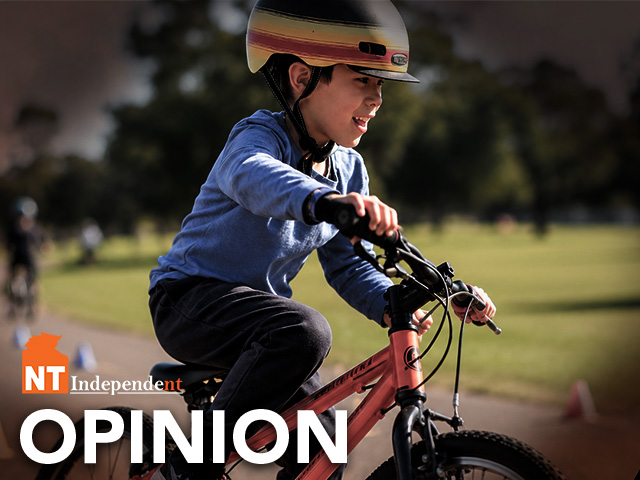
Sofia, aged 8, beams with a gap-toothed smile and nods enthusiastically as her AusBike instructor asks her if she’ll tell her parents that she rode a bike for the first time today.
Through an hour of on and off-bike games that encourage children to practice cycling’s basic elements of coordination, AusBike makes bike riding feel accessible and fun, and routinely gets children riding for the first time without the use of training wheels as an intermediary step.
Developed in conjunction with the Union Cycliste Internationale, and funded by the Australian Sports Commission, AusBike represents a more evidence-based and pedagogically-sound method for teaching children to ride than the miniature traffic courses of old with their wooden stop signs and pretend pedestrian crossings.
While those courses may be fun for children who already know how to ride, AusBike aims to support the group of children – now the majority – who never learn in the first place.
Rather than teaching hand signalling through a fake intersection, AusBike uses games like the bean bag throwing, where the child rides down a line of cones with a bean bag in one hand before throwing it into a bucket. It helps kids practice the fundamental skills necessary to perform a hand signal without wobbling off course.
And rather than having kids stop at a miniature red light, children play a bicycle-based game of ‘red light-green light’, trying to sneak up on the instructor when their back is turned, and freezing when they look around.
Sofia has just undertaken what may still be regarded as a rite of passage for kids in Australia, but one that is in decline.
And while she only needed a one-hour incursion session at her school to do so, parents’ lack of time to teach their kids to ride a bicycle is one of the top reasons bike riding is dropping among Australian children.
Of course the primary reason is a concern for safety. In a 2012 survey, seven in 10 parents agreed it was important for children to learn to ride a bicycle independently, but five out of 10 cited concerns about safety on the roads and lack of cycling infrastructure (like dedicated paths) as reasons they could not support their children to ride to school.
In a three-year study of 2000 parents conducted by VicHealth, the top reason cited by parents wasn’t actually safety itself but a fear of other parents’ judgement of them for letting their children ‘roam free’.
Changing attitudes, rather than concrete evidence of low safety certainly have a lot to do with the decline.
Whilst 40 years ago four out of five primary-aged children took active transport to school (walking, scooting or riding), now the rate is one out of five.
And whilst 59 per cent of students who live within 1 km of their school take active transport, 40 per cent still drive, with the rates only worsening in favour of driving as distance to school increases. Overall, 60 per of children are driven to school by private car, 21 per cent take active transport, 10 per cent take public transport, and 8 per cent take school buses.
The impacts on public health, road congestion and air pollution are obvious.
But potentially the greatest loss is children’s independence.
Prior to starting work with AusCycling as Community Development Coordinator for the NT, I worked with a bicycle-based social enterprise that engaged young people not in education or employment by giving them a donated bike to fix up for themselves.
In learning basic maintenance skills they had some small wins and built self-esteem, and at the end of the program they had a bike of their own. Afterwards, participants were offered work in the social enterprise, carrying out car detailing services for vehicle fleets and using electric-cargo bikes to carry all the necessary equipment out to cars for detailing on site.
Many of these young people had no elders in their life to teach them to drive or provide access to a vehicle: a bicycle was the gateway to greater independence than they had ever known.
I’m passionate about equipping as many young Territorians as possible with the skills and confidence to ride a bike, because you never know the value of such a skill to them in the future.
It offers benefits to parents in time saved in school drop-off queues; and benefits society as a whole with a higher overall state of health, reduced congestion and lower air pollution from less driving.
AusCycling runs two and four week AusBike programs funded by the Australian Sports Commission’s Sporting Schools program, with applications for Term 4 funding opening on Monday August 3, and closing Friday, August 21.
We are building capacity for NT-wide program delivery: if you would like to work as an AusBike instructor or want to bring AusBike to your school, please contact tom.allen@ausbike.org.au
Tom Allen is the NT Community Development Coordinator for the national AusBike primary school cycling education program.

0 Comments