


Warning; this article contains discussion of mental health and suicide.
What value is NT Police putting on life?
How many more NT police officers will we lose to mental health or, even worse, suicide?
In 2017, I was medically retired from the force because of PTSD and moved with my family to Victoria to access specialist mental health support that I could not get in the Northern Territory.
As an ex-NT Police officer I know one of the most important weapons a police officer has is communication. More important than a firearm is communicating, and informing people of a purpose or process.
But there is nothing more soul-destroying than the feeling of having no support when you thought it was always there.
I have the privilege of remaining in contact with many members and assisting in telling their stories.
Our brave NT police officers are exposed to many stressors.
Some can be traumatising, and cause PTSD, while there can also be adverse emotional effects through vicarious trauma, of hearing traumatic events retold by victims.
And traumatising not just for officers but also on their colleagues, their families, and the communities they serve.
The NT also has an out-of-control crime problem, while our police force is under-resourced, which leads to burnout.
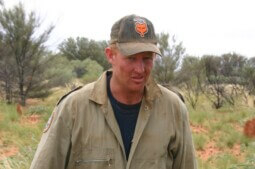
Ex-NT Police Sergeant on the job. Picture: Paul Milne
Burnout may increase the risk of PTSD, especially when coupled with dealing with traumatic events.
NT Police have had their mental health surveys and reviews. Meetings and discussions. But it is window-dressing.
We simply don’t have enough mental health professionals in the Northern Territory for a start.
And when NT police members are trying to return to work they are lost because of inaction.
One member I know of on restricted duties contacted the health and wellbeing section about the progression of their return-to-work submission.
They received no return call.
It was weeks later that NT Police returned the call, but the person calling did not know the member’s complete history.
Did the agency have any concern for this member’s mental health or what they could be feeling after that interaction?
How hard is it to return a phone call?
READ: Paul Milne’s experience of pulling a body out of croc-infested waters that led to PTSD
This member saw things nobody should ever have to see, and the thought of going back to the front line made him anxious.
He resigned without a job to go to, and he asked for an exit interview but never received one. He’s convinced that an exit interview would have identified issues with his mental health and may have led to earlier intervention.
The lack of care and support has rendered him unemployable, having been diagnosed with PTSD, anxiety, depression, and alcohol use disorder by a psychiatrist.
He’s now seeing a psychologist and will see a psychiatrist, which is something I believe could have been avoided if the department had adequate ongoing support mechanisms in place that did not rely on self-referral.
Too many times, members must repeat their issues because there is no contact person to deal with.

Lack of exit interviews hurting the force
Exit interviews seem to be an issue with police members leaving the force. While the executive say exit interviews are offered to everyone, not many actually get to have them. A lot want them. I know I never had one.
They are vital in improving your unwanted attrition rate and retaining experienced officers. They can identify the key drivers of officers leaving, and see where to focus your improvements, create real-time alerts for at-risk police members and step in to prevent them from leaving.
Other members who are assaulted on duty receive no follow up from the department.
No discussions. No emails. No other contact.
In Alice Springs, officers are still without a welfare officer or a full-time police psychologist.
They are left to self-refer to the external employee counselling services.
There is such a delay in seeking help and that must be addressed to improve mental health and wellbeing, and reducing the suicide risk to the Northern Territory Police.
I believe this is due to poor mental health literacy levels at each rank and the fear that seeking help for mental health issues will negatively affect the member’s reputation and career prospects.
And while there is discussion about the lack of support for police members, where is the support for their families?
Police Commissioner Jamie Chalker often talks about looking after “our people”.
I remember when it all happened to me, there was no contact, no support, no checking up on family. Making sure my children were doing okay.
That was ten years ago. We are still doing the same thing today.
It is hard for many struggling members to see the slogan R U OK from an organisation that has forgotten them.
The lack of support from NT Police only adds to the stigma preventing people speaking up, seeing vulnerability, or seeking help as a sign of weakness.
It is a barrier to treatment for police, and a dramatic disconnection between members and the people who are supposed to be supporting them in their organisation.
Mental health stigma is toxic. You agonise over it. You try to ignore it. You struggle and hope and bargain, but it won’t go away. When you have depression, it can be all-consuming because it hides within you and rages to an audience of one.

Change needed immediately
The workers’ compensation system needs to be looked at, it’s challenging and often very stressful, overwhelming for someone suffering. It causes more stigma and can cause more financial stress and even more stigma and shame.
Expanding the retired peer support network should be broadened and sufficiently funded to manage referrals and monitor service quality.
Similar to how the Department of Veterans Affairs operates, some functions should also be established to manage funding and clinical quality assurance of indicated treatments for work-related conditions.
All resigning and retiring Northern Territory Police employees should undergo mental health screening.
Where significant work-related mental health issues are identified, then a treatment plan should be devised and funded by Northern Territory Police.
NT Police suicide prevention initiatives, as part of the organisation-wide mental health literacy program, should be aligned with the principles of the national mental health plan for emergency service workers.
Intervention programs for police officers should focus on strengthening stress management.
Well-being checks should be done weekly, keeping on top of things might be better in the long run to provide access to culturally competent, evidence-based mental health treatment and specialists in trauma treatment.
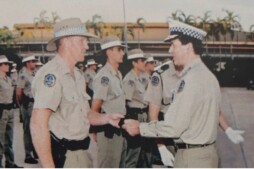
Paul Milne joined the Northern Territory police force in 2004. Supplied: Paul Milne
We spend hundreds of thousands of dollars on training civilians to become police.
But we seem to not spend money on helping them deal with what happens to them on the job, and help to transition them back into the community.
The Northern Territory is vastly trauma-specific and under-resourced in mental health. We need more funding and facilities. Through a comprehensive strategic approach to strengthening members’ mental health, leaders and champions within policing can positively impact the entire force and individual lives.
It will be done one step at a time, with leaders using resources already available.
People mention NT Police culture. Everyone in the force makes the culture from the recruit level to the Commissioner.
The culture can be transformed, positive messages can be delivered, and support can be provided.
We all can make the change.
Government can create change.
And I can make the change.
And the Commissioner can make the change.
This issue of mental health will not disappear. It needs a holistic approach from everyone together. This mental health problem will only be solved with all sides coming together.
NT police members with mental health issues are desperately crying out for support. Please start contacting them again.
That’s the NT Government. The NT Police. The NT Police Association. And fellow officers.
They want your contact. Just reach out.
They deserve it.
Paul Milne, is a former NT Police Sergeant who spent ten years in the force. In 2017 he was medically retired because of his PTSD and moved with his family to Victoria to access specialist mental health support.
If you or anyone you know is experiencing mental health difficulties, please reach out to the NT Mental Health Line on 1800 682 288, Lifeline on 13 11 14, Beyondblue on 1300 224 636, 13YARN (a service run by Aboriginal and Torres Strait Islander people) or Mensline Australia on 1300 789 978.
For more mental health support you can also visit the NT Lived Experience Network website here.


0 Comments