

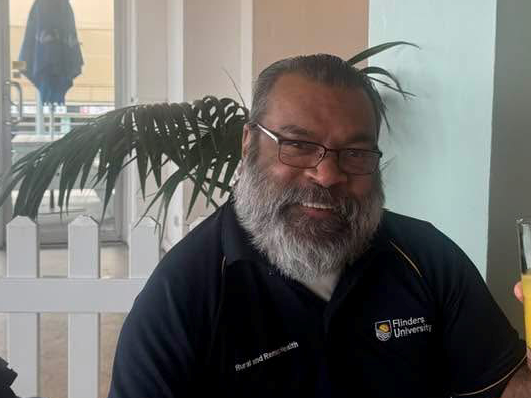
Larrakia traditional owner Richard Fejo says he was sacked from his role as chair of the Australia Day Council NT by Chief Minister Lia Finocchiaro this week after criticising the CLP Government, a move he says is part of a “childish strategy” by the government to silence dissenting voices.
Mr Fejo became a vocal critic of the CLP after first resigning from the Darwin Waterfront Corporation board late last year over Ms Finocchiaro’s move to reduce the age of criminal responsibility to 10, and said at a protest last week that the CLP is “not welcome on Larrakia land” for its policies, which he said unfairly target Indigenous Territorians.
He said on Tuesday the decision not to renew his term as chair of the Australia Day Council NT also had racial undertones.
“These puppets think like children and my removal is a childish strategy to shut down opposition to the promotion of their now visible white Australia policy,” Mr Fejo wrote on Facebook.

“They think they are punishing me because this is how [they] think in their bewildering tiny mindset, but what has actually happened is that I have been freed to be more vocal for our First Nations people, our multicultural community and our Australian people (yes white people are sick of hearing about racism too) against discrimination, bias and racism in Australia because racism has no place in Australia!
“They can take away my title but they will always face a Larrakia man!”
Mr Fejo said Ms Finocchiaro sacked him on Monday and replaced him with “a cop”, although who Ms Finocchiaro appointed as the new chair of the Australia Day Council NT was not immediately disclosed. It is understood Mr Fejo’s term as chair expired a couple months ago, but he was hoping it would be renewed.
He implied racism was behind the move to oust him as chair of the board, that aims to celebrate inclusiveness in the Territory, “embrace cultural diversity and promote Australia Day with respect and integrity”.
“The following definition ‘prejudice, discrimination, or antagonism by an individual, community, or institution against a person or people on the basis of their membership of a particular racial or ethnic group, typically one that is a minority or marginalised’,” he wrote.
“Now they say their laws apply to everyone but we all know this is fundermentally [sic] untrue because First Nations Territorians are continually discriminated against, overpoliced and over-incarcerated as a result.”
Ms Finocchiaro did not respond to emailed questions about the dismissal. In an email sent the next day, Acting Chief Minister Gerard Maley said Mr Fejo’s term as unpaid chair was for “up to three years” and started in April 2022, with both the chair and board positions appointed by the Chief Minister.
“We thank Dr Fejo for his service and contribution,” Mr Maley said.
“Superintendent Sean Parnell has now been appointed as the new Chair of the ADCNT Board. An expression of interest will be undertaken for the remaining positions.”
Attorney-General Marie-Clare Boothby flagged months ago that the CLP Government was reviewing all committees and commissions with the implied intent to install people on various boards who support the government’s policies.
That included Ms Boothby controversially rejecting an independent panel’s selection for a new director of Legal Aid NT in May and installing her own pick, who was rejected by the independent panel for not holding the necessary qualifications and who has ties to CLP figures, which led to resignations from other board members and raised integrity concerns about the legal aid and court systems.
The CLP has routinely said it makes “no apologies” when criticised about its controversial policies that Ms Finocchiaro has previously disclosed are not based on evidence.
The Chief Minister was recently named a finalist for the McKinnon Prize for political leader of the year for her “hardline stance” on crime, “channelling public sentiment into decisive leadership” and for doing what most chief ministers do by taking on the role of Police Minister.
She has faced intense criticism from local and national peak bodies, medical professionals, community groups and the federal children’s commissioner for her ‘tough on crime’ policies, including reducing the age of criminal responsibility to 10, introducing pepper spray for purchase, arming bus and public housing security with guns, expanding police powers, while also rolling back the changes made in response to the royal commission into the detention of children, including re-introducing spit-hoods, removing the premise of detention as a last resort, and reinstating the use of restraint devices and dogs in youth prisons.
Note: This article was updated to include the lines from Acting Chief Minister Gerard Maley.


Well Mr Fejo, you where on the board at Sam Burke’s Water Front Show. Time to spill the beans!
This fellow was not sacked, his term expires and there is no Larrakeyah country, perhaps a small park in Stuart park but the rest of the country was taken by the Tiwi and others seventy to a hundred of years ago.
Tough on crime policies?
It’s called a mandate, given to the government by the people of the NT in the last election.
Contract not renewed so it must be racism? No, sometimes hard decisions are made that affect people. Doesn’t mean it’s racism. no matter how convenient that is as an argument.
Peter, this crap happens daily to NT Public Servants or NTG funded NGO employees on the wrong side of politics, wrong side of a policy or wrong side of a politician.
This is pure “Run Them Out Of Town” playbook.
Pippa H that doesn’t make it racism.
Looks like he has been on the tax payer teat all his life?.
There was a clear tougher-on-crime mandate accorded to the CLP by the NT Electorate and every Territorian knows it.
In all NT urban centres, it was also clear that the identity of the crime wave was predominantly Aboriginal. To imply that incarceration of violent criminals is therefore discriminatory and racist, is the same attitude of victimism that nurtured criminal behaviour in the first place. Such irresponsibility has no place on social issue committees.
How telling us it that activists claim that tough on crime policies target Aboriginal people.
They are admitting that Aboriginal people are overwhelming more criminal than the rest of the population, something that we all know but many don’t want to admit.
Alternately you could argue that the majority of crime is committed by people who are disadvantaged and/or lack the wealth (not just financial) that most of us take for granted and it just so happens that this group is largely Aboriginal as a result of generational disadvantage.
Isn’t it better to address the disadvantage and effectively “lift everyone up” to address the causes of crime rather than relying on punitive measures that ensure that this group of people (not just Aboriginal) will continue to suffer further entrenchment of their disadvantage and thus increases the likelihood of further offending.
Is there anyone in the NT that is actually safer as a result of any of these policies. Were we any safer when mandatory sentencing was resulting in people being locked up for the most petty of crimes?