

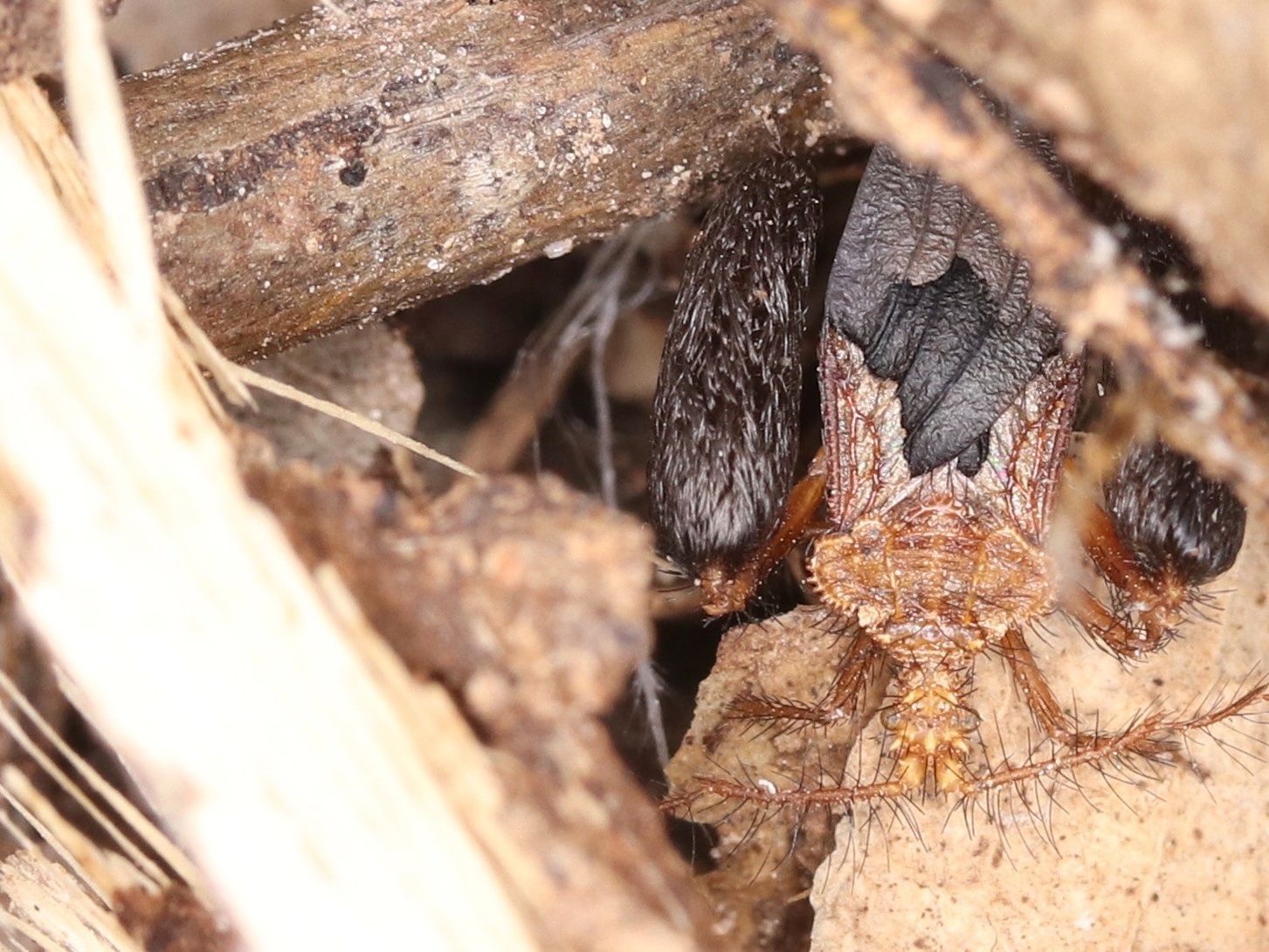
A newly discovered species of assassin bug has been named in honour of the Larrakia people by researchers from Oxford Brookes University, who found the specimen when shaking out a last bag of leaf litter collected when leaving Charles Darwin National Park after weeks of searching.
PhD student Daniel Bardey said the bug was discovered by his team in the park, which sits about 3.5km from the Darwin CBD, despite the area having been thoroughly surveyed previously.
He said the discovery came after weeks of long days and nights spent painstakingly searching, sifting leaf litter to find the bugs, with no success.
“They turn up when they want to… We had been searching for weeks and found nothing. Then, on the way out of the park, I stopped at a small patch of woodland. We shook out the last bag of leaf litter, and this new species appeared,” Mr Bardey said.
The researcher said he developed a do-it-yourself sieve to collect insects from leaf litter using everyday materials such as a washing-up bowl, chicken wire, and a cat litter tray. The holes in his design are ideal for catching the bugs he studies, making this method essential to his PhD research.

Feather-legged assassin bugs are an ancient lineage that evolved in Australia, giving rise to rare species found nowhere else. They are sometimes only seen once every few decades.
Mr Bardey said he was excited that the genus Ptilocnemus also has a historic connection with Oxford in England, where his university is based. One of its first described species, Ptilocnemus lemur, was described in 1840 by the pioneering entomologist John Obadiah Westwood at the University of Oxford.
“The original type specimen is still held in the Oxford University Museum of Natural History,” Mr Bardey said.
“Now, nearly two centuries later, the newly discovered species joins that historic collection, albeit temporarily.
“This exciting discovery highlights how much there is still to learn about Australia’s insect biodiversity. Nearly 186 years after the first species in this genus was discovered, scientists are still finding new members of this ancient lineage, sometimes in places thought to be well explored.”
In accordance with international scientific standards, a specific specimen, known as the “holotype” represents the species. This specimen will eventually be returned to the Museum and Art Gallery of the Northern Territory, along with additional specimens that will also be repatriated to various Australian museum collections.
The findings are discussed in a paper published in the Journal of the International Heteropterists’ Society.
“It’s wonderful in itself to have discovered a new species, but as a proud Australian, it has been made even more special by receiving permission to name the species in honour of the Larrakia people,” researcher Dr Matthew Bulbert said.

0 Comments