

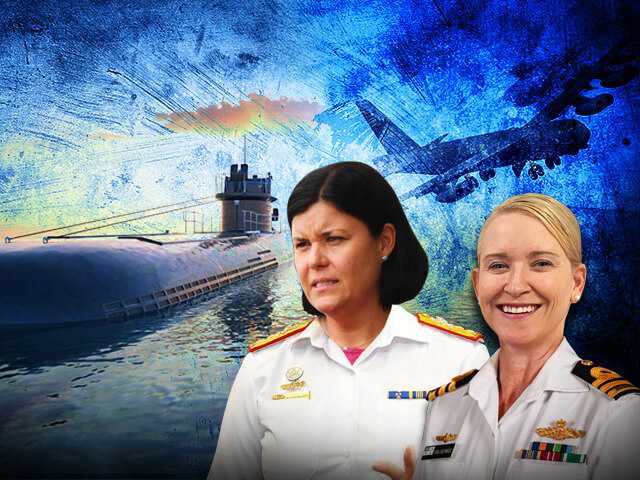
Internal briefing documents from the Department of Defence have revealed the NT Government confidentially contacted the Federal Government to engage in Australia’s nuclear submarine program.
It was not revealed when the overture was made, but the NT Government said it was assessing the “Territory’s sutiability and readiness” for the submarines.
Plans to build a fleet of nuclear submarines under the AUKUS defence treaty with the United States and the United Kingdom, were announced last year.
The NT Government’s approach to the department’s Nuclear-Powered Submarines Taskforce was not reported before the internal documents were released under Freedom of Information laws in September.
“The Nuclear-Powered Submarine Taskforce has engaged the South Australian government and engagement with the Queensland and New South Wales governments is a priority,” stated the documents, as reported by ABC.
“The Northern Territory government has initiated engagement.”
While the Fyles Government did not say when it went to the department regarding the program, the department suggested that Darwin harbour may be tapped for the program’s services and support aspect.
Darwin harbour has already been a host to visiting local and international submarines, thus, nuclear submarines from AUKUS allies could circulate through Darwin.
However, the harbour, with its long stretches of shallow waters extending out from the shoreline, is considered to be unsuitable as a training ground or deployment point for submarines.
“The development of maritime services and support in Darwin harbour” was covered in “regular, productive discussions with the Northern Territory government on a range of initiatives,” the Defence Department said in a statement.
Manison says ‘no worries’ over US deploying nuclear-capable B52s to the NT
Late last month, Deputy Chief Minister Nicole Maison said that Territorians should not be concerned about the US deploying six nuclear-capable B52 bombers to RAAF Base Tindal over the next few years, despite fears they could be used as tensions escalate with China over Taiwan.
An American military analyst warned in a Four Corners report that while current military war simulations predicted China could not currently hit Australia due to the long range required, “who’s to say that in the future China might not have more advanced missile capability that would be better suited to potentially attacking Australia or whether their attacks would be successful”.
But Ms Manison said there was nothing to worry about because the Territory has a “long and proud defence history” and the federal money to build upgrades to house the nuclear planes were good for the economy.
“There has been a huge investment and that’s going to continue for years to come,” she said.
The US plans for Tindal include a squadron operations facility for use during the Dry season, an adjoining maintenance centre, and a parking area for the six B-52s.
The US also plans to build its jet fuel storage tanks and an ammunition bunker at the site.
At present, the Department of Defence has a dock and naval airbase in Darwin harbour, an airbase at Darwin airport and two military facilities being upgraded.
Near Katherine, the Tindal RAAF base is being upgraded to host larger aircraft at the cost of billions of dollars.
The US-operated Pine Gap intelligence facility is also outside Alice Springs and has been operating in secrecy for more than 30 years now.
Military training grounds also abound the Kakadu, Tiwi Islands, and east Arnhem land during annual joint military training exercises.
Investigative journalist Kieran Finnane recently told the ABC there was too little contemporary coverage of military developments in the NT and not enough scrutiny.
“I’m concerned about the lack of debate in the community and by our political leaders about what the purpose in the military build-up in the Northern Territory is… and, to what extent it serves our interests,” Ms Finnane said.
She said that the bottom line of military activity is death and destruction.
“It’s the management of human affairs with violence and the threat of violence. Isn’t that something really that Australians need to be talking about?”
But the Fyles Government has indicated its desire to reach a $40 billion economy by 2030 from a $26 billion economy, which would be attained with the help of defence and national security spending.
Labor created the role of Defence and National Security Advocate to lobby the Federal Government and industry to encourage more spending in the NT.
A spokeswoman for Chief Minister Natasha Fyles told the ABC that the NT Government is making an assessment to decide the appropriateness of the site and is ready to support the Federal Government.
“Information regarding defence matters, including the nuclear submarine program, should appropriately be provided by the Department of Defence,” she said.
The Federal Government has already indicated the AUKUS subs will be based on the east coast, with Brisbane, Newcastle and Port Kembla identified as possible sites.

0 Comments