

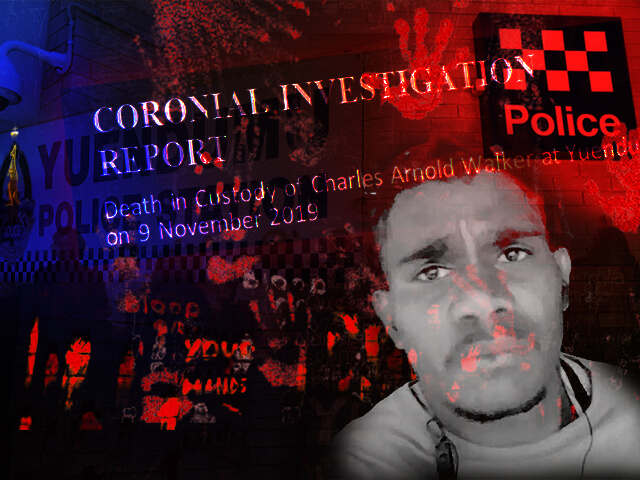
EXCLUSIVE: NT Police officers in Yuendumu lied to the family of Kumanjayi Walker about his condition the night he was fatally shot and refused to provide mouth-to-mouth resuscitation as he lay dying in a police station, a coronial report prepared by the NT Police and obtained by the NT Independent has revealed.
The report concluded mouth-to-mouth resuscitation “should” have occurred, however a medical expert who police consulted with after the death stated that the lack of mouth-to-mouth on the night of the shooting was acceptable given the “circumstances”, even though police had kits in their vehicles to administer the technique “appropriately”.
Mr Walker was shot three times by Constable Zach Rolfe on Saturday November 9, 2019, after he stabbed Constable Rolfe in the shoulder with surgical scissors and struggled on the floor with Constable Adam Eberl during an attempted arrest.
Following the shooting, Mr Walker was transported to the Yuendumu police station where Constable Rolfe and other members of the Immediate Response Team attempted to keep him alive while health staff from nearby Yuelumu were dispatched.
The coronial draft report is understood to be a late draft of a report by Superintendent Scott Pollock into the death of Mr Walker, but it comes with an annotation that Commander David Proctor was later officially delegated to the role of officer in charge of the coronial investigation, controversially replacing Supt Pollock in August 2020.
The report stated that when Mr Walker stopped breathing and CPR efforts had commenced, Senior Constable Chris Hand called St John Ambulance to seek advice about performing CPR and mouth-to-mouth resuscitation.
A transcription of that call was published in the report, showing the operator told an officer that she would instruct him on how to perform mouth-to-mouth “just to make sure we’re doing it correctly”.
“Yeah, at this point we are not gonna do mouth to mouth – anybody gonna do mouth to mouth? No,” responded the officer, identified as Constable Anthony Hawkings, who had been dispatched to Yuendumu with the Immediate Response Team.
“Ok yeah, no that’s fine,” the operator responded.
“We’re waiting, we’re waiting our medical, our medical staff to get here,” Constable Hawkings replied.

The report found all IRT members, including Constable Hawkings, Constable Eberl, Constable Rolfe and Constable James Kirstenfeldt held current first aid training.
“Given the additional level of first aid training Kirstenfeldt claimed to have received during his military career and in considering the injuries suffered by Walker, EAR (mouth-to-mouth resuscitation) should have been provided,” the report concluded.
“Appropriate mouth to mouth kits were in the police vehicles at Yuendumu and available to the members if required. Instead the IRT members were more focussed around obtaining a defibrillator and applying that when required.”
CPR, which was being administered with a defibrillator, was at some point stopped despite the Yuelumu crew still being 30 to 40 minutes away, in apparent contravention of the Australian Resuscitation Council guidelines, which state that CPR should only be stopped when the patient is responsive, qualified help arrives, the person performing it is exhausted, or an authorised party pronounce the person dead.
However, Professor Michael Reade, the medical expert reviewing the police response post-shooting – who the report claimed is one of Australia’s foremost experts on major trauma including gunshot injuries and the former director of clinical services for the Army – found that the officers acted appropriately at all times in their attempts to keep Mr Walker alive.
“Termination of attempts at resuscitation 24 min 14 secs after it commenced without meeting any of the four criteria…. However, these guidelines are written without regard to circumstances … in which Mr Walker has deteriorated despite all the interventions the police officers were able to provide… I believe the decision to terminate resuscitation at this point was correct,” his report is quoted as saying.
“In summary, I believe that from the moment that the bullet that caused wound B reached the end of its wound path, in the circumstances present at the time, Mr Walker was going to die regardless of any efforts made by the police officers present.”
The draft coronial report inexplicably made no mention of the fact that Sgt Julie Frost, who was the officer in charge at Yuendumu that night, had 16 years experience as a nurse, and made no mention of her involvement or lack thereof, in efforts to save Mr Walker’s life.
It did note that the IRT members who transported Mr Walker back to the station first stated they were taking him to the local health clinic before being reminded by Sgt Frost that staff there had recently left the community following a string of break-ins, later found to have been incorrectly pinned on Mr Walker.
The NT Independent previously reported breaches of standard police operating procedures identified in the draft report and that had the IRT operated with a proper response plan in place, it would have “most likely avoided the death of Walker from occurring”.
Police lied to Walker’s family about death
The coronial report prepared by the NT Police, which Commissioner Jamie Chalker attempted to keep from the public before it was obtained by the NT Independent, also shows that police lied to Mr Walker’s family about his condition the night he was fatally shot.
IRT officers ceased providing CPR at 8:36pm, the report states, based on footage from body-worn cameras.
It wasn’t until 9:09pm that Mr Walker was officially pronounced dead by Yuelumu health staff when they arrived at the station, an hour and a half after being notified of the shooting.
A crowd of residents, estimated at 200 by police, and Mr Walker’s family had accumulated outside the station after he was taken there with the three gunshot wounds.
“The glass entrance doors were covered from inside the station to prevent anyone from outside looking into the station,” the report stated. “The lights Inside the station remained on but, to those congregating outside, appeared as if they had been turned off.”
At an undetermined point, some in the crowd threw rocks at the roof of the station, the report said, but did not provide a specific time for when that occurred. The report also stated that the situation was “volatile”.
The report shows Mr Walker’s grandfather Eddie Robertson called the station seeking an update on Mr Walker “shortly before midnight”.
Sgt Julie Frost told him she could not provide an update, despite Mr Walker having been pronounced dead nearly three hours earlier.
Sergeant Terry Zhang then arrived by plane from Alice Springs and contacted Superintendent Jodie Nobbs to seek advice on what information he could give to the family.
“Zhang was advised to inform Robertson that Walker was still receiving medical treatment, when, in fact, he was already deceased,” the report said.
“Zhang completed this task stating the decision to ring Robertson at 12:07am was ‘a way of mitigating risk of the community sort of, not jeopardising the safety of the members in the station’.”
Mr Robertson was not informed of Mr Walker’s death until after the Territory Response Group had arrived at the station from Darwin, around 4:50am. He was then asked to formally identify the body, however Mr Robertson declined, telling police Mr Walker’s identity was not in question.
At 6:44am, Sgt Frost, Sgt Zhang and TRG members went to Mr Walker’s partner Rekeisha Robertson’s home to inform her of the death.
A coronial inquiry into the death of Mr Walker and the police response will start on Monday and is expected to go for three months.
Constable Rolfe was found not guilty of murder and two related charges in the death of Mr Walker in March.


0 Comments