


Australia’s carbon emissions from Beetaloo Basin gas fed through Tamboran Resources’ planned liquefied natural gas processing and export facility at Darwin’s Middle Arm precinct would be the equivalent of more than three coal-fired power stations annually when operating at full capacity, the Australia Institute says in a new report.
The Institute said the total amount of emissions including from any gas exported – what it referred to as the lifecycle discharged – would equate to 12 coal fired power stations, taking into account the emissions from the production, transmission, distribution and final use of the gas.
But Tamboran Resources has said the use of its gas has the potential to reduce global emissions, by reducing the burning of coal for electricity.
In dealing with emission offsets, the NT would not be responsible for those created by sending gas overseas and using it there.
The Australia Institute’s climate and energy program director Polly Hemming said that if the Northern Territory were a country, it would already be the highest per capita polluter in the world, far higher than countries like Qatar, Saudi Arabia or Brunei.

According to 2021 data from the European Commission’s Emissions Database for Global Atmospheric Research, the tiny Mriconesian country of Palau has the world’s highest emissions per capita with 60.17 tonnes of greenhouse gases per year, followed by Qatar with 34.40 tonnes, with Australia in 14th place with 14.21 tonnes. The Territory sits at about 64 tonnes.
“The misinformation from government and industry surrounding the Beetaloo Basin is alarming,” Ms Hemming said. “Tamboran Resources claimed that gas production in the Beetaloo would be the single largest emissions reduction project in Australia.
“This is just not true. It is physically not possible to reduce emissions while increasing emissions.”
Tamboran Resources says on its website it has a vision of supporting the net zero carbon energy transition in Australia and Asia-Pacific through developing low carbon fracking gas resources in the NT.
“Tamboran is already leveraging the low carbon gas we have [from] the Beetaloo Basin to be net zero in our company’s Scope 1 and 2 emissions from first commercial production,” its website states.
“It ensures lower energy prices, energy security, and growing jobs and economy of the Northern Territory, while at the same time reducing our national emissions through fast-tracking low carbon gas and encouraging the transition away from coal-fired power.”
The company has secured an exclusive right over a 170ha site at the Middle Arm precinct, which it plans to use for an LNG development with an initial capacity of 6.6 million tonnes per year, with expansion potential, but that is subject to the completion of the concept study, as well as successful Beetaloo appraisal drilling and flow testing, as well as government approvals.
Tamboran has a supply deal with Origin and is targeting first LNG production in 2030. Chief executive officer Joel Riddle told media recently that the project had the potential to deliver “hundreds of millions of dollars in royalties to the NT Government and native title holders”.
“If deemed commercial, Tamboran aims to sanction the proposed LNG development by 2026, with first volumes anticipated to commence by 2030,” he said.
“The enormous scale of the basin means that the low reservoir CO2 gas has potential to deliver large and scalable volumes over the long term not only for Australia’s east-coast gas market, but also to international markets.”
He told Energy Today that he anticipated that providing affordable natural gas domestically would enable a reduced dependency on coal fired power generation, meaning a “significant reduction in global greenhouse gas emissions”.
However, Ms Hemming said that contrary to announcements by the NT and Federal governments, fracking the Beetaloo Basin would deliver little in economic growth apart from an increase in multinational mining profits, with limited benefits for the wider community.
“What the Beetaloo gas development will deliver is an enormous increase in emissions and further concentration of the NT economy into a single industry,” Ms Hemming said.

She said the LNG facility would, at its peak, yield a maximum of 20 million tonnes per annum (Mtpa) of LNG, to be exported using fracked Beetaloo gas, and would reach 81Mtpa of lifecycle emissions once it reaches full production.
The Australia Institute report said it based its figures on an October 2021 report by energy consultancy Reputex, which was funded by the anti-fracking group, Lock the Gate Alliance, called Analysis of Beetaloo Basin Gas Emissions and Carbon Costs.
The report estimated the total emissions of extracting, processing and using gas from the Beetaloo Basin to be 72.9 grams of CO2 equivalent per megajoule of energy produced. It said this included ‘upstream’ production emissions, or the mining energy use and methane emissions, the ‘downstream’ combustion, from use by gas customers, as well as LNG processing, transport emissions and regasification at its destination.
Emissions that occur and are accounted for in the NT (and therefore Australia) consist of upstream emissions, largely methane emissions from extracting the gas, and emissions from LNG processing at the proposed NT LNG facility at Middle Arm.
The estimates made by Reputex are shown in Table 1.

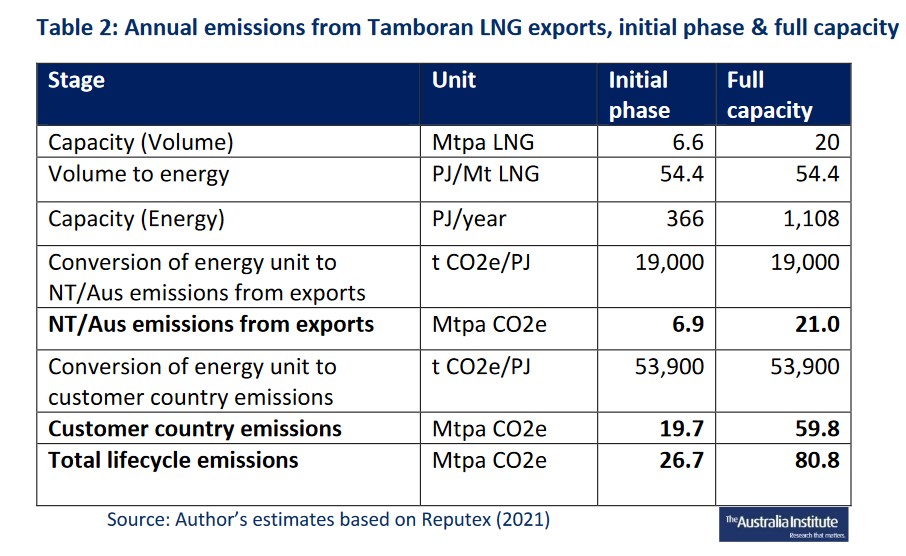
Table 2 from the report estimates that the 6.6Mtpa pilot stage of the project would result in emissions of 6.9Mtpa CO2e in the NT, and 19.7Mtpa CO2e in customer countries, a total of 26.7Mtpa CO2e.
While the 20Mtpa LNG full capacity period would see NT emissions of 21Mtpa CO2e and customer country emissions of 59.8Mtpa CO2e, a total of 80.8Mtpa CO2e.
The Institute said based on Reputex figures, Tamboran’s plans for 20Mtpa LNG (1,108 PJ/year scenario) would result in well over 1 billion tonnes of emissions over 20 years.
The Clean Energy Regulator figures show carbon emissions from coal fired power stations vary greatly but the Australia Institute states the regulator’s figures for Australia’s 19 coal-fired power stations show they emitted 128Mt in 2019-20, at an average of 6.5Mt each.
“The yearly emissions from the project would be equivalent to the yearly discharges of 12 coal-fired power stations,” Ms Hemming said.
“Once operating at full capacity the yearly discharges equal that of three coal-fired power facilities.
“The NT Government stressed that gas production from the facility will help meet the energy demand of eastern Australia.
“However, the capacity of the Tamboran facility will be around 90 per cent of the volume of gas seen to be produced across the Beetaloo Basin, suggesting that the gas from the Beetaloo is planned for the export market, not to meet domestic needs.
“The pilot stage of the NTLNG project alone would result in almost seven million tonnes of lifecycle greenhouse gas emissions per year in Australia. That’s like building a new coal-fired power station in the NT. Once the project reaches full capacity it will be like building another two coal-fired power stations in the NT,” Ms Henning said.
You can read the full report on the Australia Institute website.


Australia is already at better than net zero by any sane method of counting.
Natasha
So Katie, with the programs that we have implemented, we have confidence that our measures and strict guidelines will ensure that by capturing methane and other gasses, we will reduce the emissions by a level that will offset those predictions by almost 95%. We are, and always have been dedicated to improving the lives and living conditions of Territorians and our policies have shown that the Northern Territory has massively reduced its carbon footprint.
Katie
So CM tell me some of the ways that we have achieved this.
Natasha
I’m sorry I do not have those statistics with me but I will take that question on notice.
Can I be CM now, I pass the test?