


Jacana Energy is seeking expressions of interest to supply up to 100MW of solar power for the Darwin-Katherine region by 2027, an announcement which follows a Utilities Commission report warning of blackouts within three years unless the government deals with the anticipated nearly 50 per cent reduction in peak electricity generation capacity.
Jacana CEO Louisa Kinnear said the solar farm, or farms, were intended to contribute as much as 15 per cent of the Fyles Government’s renewable energy target of 50 percent by 2030, which she said was enough renewable energy to power 21,000 Territory homes.
“Kicking off a procurement process now ensures that we will be able to make an investment decision that supports the delivery of renewable energy well before 2030,” she said.
“The addition of more large-scale solar is a major part of the Darwin-Katherine electricity system plan and our EOI is designed to procure renewable energy in way that aligns with this plan.”
She said the EOI will open on August 22, with submissions closing on September 26, and electricity to be generated “from around” 2027.
However, three other solar farms have been built but not connected to the grid.
The Utilities Commission report, released in early July, predicted the risk that the government would not be able to maintain the Darwin‑Katherine power system as early as 2026‑27, due to falling minimum demand during the day, as a “result of increasing amounts of electricity from uncontrollable residential and commercial rooftop solar PV systems”.
Expanding on this, it said the increase in residential solar power generation brought “new technical challenges that need to be managed” but did not elaborate further, while adding that several of the current large gas generators in Darwin were also aging and due to be shut down in the next few years.
“Further, should a solution or solutions not be delivered in time to address the expected retirement of 185 megawatts of generation capacity at the Channel Island power station (47 per cent of the current generation summer capacity in the Darwin‑Katherine power system) customer demand may not be met within four years, 2027‑28,” the report said.

In April, Power and Water Corporation issued a tender seeking a specialist power system engineer to provide a “final impact assessment” on connecting three solar farms to the grid: a 10MW one at Manton, and two 10MW facilities at Batchelor.
The Manton, and one of the Batchelor instillation, are owned by Italian Energy company ENI, while the other Batchelor farm is owned by Melbourne-based Merrick Capital.
The Renew Economy website reported the solar farms were finished in 2020 but have remained unconnected because of what ENI said in a 2021 submission to the Utilities Commissioner were “onerous, unprecedented and indefensible” requirements.
It reported the company awarded the contract to provide advice on connecting the solar farms would have nine months to complete its reports, while it said a 25MW facility at Katherine, which was connected but was not being used, was not referenced in the tender.
The Utilities Commission report noted those solar farms had not been connected to the network due to concerns about the impact on system security and reliability. Budget Estimates in late June had revealed that Power and Water Corporation would not put a time-frame on when those solar farms would be fully connected to the grid.
The NT News reported the four would provide about 8 per cent of the Northern Territory’s grid-supplied electricity, powering up to 5000 homes every year.
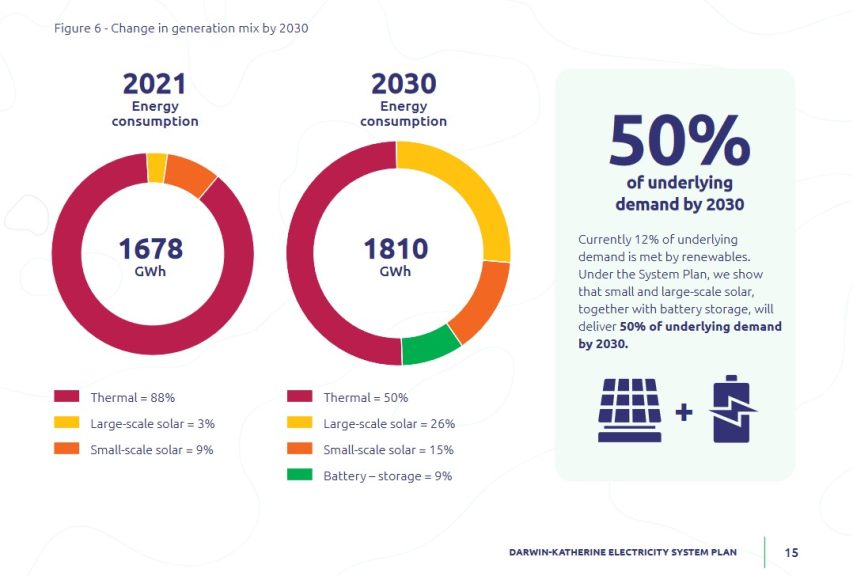
The Darwin-Katherine electricity system plan.
Infrastructure Minister Eva Lawler said the proponents were being “asked to consider” connecting at specific locations within the greater Darwin area “that are consistent with” the location of the government’s renewable energy hub.
“Jumpstarting the procurement process now ensures that we will be able to make an investment that supports the delivery of renewable energy well before 2030,” she said.
The energy hub was announced in October 2021 as part of the the Darwin-Katherine electricity system plan and the ABC reported it would be made up of large-scale solar generators near the existing transmission infrastructure at Channel Island and a second large-scale battery which would be purchased by 2024.
The plan shows two hubs which are essentially large areas, one southeast of the Weddell power station, and one in the Gunn Point area.
In April 2020, the government announced it would spend $30 million on a battery to store solar power, proposed to be 35MW, to be operational by 2022. It awarded a contract to Hitachi Energy in December 2021 to build a 35MW battery at Channel Island, which reportedly will be able to provide power for 150,000 people for one hour, and reduce emissions by about 58,000 tonnes a year, but at a cost of $45 million.
That battery is expected to be in operation next year and the government estimated it will save $9.8 million per year, keeping the promise of a five-year payback period intact.
Figures for the Darwin-Katherine electricity system plan showed 12 per cent of NT electricity came from solar in 2021. The plan said that by the end of this year 21 per cent of NT power was supposed to come from renewables, and there was to be 60MW of battery storage capacity.
The government also estimated it will save $30 million annually in running costs in 2030 if it generated 50 per cent renewable power compared to continuing with “business as usual”.



There is a vast difference between the cost of generation VS the cost of building the infrastructure. We might save money on fuel, but will the overall build plus management, maintenance and future refurbishment costs make the solar power any cheaper. We don’t have rain for 6 months of the year and panels need to be clean. How well will the supply be maintained in the wet season. The simplistic view that a certain number of megawatts will power a number of homes based on average consumption is a furphy. Solar is only at peak capacity for a quarter of the day. Batteries in a pure solar powered system need to hold 3 times average load plus a reserve to prevent excessive discharge. The solar panels need to be able to generate enough to charge the battery bank and meet grid demand in 6 hours per day. Extrapolating that the solar panels need to be capable of generating abou 5 times the grid demand. A grid load of 10 Mw requires around 50 Mw of solar panels. These figures are basic estimates and requirements could vary especially when these solar farms are going to be affected by clouds in the wet and dust/smoke in the dry.