

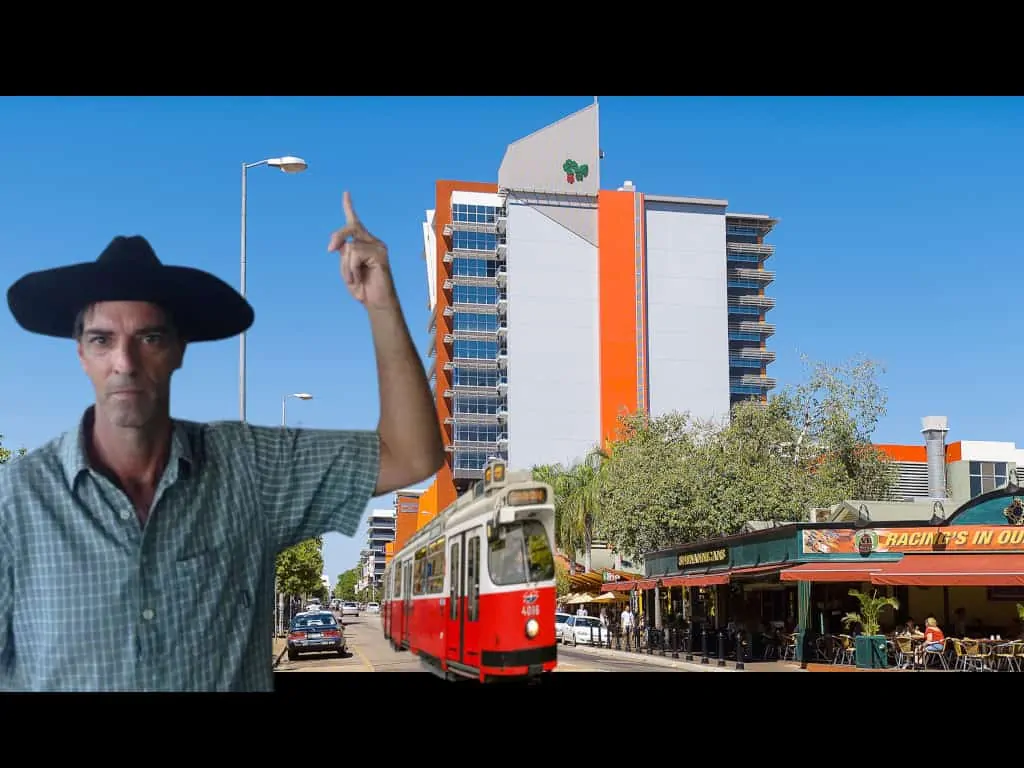
A Darwin alderman has called for a “classy” light railway system between Darwin and Palmerston to help reduce the city’s greenhouse gas emissions after a recent council study found vehicles were responsible for 60 per cent of the city’s annual two million tonnes of carbon emissions.
Alderman Andrew Arthur says building a light railway system in Darwin could attract motorists out of their cars and reduce carbon emissions in the region the way the bus service couldn’t because of “violence and alcohol” and safety concerns.
“The light railway is the way the future we have to go – sooner or later so let’s go sooner,” he told ABC Radio Darwin on Wednesday.
“The bus service at the moment, I use it. I quite enjoy the interactions of the people on the bus, but I can see that some people would feel uncomfortable and certainly there is some problems with violence and alcohol on the buses.
“But a light rail system, if it’s classy, if it’s airconditioned, if we don’t have to stop at lights, the travel times can be reduced.
“I think people would take that option. It costs money to drive, it costs money to park in town, then you’ve got depreciation of the vehicle.”
“We need to move away from this two-car family. People in Palmerston, you need two cars, people in the northern suburbs of Darwin, we need two cars. And we could drop that down to one car if we had a state-of-the-art public transport system.”
Mr Arthur had previously raised the issue at council back in September 2017 when he requested a cost benefit analysis of a light rail system from Darwin to Palmerston.
“That [light railway system] needs to go from Darwin to Palmerston, to connect those two hubs to start with, and then ideally it’ll be great if it could go to Palmerston and Casuarina and Darwin,” he said. “That circular connection. Much like they do with the buses.
“When you see the investment in roads, just let’s take Tiger Brennan Drive, from its inception – must have taken a million or a billion dollars to build Tiger Brennan Drive.
“You know, some intersections. It’s 10 lanes wide …That one into that one intersection at Palmerston with the big overpasses, that’s $120 million on its own.
“So, what I see is if a light rail system would cost far less money to build and take cars off the road so we don’t need to invest in this ever expanding spiral of more intersections, roads and lights and get people to work in half the time.”
He did not provide an estimated cost.
However, a recent light railway line in Canberra cost $700 million to run on a 12 kilometre stretch.
A light rail system has been considered before but didn’t go anywhere
A consultation draft Transport Plan had been exhibited for consultation in November 2015 that included a range of issues for consideration such as support for reservation of corridors for future rapid transit, including potentially light rail.
However, according to the Transport Plan, buses are likely to remain a key feature of public transport in the Darwin Region in the short to medium term.
“Although the Darwin City Centre Master Plan envisions the development of light rail and feedback from consultation has also expressed a community aspiration for light rail, it is likely that light rail or other forms of rapid transit will be longer term options for regional public transport,” the report stated.
“However, it is important to plan for future rapid transit now by investigating and reserving public transport corridors as part of the land use planning process.”
Light rail could reduce Darwin’s massive greenhouse gas emissions
On Tuesday, Darwin Council’s senior climate change officer Eric Lede said because Darwin is heavily relied on private vehicle use, the enormous amount of greenhouse gas emissions released in Darwin is not surprising.
“The way that Darwin has historically been developed, we have been sprawling across. We do rely on private vehicle use, so 60 per cent of this two million tonnes is from the transport sector alone,” Mr Lede told ABC Darwin Radio.
He said emissions from other capital cities that have stronger public transport, are closer to the 10 per cent mark related to transport.
According to a report from the Australian Public Transport Industrial Association and Bus Industry Confederation, road transport contributes almost 15 per cent of total greenhouse gas emissions in Australia and cars contribute almost 50 per cent of road transport related emissions.
“By 2020 greenhouse gas emissions from road transport are predicted to be more than two thirds higher than their 1990 levels with cars still accounting for the majority.”
The report also urges people to shift from cars to public transport as it can deliver a 65 per cent emissions reduction during peak times and a 95 per cent reduction in emissions during off peak times from the commuters that make the shift.

After the hottest Nov in 100 years, better late than never to innovate to reduce emissions. Sydney plans to transition 8000 buses to electric. Mind, Syd light rail was blighted by cost over runs as no clarity on what was under the roads. The pits (pun intended). Simpler in NT. why have dirt when you can concrete. Mars-like bus stops are a disincentive to public transport use. lack of cover and never cleaned. a pressure hose wouldn’t go astray. Casaurina bus hub is an inferno. Browns Mart not much better. Go under ground. Bus drivers predominantly friendly and helpful. Even transport security are good natured. Fellow passengers, simply relieved to be in a/c after the hot mess of the bus stops. go all out, pressure clean the footpaths and rid us of the broken glass. I bus regularly and never witness argy bargy. This article smacks of self-aggrandising, in lieu of action.