

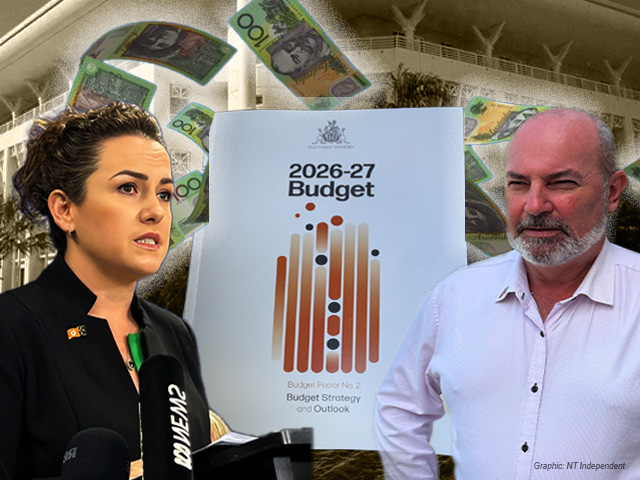
Treasurer Bill Yan delivered his second budget Tuesday morning that contains no “lollies or sweets”, with the Finocchiaro CLP Government overseeing a record net debt that will now top $11.35 billion this year and grow to $12.56 billion in 2026-27 – less than previously estimated due to better than expected revenue streams and less spending on infrastructure projects – while Mr Yan said the government is “living within our means” despite no substantive plans to reduce the debt.
There were no new spending announcements in the budget outside of what was announced over the last two weeks, with “record spending” levels reached again on everything from health to infrastructure to education to police, courts and corrections.
“[This budget] focuses on safer streets, better services, easing pressures on families and having a government where the grown-ups are in charge once more,” Mr Yan said in his budget speech to Parliament.
“It backs Territorians here and now while helping build a stronger future for our tomorrow.”
Outside of sports vouchers and the ongoing subsidy for electricity costs that will increase in cost for the government next year, there was no major relief in the budget for Territorians struggling under growing cost-of-living expenses.

The net debt to revenue ratio has slightly improved this year from previous projections, but is now at 109 per cent and projected to increase to 117 per cent by the end of the 2026-27 financial year, meaning the Northern Territory will continue to spend more than it brings in.
The annual debt interest repayment will reach $679 million this financial year, equal to $61,800 per Territorian in 2026-27, up from $58,000 last year, with total interest payments reaching more than $1 billion by next year.
Mr Yan also flagged the cost of building the Darwin ship lift project for Paspaley Group as a major ongoing expense for the NT, which will now cost $850 million to build and ultimately cost taxpayers a total of $1.8 billion after ongoing maintenance and other costs are incorporated.
The public will see no money in return for constructing the facility for Paspaley, but the government has committed to building it anyway, even after the Public Accounts Committee found there was never a business case developed for the project.
Treasury officials in the budget lock-up said the government will have spent $390 million on the project by the end of the 2025-26 financial year.
The public service – the single largest expenditure item for the government – increased by 884 full time equivalent employees since September 2024, with Mr Yan claiming that was driven by “increased frontline and school-based staff”, including more police, nurses and corrections staff. He said executive-level public servants and non-frontline staff “remain largely unchanged” since the CLP was elected in 2024.
Employee and related expenses are forecast to increase from $4.16 billion this financial year to $4.53 billion by 2029-30.
While Mr Yan celebrated a general government net operating surplus for the 2025-26 financial year of $95 million, the Territory will still run a net deficit of $488 million this year when all costs are factored in.
The deficit next financial year is projected to be more than $1 billion, while slowing down over the forward estimates to $239 million by 2028-29, driven largely by projected increases to the Territory’s share of GST revenue continuing.
The Territory’s bottom line was also helped by an additional $1 billion in 2025-26 in unexpected revenue from higher than anticipated royalty revenue due to growth in commodity prices; additional stamp duty due to higher than expected residential sale volumes and a few “large one-off commercial transactions”; as well as additional payroll tax due to strong private sector wages and employment.
Infrastructure works spending down again
Revised infrastructure spending figures for the current 2025-26 financial year has shown a $341 million decrease in spending from what was budgeted at $2.4 billion for the total works program.
While NT-funded works were supposed to reach $910 million this financial year, $668 million was actually spent, budget papers show. The government said the underspend was due to delays caused by “severe weather events across the Territory”.
General government capital works for 2025-26 was budgeted at $1.45 billion, but came in at $1.17 billion, with the government projecting a $1.45 billion figure again for 2026-27.
New capital works commitments in this year’s budget include $430 million to be spent by 2029-30 “to progress works on the infrastructure program, including delivery of new Katherine and Darwin [prison] work camps, a Palmerston secondary special education school and to fund road repairs and replacement”.
A new $30 million will also be spent over the same period to progress works on the Northern Marine Complex, including the ship lift and another $10 million per year to replace medical equipment across the Territory, including a new CT scanner for Tennant Creek.
No new funding for Health infrastructure was announced in this year’s budget, outside of previously announced repairs to Royal Darwin Hospital’s air conditioning system.

Economy growing slowly
Mr Yan said during last year’s budget release that he expected the NT’s Gross State Product – the measure of growth of the economy – to surge by 7.8 per cent in 2025-26, but that figure is now estimated at 2.7 per cent for the year, with 5.8 per cent the new projection for 2026-27 before dropping to 1.4 per cent in 2027-28 led by a projected recovery in household consumption as cost of living pressures “are assumed to ease, alongside continued investment in the Beetaloo Sub-basin”.
The government said Territory GSP was affected negatively by recent flooding events, as well as oil, fuel and fertiliser price volatility as a result of conflict in the Middle East.
The budget papers project private investment to shrink by 15.8 per cent this financial year, with activity in the Beetaloo and the Sturt Plateau pipeline and compression plant expected to improve things slightly in 2026-27.
Population growth is projected to remain stagnant at 1.1 to 1.2 per cent over forward estimates to 2030, while the unemployment rate is estimated to peak at 5.2 per cent next year while remaining steady at 4.6 per cent over estimates. The small population increase is being driven by overseas migration inflows of “skilled and temporary student visa holders”, the budget papers said.
Mr Yan said the economy was “showing encouraging signs”.
“The Territory is open for business again,” he said in his budget speech. “Confidence is returning, investment is growing and jobs are being created.”
Mr Yan said on Tuesday morning that he met with credit rating provider Moody’s late last year and was pleased to see the Territory’s credit rating was not downgraded. He said he expects that to remain later this year when its financial position is assessed again and said he was working to improve the Territory’s credit rating.
The government is expecting to bring in $10.7 billion next financial year, with total expenditure listed at $12.78 billion.
The Federal Government is contributing 72 per cent of the Territory’s total revenue.
Total tied and untied Commonwealth contributions reached $7.5 billion this financial year and is expected to increase to just over $7.7 billion in 2026-27, before growing by an estimated 5.3 per cent year over year to $8.1 billion in 2029-30, treasury figures suggest.
The net debt is projected at $12.5 billion next year, growing in forward estimates to more than $13 billion by 2029-30, slightly lower than the $14 billion previously expected.
Direct savings measures in the 2026-27 budget only total $50 million over the four-year budget cycle to 2029-30, which will be found by increasing the current departmental “efficiency dividend” from one per cent to 1.5 per cent next financial year.
Labor Opposition Leader Selena Uibo said the CLP’s budget was “extremely disappointing”.
“What we’ve seen is more or less of the same,” she said, adding the lack of infrastructure projects in the pipeline and funding failing to get out the door was concerning.
“We have seen the debt continue to blow out under Bill Yan and the CLP Government. It’s time for the CLP to show Territorians that they mean business when it comes to growing the Territory’s economy.”


Does this debt figure in the story include the Northern Territory Public Service Superannuation Debt Liabilities?
1. Is only 28 per cent of NT Government revenue generated by the Northern Territory?
2. Is NT Government Debt $61,800 per annum + $2800 interest per annum per person?
3. Will Northern Territory private sector investment shrink by 15.8 per cent this financial year?