

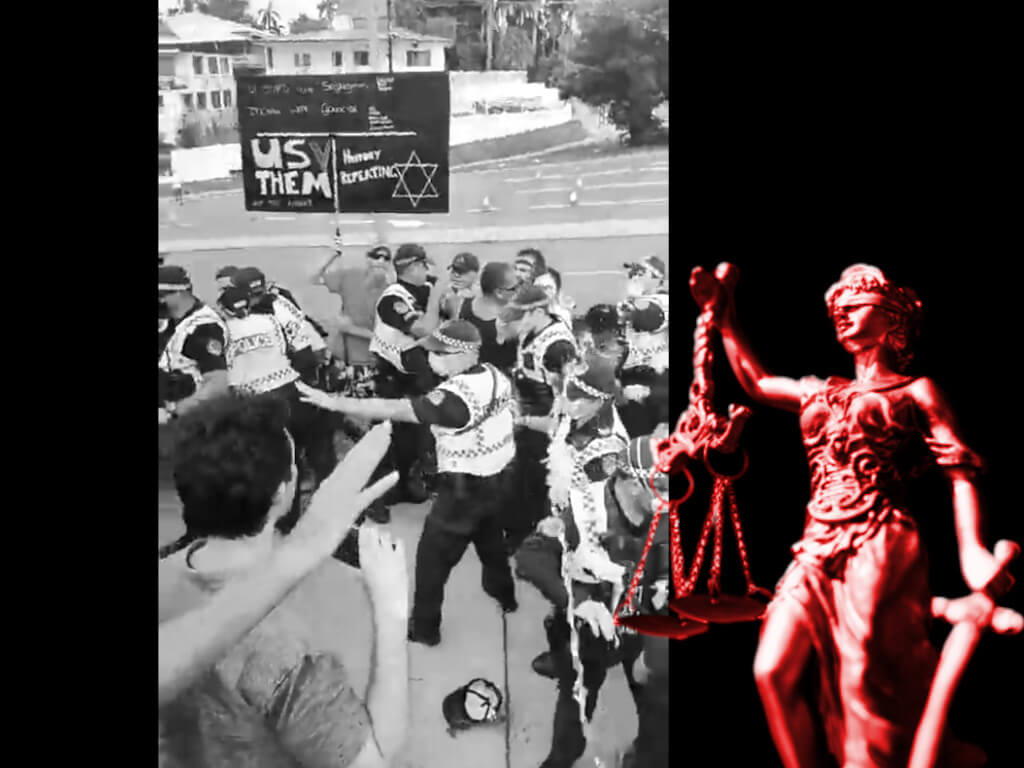
A man accused of riotous behaviour and throwing a “chemical” at police officers during an anti-mandate rally last year was found not guilty on five charges in the Darwin Local Court on Tuesday, after the prosecution failed to meet a court ordered deadline to disclose evidence.
Thomas Hewitt-Jones, 37, now a resident of Sydney, was facing five charges over his involvement in a “Free in the NT” anti-COVID-19 vaccination mandate rally on November 6, during a period where Chief Health Officer Dr Hugh Heggie had restricted movement for people who were not vaccinated.
The court heard accusations that the prosecution knowingly withheld evidence relating to an analysis of the alleged chemical until days before the trial date that was unfair to the defendant.
On November 6, 2021, NT Police intercepted protesters walking into the city after parking their cars near Bundilla Beach due to officers blocking East Point Rd to check for vaccination certificates.
When police and protesters met near the intersection of Conacher St, alleged violence occurred, when the “chemical” that “burnt police” was alleged to have been thrown.
Around the same time police had used capsicum spray on the protesters.

Appearing for the defendant were John Lawrence SC and Koulla Roussos, receiving instruction from solicitor Eric Withnall.
On Monday, Mr Hewitt-Jones’s barristers successfully argued for, and received, an order preventing the prosecution from leading into evidence any of the material served on the defence after the full disclosure deadline of March 21 which had been imposed by Chief Judge Elizabeth Morris on February 7.
Prosecutor Christopher Tang – a junior prosecutor who was assigned the case on June 26 – sought some time to decide on a course of action, and said he believed that on Monday it was still in the public interest to proceed with the prosecution because they were “not trivial charges”.
The prosecution later decided to withdraw the breach of CHO direction charge and proceed with the others.
Two police witnesses gave evidence on Tuesday, with the defence arguing the evidence could not prove Mr Hewitt-Jones’s identity in relation to the alleged criminal acts.
On Tuesday morning, Mr Tang told the court the DPP had reconsidered their position and would not proceed in light of the evidence they had that could be used, in addition to the fact another police officer could not give evidence because he reportedly had to look after his child.
The defence put a ‘no case’ submission on the basis police could not identify Mr Hewitt-Jones, and it was upheld.
Judge Thomasin Opie was asked to rule based on the evidence that had been presented, and found Mr Hewitt-Jones not guilty on five counts, one of engaging in riotous behaviour, and four counts of aggravated assault against police.
Why the prosecution failed to present the evidence
On December 16, a preliminary brief of evidence was handed to the defence, which included statements from the officers, photos and a statement of facts, then at the directions hearing on February 2, Chief Judge Morris made the full evidence disclosure order for March 21.
The court heard the last aggravated assault charge was not laid until July 11, which was a week before it was due in court, which Judge Opie said was “extraordinarily late” in the overall proceedings.
Mr Lawrence told the court a chemical analysis report, showing what was allegedly thrown, was finalised on November 30, and given to prosecutors on February 8, and then not presented to the defence until July 13 – five days before the case was due to be heard.
“This just illustrates, in a horrible way, what we’ve been deprived of,” Mr Lawrence said.
“Now this was a case which had, as a central point, rioters throwing chemicals at police officers and burning them.
“And the police had a report dated the 30th of the very month of November but which didn’t take it any further. And they had it until at least February and they didn’t give it to us until the 13th of July.
“And we had been asking also for the briefing letter to the expert, from the police or prosecution, which is what you always do when you’re confronted with an expert witness.
“What were your terms of engagement? What were you asked to look for? You always get that. And I’m still to get that.
“The whole country relies on the prosecution, the independent office of the DPP. Independent from government. Independent from police. Independent from everybody, making even-handed, fair decisions we trust.
“We need to have that trust. And this case flies in the face of holding such trust. Which is why it’s exceptional.”

Mr Tang said he took exception to Mr Lawrence’s submission that it was a deliberate act to withhold evidence, suggesting it was “apparent certain steps could have been taken to remediate errors made”.
But Mr Lawrence said the DPP were trying to defend the indefensible.
“I think this is important culturally because what it reeks of, and I thought while watching the prosecutor trying defend the indefensible; it reeks of normalisation,” he said.
“That’s what we’ve got here. The price of liberty is eternal vigilance, as Edmund Burke said. And that is arguably what’s happened here because this man had the wherewithal to engage a full legal team….”
Mr Lawrence said other evidence such as police body-worn vision, and the bulk of the witness statements were given to the defence between June 30 and July 13. He said Ms Rousso had emailed the prosecution on January 7 and January 28 but had not received a response.
Mr Tang said the information was loaded into a system that allows access to the defence on February 8, but an administrative error meant it was not shared with the prosecution and conceded the DPP had not done well enough.
He argued the body-worn camera vision was only 1 hour and 47 minutes long and was disclosed 18 days before the trial was due to begin, giving the defence enough time.
“I do believe that is important,” he said.
“I conceded from the outset yesterday the material should have been disclosed earlier.”
But Mr Lawrence said Mr Tang was handed the case on June 26, and thought it was “a bit unfair”, suggesting it did not “ring true” that he would be assigned the case over a more experienced person at that point, after they had missed the evidence disclosure deadline.
He said it had still not been explained why the prosecution “sat on evidence for months”.
“Despite knowing it should have been disclosed, knowing it had been ordered by a judge to be disclosed. Being asked on several occasion to disclose it. And not disclosing it….unless your honour has any evidence that explains why the material wasn’t disclosed despite it being in the hands of the prosecution, and being the subject of judicial orders, you can only infer this was by choice,” he said.
“The problem with an error (as a potential alternative explanation provided by the judge) is no one is saying that. Where is the director of public prosecutions or the deputy, coming in here with an affidavit saying ‘This is what happened, it sat in the bottom of a filing cabinet’? That hasn’t happened.”
Mr Lawrence said full disclosure at the required time was a requirement of the DPP guidelines as well as the Local Court Act.
Mr Tang said he disagreed with Mr Lawrence’s claim the DPP had made a purposeful decision not to present the material on time but argued a large workload was part of the reason.
Costs deferred to later date, police commissioner quoted
Mr Hewitt-Jones is seeking costs from the government, which was not opposed by the DPP but who argued those costs be “reasonable”. Judge Opie reserved her decision until next month.
“It could be fairly described as a gross failure by the prosecution to produce, discover, give, the materials to the defence,” Mr Lawrence told the court in arguing for costs.
“And the other aspect of it is the exceptional legal circumstances…there is more than an aggravated assault of course, this is an event that was beginning, middle and end, political. It had had to do with public order, it had a public interest component.
“Constitutional arguments were looming as to to whether the people who were marching that day were entitled to march, per se.
“Didn’t we all read about this in the paper, because included was the Northern Territory Police Commissioner himself painting a picture, describing the people that were demonstrating as disgraceful, and said that ‘we are coming after you’. They were his very words. The Police Commissioner.”
Mr Tang said the charges were not political but related to an important matter of public health, that it was a matter allegations of violence against police, and what the Police Commissioner said was not relevant in an argument over costs. He argued the DPP acted in good faith.
Mr Lawrence said Mr Hewitt-Jones had no prior convictions and was facing three years in jail for engaging in riotous behaviour, and a potential seven years for the aggravated assault, so the potential consequences were significant.
When asked at a press conference on December 7, if police had identified what the substance allegedly thrown was, Police Commissioner Jamie Chalker told the media the results had come back from Victoria the day before but would not say what the results showed.
This is despite having been publicly descriptive of its effects previously, and telling the alleged offenders police were “coming for you”.
“The advice I received yesterday was the forensic results had come back and it is being presented into the prosecution file,” he said.
In late November, he told the media the substance had been scientifically analysed but it was “his understanding the initial analysis required further testing”.


0 Comments