

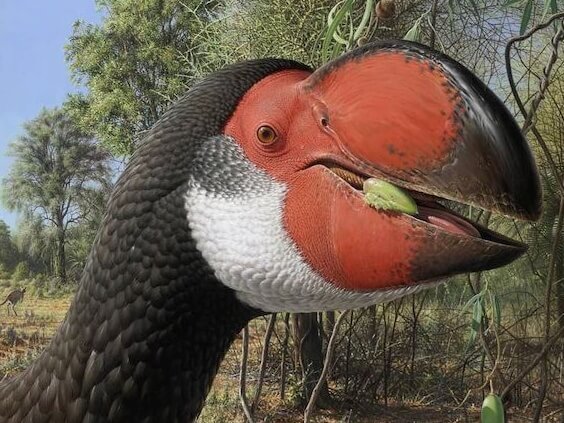
Bone specimens from what was “arguably the largest bird ever to live on Earth” have been dug up near near Alice Springs, and show their size and breeding cycle could not keep pace with the environmental changes around them causing their extinction, vertebrate palaeontologists have concluded.
UCT Professor Anusuya Chinsamy-Turan said the ‘Thunder Bird’, officially known as the Dromornis stirtoni,existed seven million years ago, stood up to three metres tall and weighed up to 600kg – about six times larger than emus.
She said studies of the microstructure of these giant Australian fossil bones found near Alice Springs and the northern reaches of the Flinders Rangers by UCT, and Flinders University vertebrate palaeontologists indicate their size and breeding cycle gradually changed over millennia but ultimately couldn’t keep pace with the environmental changes around them.
“Sadly, for these amazing animals, which already faced rising challenges of climate change as the interior of Australia became hotter and drier, their breeding biology and size could not match the more rapid breeding cycle of modern-day emus to keep pace with more demanding conditions,” she said.
“Questions, such as how long these gigantic birds took to reach adult size and sexual maturity, are key to understand their evolutionary success and their ultimate failure to survive alongside humans.
“We studied thin sections of the fossilised bones of these thunder birds under the microscope so that we could identify the biological signals recorded within. The microscopic structure of their bones gives us information about how long they took to reach adult size, when they reached sexual maturity, and we can even tell when the females were ovulating.”

Research, published in The Anatomical Record, compares the bones of Dromornis stirtoni, the earliest and biggest dromornithidae, through to the smallest of the flightless birds, Genyornis newtoni – the last species of dromornithidae – which lived alongside early emus.
The study indicates Dromornis stirtoni – arguably the largest bird ever to live on Earth – took a long time to grow to full body size and to become sexually mature, possibly up to 15 years, Professor Chinsamy-Turan said.
Flinders Palaeontology Associate Professor Trevor Worthy, who co-authored the research, said that dromornithids were contemporary with emus for a very long time before the final species went extinct.
“The differing breeding strategies displayed by emus and dromornithids gave the emu a key advantage when the paths of these birds crossed with humans about 50 thousand years ago, with the last of the dromornithids goings extinct about 40 thousand years ago,” Professor Worthy said.


0 Comments