


BY Justin Tutty
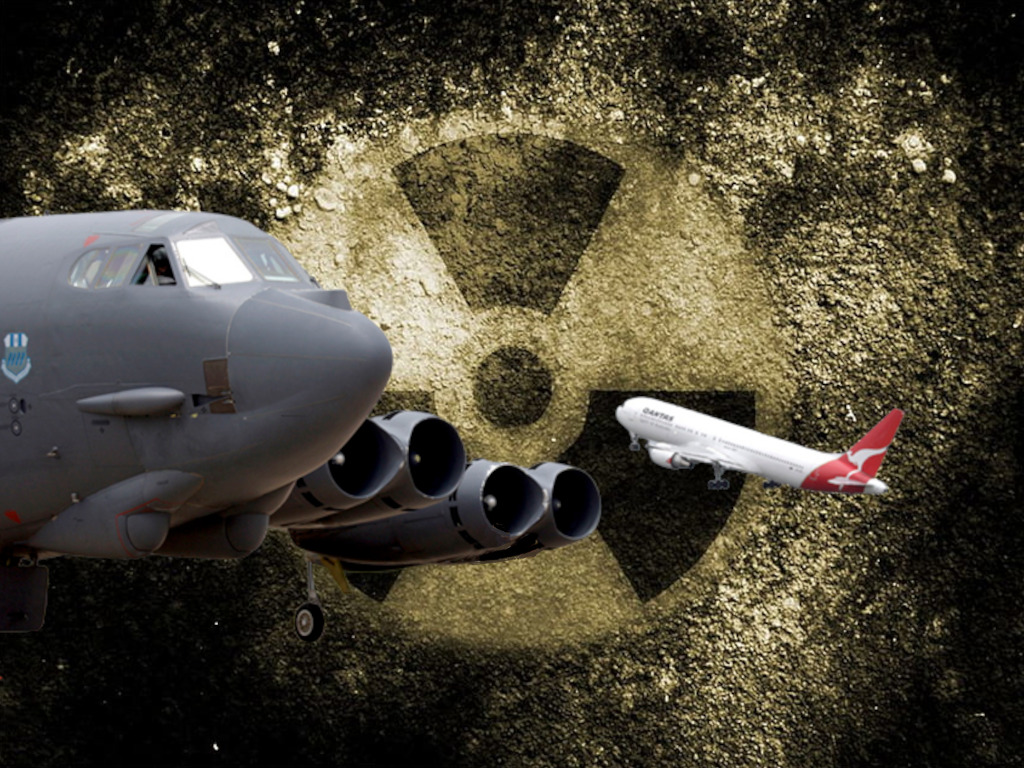
Last week’s arrival of two USA B-52s in Darwin (en route to the Avalon Airshow in Melbourne) punctuated recent attention to unresolved questions around the status of US nuclear weapons delivery platforms in Australia.
These two foreign bombers also illustrate a tale of two treaties: one, which Australia signed in the 80s, binding us to the regional ambition of a nuclear free South Pacific; the other, a more recent Australian innovation, offering the world a path towards total disarmament.
The Treaty of Rarotonga
Earlier last month, a senate committee explored questions as to whether American planes and ships could – in theory, at least – come here with a nuclear payload without breaching international protocols.
Defence Secretary Greg Moriarty told the estimates committee hearing that he could not rule out that US strategic B-52 bombers, which rotate through the Northern Territory, could carry nuclear weapons.
At one end of the relationship, the USA maintains a policy of ‘warhead ambiguity’, refusing to confirm or deny which of their delivery platforms are currently armed.
At the other end stands Australia’s commitments to our regional neighbours under the South Pacific Nuclear-Free Zone Treaty (the Treaty of Rarotonga). While prohibiting stationing nuclear weapons in Australia, this treaty nonetheless leaves room for each party ‘to decide for itself whether to allow visits by foreign ships and aircraft to its ports and airfields’.
In the case of New Zealand, that decision was made to disallow visits by ships or planes that were not confirmed to be free of nuclear weapons. Rather than respecting New Zealand’s decision, and thus jeopardising their policy of ‘warhead ambiguity’, the USA chose instead to suspend ANZUS treaty obligations to New Zealand. Then president Reagan declared that New Zealand was “a friend, but not an ally”.
Australia, though, chose to adapt to the USA’s policy, and avail the freedom under the treaty to permit visits by US ships and planes without any assurances regarding the status of armaments. Speaking in last month’s committee hearings and subsequent interviews, Foreign Affairs Minister, Penny Wong framed this setting as a matter of respecting USA policy.
“Successive Australian governments have understood and respected the longstanding US policy of neither confirming nor denying the presence of nuclear weapons on particular platforms.”
That meant one thing back in the 80s, when B-52s began visiting Aussie airfields. But it certainly looks a bit different now, in the age of AUKUS, and the broader Joint Force Posture Agreement.

The announcement of AUKUS, centred as it was around nuclear-powered submarines, hit a sore point in another treaty, the Treaty on the Non-Proliferation of Nuclear Weapons. While nuclear-powered subs aren’t exactly nuclear weapons, they do open a loophole in the otherwise tight auditing of worldwide stocks of highly enriched nuclear fuel, suitable for weapons manufacture.
But more significantly, the AUKUS announcement will deepen the JFPA, a 25 year treaty that kicked off in 2015. This agreement grants the USA “unimpeded access … relating to the pre-positioning and storage of defence equipment and supplies”. And while, so far, the agreed facilities in the NT include only training grounds, the US Marine Corps base at Robertson Barracks and the US Air Force bases in Darwin and Tindal – with AUKUS we’ve learned of plans for a number of new bases in the NT.
After years of excusing the growing USA presence in the NT through the lens of co-located rotational deployments, most commentators have now abandoned the pretense of ‘not-a-base’. Territorians are now required to confront the reality of hosting what the USA sometimes calls lily-pads: bases to deploy to, and seek sanctuary from, any future conflict in our region.
These are very different times to the 80s, when the South Pacific Nuclear Free Zone was defined by the Treaty of Rarotonga, and when nations like Australia and New Zealand made decisions about allowing brief, irregular visits by USA ships and planes that may or may not carry nuclear arms.
It remains unclear just how far Australia, or our regional neighbours, imagine that the Treaty of Rarotonga’s allowance for ‘visits’ can be stretched to make way for USA ambitions under the JFPA. Just how many days constitute a ‘visit’? How long can a landed plane be described as ‘in transit’? And what of all that ‘unimpeded materiel’?
What is abundantly clear, however, is that these new times demand new measures.
The Treaty on the Prohibition of Nuclear Weapons
The Treaty on the Prohibition of Nuclear Weapons is an initiative of the International Campaign to Abolish Nuclear Weapons, an organisation founded in Australia, whose work won them the Nobel Peace Prize in 2017.
The treaty came into force in January 2021, after attaining the 50th ratifying state party, making nuclear weapons illegal under international law. The TPNW binds parties to meet a deadline for destroying any nuclear weapons held, or removing any hosted. In doing so, the TPNW has broken the stalemate on the NPT, an instrument from the 1970s which was of some utility in slowing the international spread of nuclear weapons, but whose parties have been deadlocked on requirements to make progress towards disarmament.
The Australian Labor Party has committed, since 2018, to sign and ratify the TPNW in government. This commitment was reiterated repeatedly in the context of the last federal election. More than 100 Australian federal parliamentarians, including Prime Minister Anthony Albanese, have pledged their support for the treaty. Polling shows strong support by Australian people for the Australian parliament to sign, ratify and further this Australian-initiated treaty.
While it’s not clear just how far Rarotonga could stretch to accommodate the growing USA presence, foreign nuclear weapons transiting through Australia in any context would be simply banned under the TPNW. This would then ensure that USA nuclear capable delivery platforms, like the B-52s seen in Darwin last week, would be refused entry, unless they confirmed that they were not carrying nuclear weapons.
Signing the TPNW, as the Labor party promised last year, would be a significant step. Australia would reclaim and solidify a leadership role in international efforts towards the imperative of nuclear disarmament. But it would also be an important step in the unfolding new phase of the military relationship between Australia and the USA.
The requirement on Australia as a signatory to disallow the presence of foreign nuclear weapons would undoubtedly impact on the potential scope of the still-growing USA presence. But it would do so without jeopardising the JFPA in toto. To date, there has been little public evidence of Australia setting limits to the growing USA presence in NT.
The JFPA still has another 17 years to run. Ratification of the TPNW would go a long way to reassuring locals that Australia still has a hand on the wheel and is not leaving it all up to our larger alliance partner to set the terms of their presence here.

Justin Tutty is a Darwin-based anti-nuclear activist, and founding member of the Independent Peaceful Australia Network. IPAN’s recent report, ‘Charting our own course, identified progress on the Labor government’s commitment to ratify the Treaty on Prohibition of Nuclear Weapons as an urgent security priority.

0 Comments