


Godfrey Alan ‘Goff’ Letts, who became the Majority Leader in the newly minted Legislative Assembly of the Northern Territory in 1974, died on March 10, aged 95. Dr Robyn Smith writes about his life.
In 1921 Godfrey William ‘Goff’ Letts travelled from Kalgoorlie in Western Australia to Donald in central Victoria to become managing editor of the Donald Times, which had been established as the Donald Birchip Times by his grandfather in 1875.
An accountant, Letts had been working at the Kalgoorlie Miner until he was invited to take the editorial role by his uncle.
He must have enjoyed it; in 1981 he celebrated 60 years as the paper’s editor and was considered the longest-serving newspaper editor in Australia.
Marion Christina MacDonald became his bride in 1924. That union would result in four sons, one of whom was Godfrey Alan ‘Goff’ Letts who was born on 18 January 1928.
The younger Goff qualified as a veterinarian in 1950 and was employed by the Victorian Department of Agriculture. He married Joyce Crosby in November 1952.
In 1957, the Letts’ travelled to the Northern Territory where Goff temporarily served as a veterinary officer in Alice Springs before being appointed district veterinary officer for the northern region in Darwin.
Bovine pleuropneumonia — which Letts recently described as being “a bit like COVID-19 in cattle” — was highly problematic and the subject of an intensive eradication program.
In 1958 he was appointed assistant director of the Animal Industry Branch, a position he held for many years.
Letts chaired the NT Wildlife Council from 1964 until 1970 and was a member of the Lands Board over the same period.
His interest in agriculture, pastoralism and animal husbandry is hardly surprising given his home town of Donald, which services surrounding districts that produce wheat, barley, sheep and vegetable crops.
These interests would also provide the foundation for his political activism.
In 1966, he was a foundation member of the Country Party in the Northern Territory.
Alistair Heatley recorded that a Darwin branch was formed on July 20, and an Alice Springs branch on July 29.
At that time governance in the Territory was a peculiar hybrid model that had been designed and foisted upon the citizenry by the federal government.
Under this regime, the federal government retained power and control because its hybrid ‘legislature’ was comprised of appointed and elected members, the appointed members outnumbering the elected ones.
To double-entrench control, the presiding officer (appointed, not elected) had two votes: a deliberative and a casting vote.
That hybrid quirk remains: the speaker of the Legislative Assembly has both a deliberative and a casting vote, which can be — and has been — exercised in the event of a tied vote.
It didn’t sit well with Letts when he was appointed to the Legislative Council to represent the Department of Lands and Primary Industry in 1967.
He resigned from the department and, therefore, the Council in 1970 to resume life as a vet.
In 1971, he was elected to the Legislative Council as the member for Victoria River and there sat as the leader of the Country Party, which had five members.
Independent member for Nightcliff Dawn Lawrie was also an elected member of the Legislative Council.
“Despite our differing political views Goff and I were very good friends and shared the common goal of the political advancement of the Northern Territory with a vision of a fully elected parliament answerable to the people of the NT,” she said.
In 1973 the Legislative Council appointed Letts, Dick Ward and Ron Withnall as special negotiators for more self-government with the Commonwealth.
Kep Enderby was the Minister for the Northern Territory and, being “a dedicated socialist, he wasn’t interested in granting any more autonomy to the Northern Territory”, Letts said.
Letts was the architect of a merger between the Liberal Party and his own Country Party, which is how the Country Liberal Party acquired its name.
It was formed just prior to the 1974 election of the first Legislative Assembly of the Northern Territory and Letts was its leader.
Birth of the Legislative Assembly
The Whitlam Government established a Joint Parliamentary Committee of Inquiry in September 1973. Its brief was to come up with arrangements for responsible self-government of the Northern Territory, although Whitlam’s policy of ‘new Federalism’ was opposed to any new states in Australia.
As I wrote with Dean Jaensch in 2015, among other things, the committee was to have regard to the following.
The relationship which will need to exist between a local executive and the national government.
The size, composition and diversity of interest of the population of the Territory including the special difficulty of providing for effective participation by the Aboriginal people in a political system which is alien to their traditional culture.
And any other special considerations which the committee considers relevant to its conclusions.
It was a comment on the troubled history of constitutional development in the NT that the final report of the committee was not published until November 1974, one month after the election for the First Assembly.
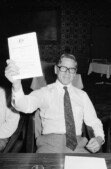
Barrie Dexter in 1976 with a copy of the Aboriginal Land Rights (Northern Territory). Picture: National Archives
What is interesting in the context of contemporary debate about a Voice to Parliament is that: “The committee received evidence from the secretary of the Department of Aboriginal Affairs, Barrie Dexter, from the National Aboriginal Consultative Committee representative, Bruce McGuinness, and from the secretary of the Central Australian Aborigines Congress, Neville Perkins, calling for special electorates for Aborigines superimposed on the open electorates, with Aborigines having the right of two votes: one in the open electorate and one in the Aboriginal electorate.”
One member of the committee, Senator Jim Keeffe, was not convinced. He recommended: the Assembly should contain 25 members; that six of the members be Aboriginal; that the election of these six members be from Aborigines on the NACC electoral roll voting and in the Territory as one electorate; and that first past the post voting be used for this special election.
But these recommendations did not receive majority support, nor were they reflected in the 1974 electoral system. The majority of the committee had obviously been impressed by the first of the arguments of the chief electoral officer, Frank Ley, who concluded: “…that the electoral system which would best suit the Northern Territory would be a single-member electorate system combined with optional preferential voting”.
Its recommendations were for a system of single-member electorates with 19 members, and that optional preferential voting would be adopted but that the method of voting in the Territory should be consistent with that of federal elections.
The 1974 election was contested on these bases.
The average electorate size in 1974 was in the order of 2000 people, and for Aboriginal people, enrolment was optional.
Letts was easily returned as the member for Victoria River and on this occasion became Majority Leader in the newly minted Legislative Assembly of the Northern Territory.
Of the 19 members in that Assembly, 17 represented the Country Liberal Party and two were independents: Dawn Lawrie in Nightcliff, and Ron Withnall in Port Darwin.
Letts put this overwhelming victory down to the “continual interference in Territory affairs” by the aforementioned Kep Enderby.
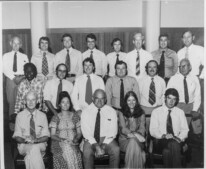
Picture: Library and Archives NT
The picture above is of the member of the First Legislative Assembly, 1976. At rear, left to right: R. J. Withnall; G. Tambling; M. J. Ballantyne; Eric Manuel; M. B. Perron; I. Tuxworth; N. Dondas; R. M. Steele. Second row, left to right: H. Tungatalum; R. W. S. Vale; R. Ryan; P. A. E. Everingham; R. Pollock; R. Kentish. Seated, left to right: G. A. Letts; Mrs D. Lawrie; J. L. S. MacFarlane; Ms E. Andrew; J. M. Robertson.
Roger Vale identified the photo as having been taken early in 1976 after the February Alice Springs by-election in which Eric Manuel was elected. The vacancy had been created by Bernie Kilgariff’s resignation in November 1975 in order to contest the Senate.
The first sitting of the Assembly was on November 20, 1974 when a number of procedural motions established committees and the like, but members also had to deal with legislation to set up the mechanics of the Assembly itself.
As the Administrator Jock Nelson informed members: “The first meeting of the Assembly has been summoned because there are a number of urgent matters of an administrative nature which must be dealt with…Paramount is the need to adopt a new set of standing orders to reflect the constitutional changes that have occurred.”
The first bill presented was the Legislative Assembly (Speaker) Bill (Serial 1). They literally had to start from scratch and it was Letts who had ultimate carriage of it all.
He announced his team of six executive members (that is, ministers), one of whom was his deputy, Paul Everingham.
The second bill was the Public Service Bill (Serial 3). That, of course, was necessary to transfer functions from federal government departments to newly created Northern Territory departments.
It was a dynamic time in the Northern Territory and, unfortunately, barely a month out from Cyclone Tracy.
Tracy resulted in a great deal of chaos and yet more negotiation with the federal government, which again assumed control of administration of the NT for 12 months.
Lawrie said Letts was a man of principle and vision who earned respect across the political spectrum.
“He was in effect a man for the time and served the NT well,” she said.
Given the result of the 1974 election, it was surprising that Letts was defeated by the ALP’s John Kevin Raphael ‘Jack’ Doolan in the 1977 election.
Letts blamed his defeat on the rigours of high office preventing him from spending more time in his electorate and the CLP’s stance on land rights, which alienated the sizeable Aboriginal vote.
He also admitted to being “worn out” after the events of the preceding several years.
Heatley, however, noted that the CLP “suffered a severe rebuff” at the 1977 election, which resulted in Letts and “most of his executive” being defeated.
Everingham assumed leadership of the Country Liberal Party and, on July 1, 1978, became the Northern Territory’s first Chief Minister.
Letts became a consultant from his home at Batchelor and chaired a board of inquiry into feral animals in the NT in 1978-79. In 1979, he was appointed to the Advisory Council of the CSIRO and the Uranium Advisory Council. He served on them until 1983.
In 1980, he was preselected as the CLP candidate for the House of Representatives, but withdrew when he was offered the chairmanship of the NT Conservation Commission, which was based in Alice Springs.
In 1983, he resigned from his public positions to contest the central Australian electoral division of Araluen as an independent in the Northern Territory election.
As Heatley noted: “His decision to stand against the CLP incumbent (and a government minister) reflected his view that the CLP government was taking an unnecessarily confrontationist attitude towards the Commonwealth and towards Aborigines in the Territory. In particular, he was affronted by the strident opposition to the transfer of the Ayers Rock (Uluru) park area to Aboriginal ownership”.
He was defeated by Jim Robertson in what was a landslide victory for the CLP.
Letts and his wife left the Northern Territory after 30 years in 1984. For many years they resided in the Lodden Shire in Victoria where Letts served, as he had done in the NT, on a number of boards and in a range of administrative positions.
Like his father and great-grandfather, he became editor of the twice-weekly Buloke Times and continued to write editorials until the days just before he died.
In 2021, he published a memoir entitled Where Brolgas Dance. It won the Chief Minister’s History Book Award in the same year.
Letts died at Stawell in Victoria on March 10. He was 95.
He is survived by Joyce, two of his brothers, his six children, and numerous grandchildren and great-grandchildren.
“I have nothing but the deepest respect for the late Dr Goff Letts, a man of vision, integrity and with a passion for the welfare and advancement of all Territorians,” Lawrie said.
“I mourn his passing and extend my condolences to his family who also have my deepest respect.”
Vale Goff Letts.

0 Comments